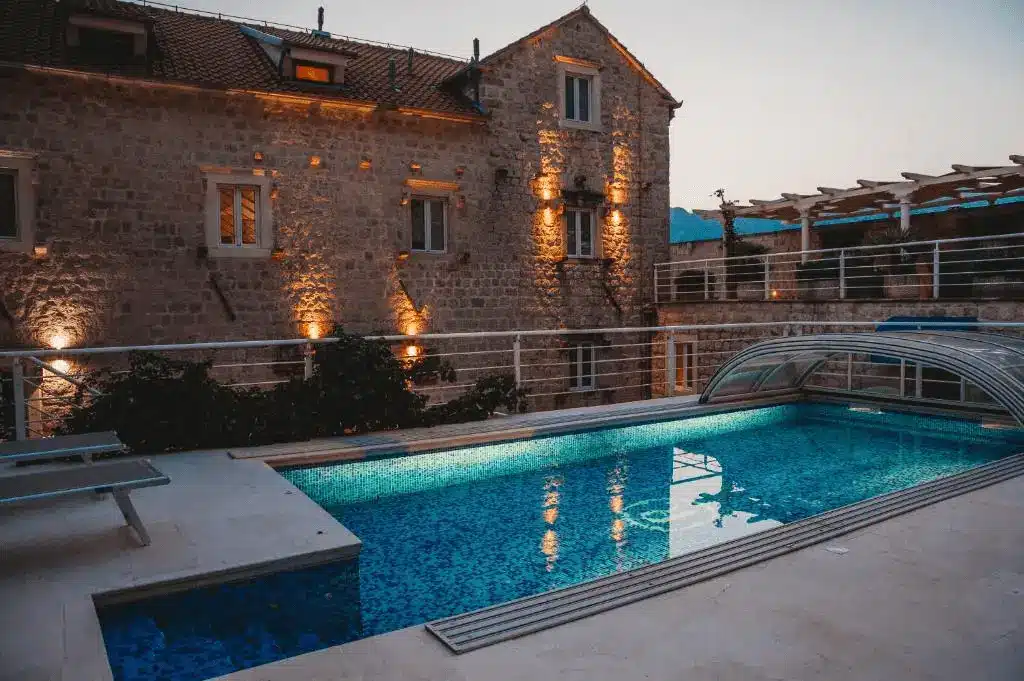
Palazzo Radomiri stands as one of Montenegro’s most authentic maritime residences—a white stone Baroque palace built by ship-owning captains during Venetian rule. Constructed in the early 1700s in Dobrota, this captain’s estate features the original private mooring where trading vessels once docked, now transformed into an exclusive sunbathing platform extending directly into the Bay of Kotor.
With just ten rooms preserving period architecture and family heirlooms, Palazzo Radomiri offers direct sea access, waterfront dining on historic stone terraces, and the rare privilege of inhabiting a structure that has commanded this coastline for three centuries. Explore more best historic hotels in Montenegro for exceptional coastal heritage stays.
Palazzo Radomiri ★★★★
The Palazzo Radomiri was commissioned in the early 18th century by the Radomiri family—a maritime dynasty whose trading vessels controlled significant Adriatic commerce under Venetian Republic authority. The palace’s construction from locally quarried white stone followed Baroque architectural principles that dominated Mediterranean coastal estates of the period, establishing it as both a residence and a visible declaration of the family’s shipping wealth.
The structure’s direct positioning on the Dobrota waterfront was strategic: the integrated stone jetty (molo) functioned as a private dock where cargo was transferred and vessels maintained, creating a self-contained maritime operation within the estate grounds.
Palazzo Radomiri Heritage Boutique Hotel is an exquisitely preserved 18th-century captain’s palace that captures the soul of Boka Bay, offering an intimate waterfront experience defined by original stone masonry and Mediterranean elegance.
This physical infrastructure survived the region’s devastating earthquakes—including the 1979 event that destroyed much of Kotor’s built heritage—making Palazzo Radomiri one of the Bay’s few continuously intact 18th-century structures. The palace’s architectural resilience stems from its foundation engineering: massive stone blocks set directly into bedrock, reinforced with iron-pinned joints that absorbed seismic movement. Today’s restoration has preserved these original construction methods while integrating modern systems discreetly within historic walls.
The transformation into a ten-room boutique hotel maintains the palace’s residential character through careful spatial decisions. Guest rooms occupy the original family quarters, retaining exposed stone walls, restored wooden beam ceilings, and authentic period furnishings sourced from the Radomiri estate and similar maritime families. The ground-floor salon—once the captain’s reception hall for negotiating trade agreements—now serves as a guest sitting room, its original frescoed ceiling and Murano glass chandeliers preserved in working condition.
Each suite opens to either sea or mountain views, with windows positioned in their 18th-century locations to frame the same coastal vistas the original inhabitants commanded.
The palace’s private jetty extends 15 meters into the Bay of Kotor, constructed from the same white stone as the main structure. This platform now functions as both sunbathing terrace and direct swimming access—guests descend historic stone steps to enter water that reaches 24°C in summer months.
The hotel restaurant occupies the waterfront terrace where captains once supervised cargo loading, with dining tables positioned literally at the water’s edge. The menu emphasizes Adriatic seafood and Mediterranean preparations that reflect the maritime trade routes the Radomiri family once controlled.
The interior courtyard—originally a service area for palace operations—has been converted into a Mediterranean garden planted with indigenous lavender, rosemary, and citrus trees. A discreet outdoor pool integrates into this space without compromising the historic stone enclosure, providing freshwater swimming within palace walls. The wellness area occupies restored stone cellars, where a sauna and massage treatments operate in vaulted chambers that once stored maritime provisions.
Palazzo Radomiri’s location in Dobrota places guests three kilometers from Kotor’s Old Town via the coastal lungomare walking path, a 35-minute seaside promenade that passes other captain’s palaces from the same era. The hotel provides complimentary bicycles and kayaks for independent coastal exploration—a modern echo of the self-sufficient maritime lifestyle the original residence embodied.
This is not reconstructed heritage; this is a captain’s operational headquarters where the infrastructure of 18th-century Adriatic commerce remains physically intact and functionally repurposed for contemporary coastal living.
Check Availability & Rates →At Palazzo Radomiri, you inhabit the exact stone halls where maritime captains commanded Adriatic trade routes under Venetian authority—sleeping in their family quarters, dining on their cargo platforms, and accessing the sea through their private mooring, all preserved in operational integrity.
FAQ: Palazzo Radomiri
What is the historical significance of Palazzo Radomiri?
Palazzo Radomiri is an early 18th-century Baroque palace built by the Radomiri family, a wealthy ship-owning dynasty during Venetian Republic rule of Montenegro. The palace served as both family residence and maritime operations center, featuring an integrated private jetty where trading vessels docked. It represents one of the Bay of Kotor’s few continuously intact captain’s estates from this period, having survived multiple earthquakes including the devastating 1979 event that destroyed much of the region’s historic architecture.
Does Palazzo Radomiri have direct sea access?
Yes. The palace features its original 18th-century stone jetty extending 15 meters into the Bay of Kotor, now serving as a private sunbathing platform and direct swimming access for guests. The jetty was originally constructed as a functional mooring for the Radomiri family’s trading vessels and remains structurally intact, allowing guests to descend historic stone steps directly into the Adriatic.
How many rooms does Palazzo Radomiri have?
Palazzo Radomiri operates as an ultra-intimate boutique hotel with just 10 rooms and suites. Each accommodation occupies the original family quarters of the palace, featuring exposed stone walls, restored wooden beam ceilings, period furnishings, and either sea or mountain views through 18th-century window placements.
What dining experience does Palazzo Radomiri offer?
The hotel restaurant is positioned on the palace’s waterfront stone terrace—the same platform where captains once supervised cargo operations. Dining tables sit at the water’s edge, with the menu emphasizing Adriatic seafood and Mediterranean preparations that reflect the historic maritime trade routes the Radomiri family controlled during the Venetian era.
Experience Montenegro’s Maritime Heritage at Its Source
Palazzo Radomiri demonstrates how authentic historic preservation creates irreplaceable luxury—no modern construction can replicate three centuries of maritime authority embedded in operational stone infrastructure. This is where Montenegro’s Adriatic legacy remains physically intact and experientially accessible. For comparable historic coastal estates, discover Heritage Grand Perast and Hotel Astoria Budva, each offering distinct perspectives on the Bay of Kotor and Budva’s architectural dominance.
More curated itineraries and luxury-focused travel insights at Your Luxury Guide. For official travel information and destination updates, visit Montenegro tourism-info.
Your Luxury Guide — Where Exceptional Travel Begins.