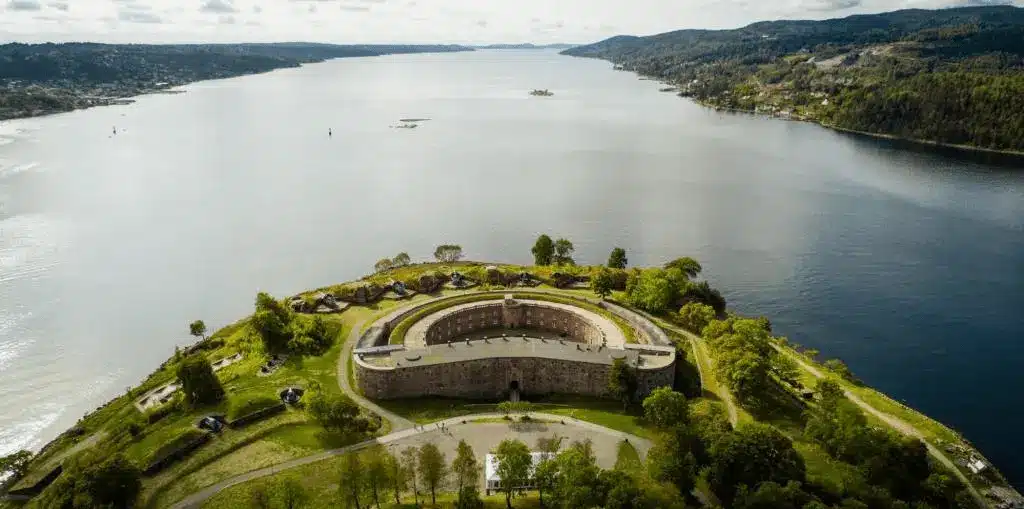
Oscarsborg Castle Hotel places guests inside the active 1850s military fortress that commanded the narrowest point of Oslo Fjord—the same artillery batteries that sank the German cruiser Blücher on April 9, 1940, altering the invasion timeline of Norway. This is not a decorative castle experience. You occupy operational casemates, walk fortified ramparts built to withstand naval bombardment, and inhabit the island that functioned as Oslo’s final defensive barrier for a century.
The fortress remains Norway’s most tactically significant coastal position, and the hotel preserves the stone corridors, powder magazines, and observation towers exactly as they were engineered for territorial defense. Access is by private ferry only—the same moat principle that made Oscarsborg impenetrable now ensures absolute separation from mainland traffic.
Oscarsborg Castle Hotel & Resort ★★★★
Oscarsborg Fortress was commissioned in 1843 by King Oscar I to close the 1,640-foot gap at Drøbak—the narrowest choke point in Oslo Fjord. Swedish military engineers designed interlocking fields of fire: the main island battery held three 28-centimeter Krupp cannons with 10,500-meter range, while satellite fortifications on Husvik and Kaholmen covered blind approaches.
By 1890, the fortress was upgraded with electric searchlights and torpedo tubes, creating a three-layer kill zone no warship could survive. The fortress never surrendered in peacetime and remained active until 2002—making it Norway’s longest continuously operated military installation.
The Oscarsborg Castle Hotel occupies the fortress’s original officer quarters, garrison barracks, and administrative buildings. Stone walls are 90 centimeters thick—regulation for coastal artillery positions—and windows remain deliberately narrow to limit blast radius from counter-battery fire.
Guest rooms inside the casemates preserve vaulted ceilings designed to contain explosive concussion, while the corridors still follow military traffic patterns: wide enough for munitions trolleys, with right-angle turns that prevented enfilade fire. The commandant’s residence now serves as the luxury suite, retaining the elevated position that allowed visual command of the entire water approach to Oslo.
What defines Oscarsborg is its operational authenticity. The main battery remains in place—visitors walk among the original Krupp guns that fired on the Blücher on April 9, 1940. The German cruiser, carrying Gestapo command staff and Oslo occupation forces, was hit twice at 500 meters. The fortress’s underwater torpedo battery delivered the final strike—two torpedoes at 100 meters that broke the ship’s keel. The Blücher sank in 90 minutes, drowning 830 personnel and delaying the German capture of Oslo by 24 hours. That delay allowed King Haakon VII and the Norwegian government to evacuate with the national gold reserves—turning a tactical victory into strategic preservation of Norwegian sovereignty.
Breakfast is served in the former officers’ mess, where battle plans were reviewed under gas lamps. The bar occupies the powder magazine—stone-lined chambers engineered to contain accidental detonations. The fortress church, built in 1848, still holds services, its spire functioning as the island’s primary navigation marker.
Evening walks trace the rampart circuit where sentries monitored all Fjord traffic for 150 years. The fortress commander’s tower offers 360-degree surveillance—the same vantage that made Oscarsborg the de facto gateway to Norway’s capital.
Guest rooms are distributed across multiple fortress buildings, each preserving military function. The King’s Battery wing retains gun crew quarters—compact, stone-walled chambers designed for rapid deployment to firing positions. The North Fort rooms occupy the forward observation post, with direct sight lines down the Fjord’s main channel. The Main Island suites are housed in the administrative complex, where garrison command coordinated with Oslo’s defense ministry.
Every room maintains the fortress aesthetic: exposed stone, minimal ornamentation, furniture scaled to military proportions. Modern heating and private bathrooms are integrated without altering structural elements. The effect is complete immersion in Norway’s most consequential defensive position.
The island itself enforces exclusivity. The Oscarsborg ferry departs Drøbak harbor every two hours—no private boats dock without fortress authority clearance. Once ashore, guests occupy a 30-acre military reserve where every structure served the defense of Norway’s capital.
The fortress museum displays recovered Blücher artifacts, including the ship’s bell and Nazi command documents sealed in waterproof cases. Walking the battery positions, you inhabit the exact firing points that held absolute authority over who entered Oslo Fjord.
No hotel in Norway offers this combination: verified battlefield command, island isolation, and the preserved architecture of national defense.
Check Availability & Rates →To stay at Oscarsborg is to hold the Fjord—not as spectator, but as occupant of the artillery battery that defended Norway’s sovereignty when diplomacy failed. The fortress gives you the island, the guns, and the command tower. Every other castle offers history. Oscarsborg offers territorial authority.
FAQ: Oscarsborg Castle Hotel
How do you reach Oscarsborg Castle Hotel?
Access is exclusively by the Oscarsborg ferry from Drøbak harbor, departing every two hours. The 10-minute crossing delivers guests directly to the fortress pier. No road access exists—the island’s military isolation is preserved as the primary security feature of the stay.
What makes Oscarsborg historically significant?
Oscarsborg Fortress sank the German cruiser Blücher on April 9, 1940, using 1890s Krupp artillery and torpedo batteries. The attack delayed the capture of Oslo by 24 hours, allowing Norway’s government and royal family to escape with national reserves—preserving Norwegian sovereignty throughout the occupation.
Are the fortress batteries still operational at Oscarsborg?
The original Krupp artillery pieces remain in firing positions but are preserved as monuments. Guests access the main battery platforms, torpedo installation, and observation towers—all structural elements that functioned as Oslo Fjord’s primary defense for 160 years.
What type of rooms does Oscarsborg Castle Hotel offer?
Accommodations occupy former officer quarters, garrison barracks, and command buildings. Rooms feature 90-centimeter stone walls, vaulted casemate ceilings, and narrow window emplacements—authentic military architecture with integrated modern utilities and private facilities.
The Island Fortress Remains Norway’s Ultimate Command Position
Oscarsborg Castle Hotel offers territorial authority no mainland property can replicate—the island fortress where Norway’s most decisive naval engagement was fought, preserved as the nation’s monument to defensive sovereignty.
Discover Hotel Ullensvang commanding the Hardangerfjord from its historic shoreline estate.
For more curated itineraries and luxury-focused travel insights, visit Your Luxury Guide. For official travel information and destination updates, visit Norway tourism-info.
Your Luxury Guide — Where Exceptional Travel Begins.