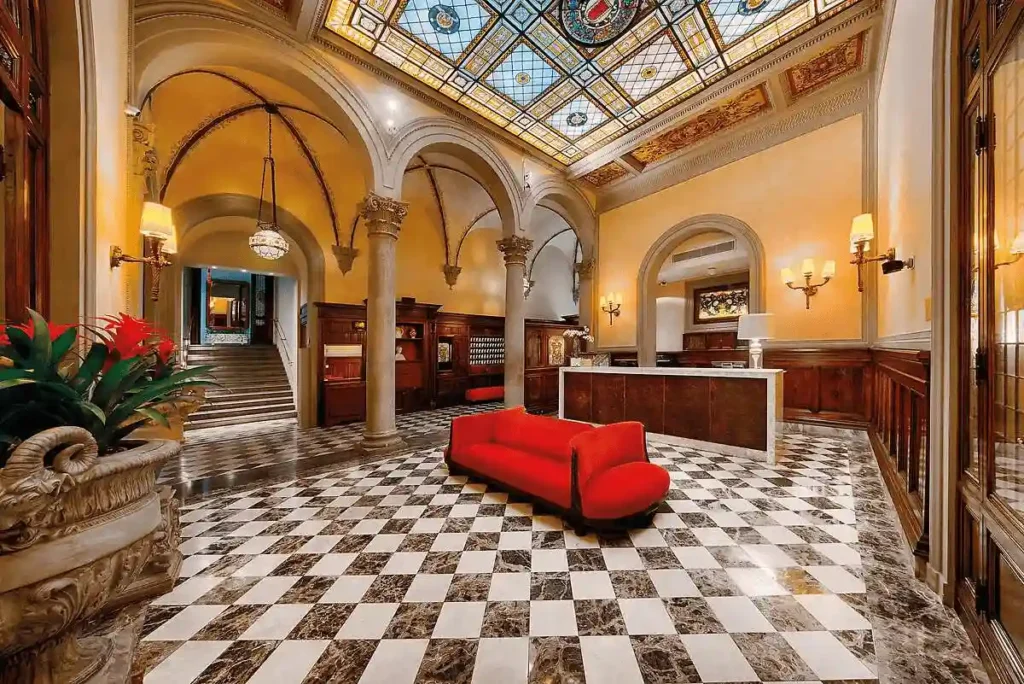
NH Collection Firenze Porta Rossa operates from a 12th-century palazzo anchored by the Torre Monalda, a perfectly preserved 13th-century defensive tower. For over 600 years, this address has maintained continuous hospitality service—a documented lineage that positions it among Italy’s oldest functioning hotels. The Monalda family, influential silk traders during the Florentine Republic, established this palace as a center of commercial and political authority.
Today, the building’s exposed medieval stone, restored Renaissance frescoes, and 19th-century stained glass create a spatial environment where guests inhabit seven centuries of Florentine command. The property delivers contemporary NH Collection standards within an architectural framework that has defined Via Porta Rossa since the Middle Ages.
NH Collection Firenze Porta Rossa ★★★★★
The NH Collection Firenze Porta Rossa occupies a medieval palazzo whose foundation predates the consolidation of the Florentine Republic. The Torre Monalda, rising from the building’s core, served as a defensive stronghold for the silk-trading Monalda family—a lineage that controlled key commercial corridors during Florence’s 14th-century ascent. The family’s wealth derived from silk monopolies, positioning this palazzo as both a private residence and a transactional headquarters where guild authority was exercised.
The building’s transition to formalized hospitality began in the 1300s, establishing a continuous operational record that spans six centuries—a rarity even among Europe’s historic properties.
NH Collection Firenze Porta Rossa is one of Italy’s oldest hotels, offering a sophisticated blend of 13th-century architectural heritage and contemporary design, anchored by the magnificent Monalda Tower.
The recent restoration preserved the palazzo’s rugged stonework while introducing contemporary infrastructure. Guest rooms reveal original Renaissance frescoes, carefully uncovered during renovation and restored to their documented pigmentation. The building’s signature stained-glass ceilings—installed in the 19th century—create shifting light patterns throughout the day, mapping the sun’s movement across Florentine architecture. These aren’t decorative additions; they’re structural elements that demonstrate the palazzo’s evolution from medieval fortress to Renaissance residence to modern luxury hotel.
The Tower Suite spans three floors within the Torre Monalda itself, offering a 360-degree private terrace with direct sightlines to the Duomo, the Arno, and the Tuscan hills beyond. This isn’t a standard “view room”—it’s occupancy of a fortified medieval structure that once surveyed the city’s trade routes.
The suite’s stone walls, over two meters thick in places, provide both thermal regulation and acoustic isolation, a medieval engineering advantage that modern construction rarely replicates.
The palazzo’s ground floor houses Savini Tartufi, a specialized truffle restaurant that focuses exclusively on Tuscan truffle preparation. The dining room occupies the original commercial hall where the Monalda family conducted silk transactions. The restaurant’s menu rotates with truffle seasonality—white truffles from the San Miniato hills in autumn, black truffles from the Mugello forest in winter—paired with estates from the Chianti Classico region. This is culinary precision anchored by geographic specificity.
The hotel’s location on Via Porta Rossa provides pedestrian access to Via de’ Tornabuoni’s luxury retail corridor and a five-minute walk to Piazza della Signoria. The concierge team secures advance reservations for the Uffizi’s Tribune room and the Vasari Corridor, spaces where public access is limited and pre-coordination is required. The property also offers chauffeur services for transfers to Amerigo Vespucci Airport and guided vineyard excursions to certified Chianti estates.
The “Porta Rossa” (Red Door) remains a documented feature of the building’s medieval facade—a visual marker that artists and writers referenced throughout the Renaissance. The door’s pigment, derived from crushed cinnabar, was a status indicator reserved for families with political authority. Guests today pass through the same threshold that marked commercial power during Florence’s golden age.
Check Availability & Rates →Few addresses in Florence offer verifiable continuity from the medieval republic to the modern era. The NH Collection Firenze Porta Rossa operates from a palazzo where the Monalda family exercised silk-trade dominance, where defensive towers guarded commercial authority, and where hospitality has functioned without interruption for six centuries. This is not heritage recreation—it is documented architectural permanence.
FAQ: NH Collection Firenze Porta Rossa
What makes the Torre Monalda unique among Florence’s historic hotels?
The Torre Monalda is a perfectly preserved 13th-century defensive tower that now houses the hotel’s exclusive three-floor Tower Suite. The suite provides a 360-degree private terrace with panoramic views of the Duomo, the Arno, and the Tuscan countryside, offering guests occupancy of a medieval fortification with stone walls exceeding two meters in thickness.
How long has the NH Collection Firenze Porta Rossa operated as a hotel?
The property has maintained continuous hospitality service for over 600 years, with documented use as a lodging establishment beginning in the 14th century. This operational lineage positions it among the oldest functioning hotels in Italy, with uninterrupted service spanning from the Florentine Republic to the present.
What dining experience does Savini Tartufi offer?
Savini Tartufi is a world-class restaurant specializing exclusively in Tuscan truffle preparation. The menu rotates with seasonal truffle availability—white truffles from San Miniato in autumn, black truffles from Mugello in winter—paired with Chianti Classico estates. The dining room occupies the palazzo’s original commercial hall, where the Monalda family conducted silk-trading transactions.
Which original architectural elements are preserved in guest rooms?
Many guest rooms feature original Renaissance-era frescoes that were uncovered and restored during the hotel’s recent renovation. The lobby and common areas showcase 19th-century stained-glass ceilings and windows, which create dynamic light patterns throughout the day while preserving the building’s historical integrity.
Where Medieval Command Meets Modern Precision
The NH Collection Firenze Porta Rossa demonstrates how architectural permanence translates into contemporary luxury. This palazzo has housed commercial authority, noble residence, and hospitality service across seven centuries without abandoning its medieval foundation.
Travelers seeking properties where history functions as a competitive advantage, explore the Brunelleschi Hotel Florence, located within a Byzantine tower, or the Hotel Bernini Palace Florence, a Baroque residence that housed Florentine nobility.
For more curated itineraries and luxury-focused travel insights, visit Your Luxury Guide. For official travel information and destination updates, visit Italy tourism.
Your Luxury Guide — Where Exceptional Travel Begins.