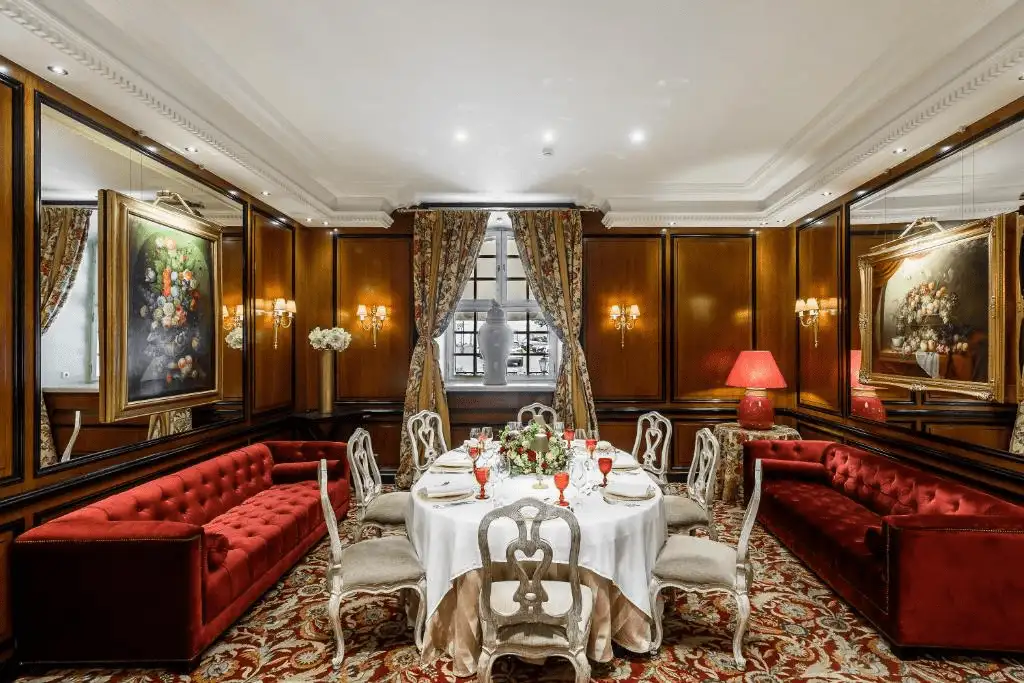
Narutis Hotel Vilnius occupies a 1581 landmark complex on Pilies Street that once housed the elite Nobles’ College (Collegium Nobilium) and served as residence for Vilnius University professors. The idiosyncratic structure blends Gothic cellars with 18th-century Baroque frescoes and Classical additions across multiple wings.
Today, the building operates as a 5-star boutique hotel with 51 individually designed suites defined by the original split-level floor plan. Behind memorial plaques commemorating literary figures Józef Ignacy Kraszewski and Juliusz Słowacki lies a sophisticated retreat where academic heritage meets contemporary luxury.
Narutis Hotel Vilnius ★★★★★
The Narutis Hotel is not a restored mansion; it is a living architectural palimpsest. Since 1581, this Pilies Street landmark has absorbed three centuries of authority: Gothic vaults from merchant-era storage, Baroque frescoes commissioned by university patrons, and Classical facades added during the Polish-Lithuanian Commonwealth’s intellectual golden age. The structure’s “hotch-potch” layout is not accidental—it is the physical record of Vilnius’s transformation from medieval trading hub to university capital.
Narutis Hotel Vilnius offers a living journey through five centuries of Lithuanian history, housing guests within a UNESCO-listed monument where 16th-century Gothic vaults meet the refined elegance of 18th-century Baroque frescoes and Small Luxury Hotels™ service.
In the 18th century, the building served the Nobles’ College, an elite preparatory institution for the Polish-Lithuanian aristocracy. Its most distinguished tenant was Jean-Emmanuel Gilibert, the French botanist who established Vilnius University’s first orangery within the hotel’s inner courtyard in 1782.
The botanical garden’s walled sanctuary—still intact today—represented Enlightenment-era scientific ambition at the empire’s northern frontier. Writers Józef Ignacy Kraszewski and poet Juliusz Słowacki later inhabited these halls, their memorial plaques marking the site’s literary prestige. The building was never peripheral; it was the residential anchor for the university’s intellectual elite.
The 2013-2014 renovation preserved this hierarchical complexity. Each of the 51 suites is dictated by the original 16th-century floor plan, resulting in unique ceiling heights, split-level corridors, and irregular spatial volumes. Select rooms feature original 18th-century mythological frescoes uncovered during archaeological surveys—authentic decorative programs that once signaled wealth and classical education to visiting nobility.
The “Column Hall,” a grand ceremonial space accommodating 120 guests, retains superior natural acoustics engineered for 18th-century oratory and music. These are not replicas; they are the preserved mechanisms of aristocratic power.
The Narutis Spa occupies the building’s 16th-century Gothic cellars. Massive stone archways frame a heated indoor pool, Turkish hammam, and specialized massage rooms within vaults designed for merchant storage. The physical isolation of these subterranean spaces—originally intended for valuable goods—now provides absolute silence. The spa’s material palette mirrors the structure above: exposed 400-year-old brickwork, heavy brass fixtures, and controlled thermal environments. The basement’s role has shifted from commercial utility to elite wellness, but the Gothic infrastructure remains unchanged.
The Narutis Restaurant, a 40-seat fine-dining venue, overlooks Pilies Street through tall windows that once illuminated professors’ studies. The dining hall is framed by the same 18th-century fresco cycles visible in select guest suites—mythological scenes commissioned to assert the college’s classical scholarship. The menu emphasizes upscale Lithuanian and European techniques, anchoring the property’s prestige within local culinary tradition.
The breakfast parlor, set within the original vaulted cellars, features the same Gothic masonry that isolates the spa—proof that the building’s historic infrastructure continues to define guest experience at every level.
The hotel’s inner courtyard garden is the direct descendant of Gilibert’s 1782 botanical experiment. Enclosed by 16th-century walls, it functions as a “walled sanctuary” insulated from Pilies Street’s pedestrian traffic. The courtyard’s quiet is architectural, not incidental—its original design intended to protect delicate imported plants from Vilnius’s harsh continental climate. Today’s guests occupy the same protected microclimate that once sustained French orangeries for Central European aristocracy.
The Narutis Hotel’s idiosyncratic layout, split-level corridors, and material authenticity reflect of continuous institutional use since 1581. From merchant cellars to university residences to modern 5-star infrastructure, the building has never abandoned its role as a seat of intellectual and social authority. The frescoes, Gothic vaults, and botanical courtyard are not decorative; they are the physical evidence of Vilnius’s transformation from Commonwealth frontier to Baltic cultural capital.
Check Availability & Rates →Where 16th-century Gothic vaults shelter Europe’s elite beneath the same stone archways that once protected merchant fortunes, and 18th-century frescoes commissioned for aristocratic education now frame contemporary luxury within the unbroken lineage of Vilnius University’s intellectual dominance.
FAQ: Narutis Hotel Vilnius
What is the historical significance of Narutis Hotel Vilnius?
Narutis Hotel occupies a 1581 landmark complex that served as residence for Vilnius University professors and the elite Nobles’ College (Collegium Nobilium) in the 18th century. The building housed distinguished figures including French botanist Jean-Emmanuel Gilibert, who established the university’s first botanical garden in its inner courtyard in 1782, and renowned writers Józef Ignacy Kraszewski and poet Juliusz Słowacki. The structure has operated continuously as a hospitality property since the early 20th century, making it one of the oldest functioning hotels in the Baltics.
What architectural features define the Narutis Hotel?
The hotel is characterized by an idiosyncratic layout blending Gothic, Baroque, and Classical elements across multiple interconnected wings. The structure features 16th-century Gothic vaulted cellars, exposed original brickwork, 18th-century mythological frescoes uncovered during archaeological surveys, and split-level corridors reflecting three centuries of additions. Each of the 51 suites has unique ceiling heights and spatial volumes dictated by the original 1581 floor plan, preserving the building’s authentic heritage complexity.
What is the Narutis Spa experience?
The Narutis Spa occupies pristine 16th-century Gothic cellars featuring massive stone archways and original masonry. The subterranean wellness center includes a heated indoor pool, sauna, Turkish hammam, and specialized massage rooms within vaults originally designed for merchant storage. The Gothic infrastructure provides absolute acoustic isolation from modern Vilnius, maintaining the thermal and spatial conditions that once protected valuable commercial goods.
What is the significance of the hotel’s inner courtyard?
The hotel’s courtyard is the direct descendant of Jean-Emmanuel Gilibert’s 1782 botanical garden and orangery, established as part of Vilnius University’s scientific expansion. Enclosed by original 16th-century walls, the space functions as a protected microclimate sanctuary—the same architectural design that once sheltered delicate imported plants from Lithuania’s harsh continental winters. Today it serves as a quiet, walled retreat for guests, preserving its 18th-century role as an elite botanical experiment at the Commonwealth’s intellectual frontier.
The Enduring Authority of Vilnius’s Academic Elite
Narutis Hotel Vilnius is not a reconstructed monument; it is the living infrastructure of institutional power. From Gothic merchant cellars to Enlightenment-era botanical experiments to contemporary 5-star operations, the building has never abandoned its role as residential anchor for Vilnius’s intellectual and social elite.
Continue exploring Vilnius’s most distinguished heritage properties at Hotel Pacai Vilnius and Grand Hotel Vilnius.
For more curated itineraries and luxury-focused travel insights, visit Your Luxury Guide. For official travel information and destination updates, visit Lithuania tourism-info.
Your Luxury Guide — Where Exceptional Travel Begins.