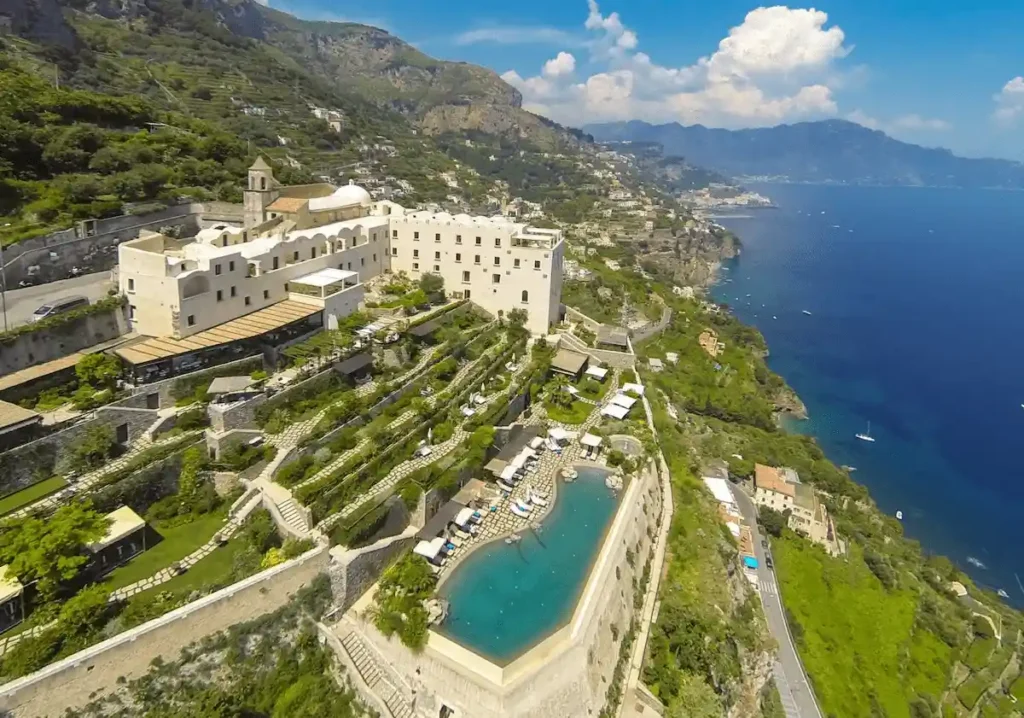
Monastero Santa Rosa Hotel & Spa commands one of the Amalfi Coast’s most dramatic positions—a 17th-century Dominican convent carved into the cliffs of Conca dei Marini, 70 meters above the Tyrrhenian Sea. Founded in 1681 as a contemplative monastery for noble daughters of Southern Italy, the property served religious orders for over 250 years before abandonment in the mid-20th century.
After a meticulous restoration that preserved original vaulted chapels, terraced gardens, and stone-cut corridors, the convent reopened in 2012 as a 20-suite luxury retreat. This transformation respects the Dominican legacy while delivering contemporary amenities: a two-level spa, Michelin-caliber dining, and direct access to secluded beach platforms via the historic cliffside stairway once used by the sisters.
Monastero Santa Rosa Hotel & Spa ★★★★★
The property’s Dominican foundation dictated its architectural form: a vertical monastery designed for prayer and contemplation, now adapted for privileged seclusion. The original structure featured stone-vaulted cells aligned along the cliff face to maximize sea views during contemplative hours, a spatial hierarchy that translates seamlessly into modern luxury hospitality.
Twenty suites occupy these former monastic chambers, each preserving original terracotta floors, exposed stone walls, and arched doorways while integrating marble bathrooms, rainfall showers, and climate control systems invisible to the historic envelope.
Monastero Santa Rosa Hotel & Spa is a prestigious cliffside sanctuary that offers guests the rare privilege of residing within a 17th-century Dominican monastery, blending its original spiritual architecture with terraced organic gardens and a legendary infinity pool suspended above the Gulf of Salerno.
The main chapel—still intact with its 17th-century altar and frescoed dome—now serves as a private event space, its acoustic properties designed for Gregorian chant now hosting intimate classical performances. The convent’s terraced herb gardens, once cultivated for medicinal and culinary use by the sisters, continue this tradition under modern horticultural management, supplying the hotel’s restaurant with rosemary, basil, and citrus harvested from the same terraces that fed the Dominican community.
What distinguished this monastery from mainland counterparts was its clifftop position—chosen deliberately for isolation from secular Naples but resulting in one of the Mediterranean’s most commanding vantage points. The nuns’ daily routine involved navigating 300 stone steps to reach a small beach platform for laundry and limited sea access, infrastructure now repurposed as the hotel’s private beach service with restored pathways, cushioned sun loungers, and seasonal boat transfers to Amalfi town.
The infinity pool occupies the convent’s original contemplation terrace, a deliberate architectural choice that extends the historical lineage: where Dominican sisters once meditated facing the infinite horizon, guests now experience the same visual merger of water and sky from heated saltwater rather than stone benches. This is spatial continuity preserved across 340 years of occupation.
The two-level spa integrates the monastery’s lower grottos—natural limestone caves used historically for food storage due to their constant temperature. These caverns now house treatment rooms, a Turkish bath carved from the original stone, and a biosauna that maintains the grotto’s thermal stability without mechanical intervention. Treatments emphasize local ingredients: olive oil from nearby Ravello groves, lemon-infused scrubs from Conca dei Marini’s famous citrus terraces, and sea salt harvested from the coastal rocks below the property.
Dining operates from the former refectory, a vaulted hall where Dominican sisters took silent meals facing the sea. The room’s original proportions—14-meter length, 4-meter height, single arched window overlooking Positano—remain unchanged. The kitchen sources ingredients: red prawns from Cetara’s fishing fleet, buffalo mozzarella from Paestum dairies, and the historic sfusato amalfitano lemons grown on the hotel’s own terraces, the same varietal cultivated by the convent’s original inhabitants.
Access follows the historic coastal footpath connecting Conca dei Marini to Amalfi, a route once walked by Dominican friars delivering supplies from the archdiocese. Modern guests arrive via this same road, now paved but still tracing the cliff’s natural contour, reinforcing the property’s deliberate isolation—a 4-kilometer distance from Amalfi that preserves the monastery’s founding principle of contemplative separation.
Check Availability & Rates →Monastero Santa Rosa maintains the Dominican legacy of elevated contemplation—no longer spiritual, but spatial. The same cliffs chosen for religious isolation now deliver the secular luxury of absolute privacy, with infinity pools replacing prayer benches along a horizon that remains unchanged since 1681.
FAQ: Monastero Santa Rosa Hotel & Spa
What is the historical significance of Monastero Santa Rosa? Monastero Santa Rosa was founded in 1681 as a Dominican convent for noble daughters of Southern Italy, serving as an active monastery until the mid-20th century. The property’s cliffside position 70 meters above the Tyrrhenian Sea was chosen for contemplative isolation, resulting in one of the Amalfi Coast’s most dramatic architectural sites. After restoration, it reopened in 2012 as a 20-suite luxury hotel preserving original vaulted chapels, stone corridors, and terraced gardens.
How many rooms does Monastero Santa Rosa have? The hotel features 20 suites, each occupying former monastic cells with preserved terracotta floors, exposed stone walls, and arched doorways. All suites include modern marble bathrooms, private terraces, and direct sea views through the original window placements designed for the nuns’ contemplative practice.
Does Monastero Santa Rosa have direct beach access? Yes, the property maintains the monastery’s original 300-step stone stairway descending to a private beach platform historically used by Dominican sisters. The hotel now provides this access with restored pathways, sun loungers, and seasonal boat service to Amalfi, preserving the cliff-to-sea connection integral to the convent’s daily operations.
What dining options are available at Monastero Santa Rosa? The main restaurant occupies the former refectory, a vaulted hall where Dominican sisters took silent meals. The kitchen sources ingredients within 15 kilometers, including red prawns from Cetara, buffalo mozzarella from Paestum, and sfusato amalfitano lemons grown on the hotel’s original convent terraces. The menu emphasizes Campanian coastal traditions using the same local products that sustained the monastery.
A Cliffside Legacy Preserved
Monastero Santa Rosa Hotel & Spa demonstrates how architectural purpose transcends religious function—the Dominican imperative for elevated contemplation now serves luxury travelers seeking the same cliffside seclusion that defined monastic life. The property’s 340-year lineage remains legible in every spatial element: prayer cells as suites, contemplation terraces as infinity pools, grottos as spa sanctuaries.
For those seeking the definitive historic accommodations of the Amalfi Coast, the 13th-century monastic heritage of Anantara Convento di Amalfi Grand Hotel and the 11th-century Romanesque grandeur of Caruso, A Belmond Hotel, Amalfi Coast, represent the pinnacle of Italy’s preserved cliffside architecture.
For more curated itineraries and luxury-focused travel insights, visit Your Luxury Guide. For official travel information and destination updates, visit Italy tourism.
Your Luxury Guide — Where Exceptional Travel Begins.