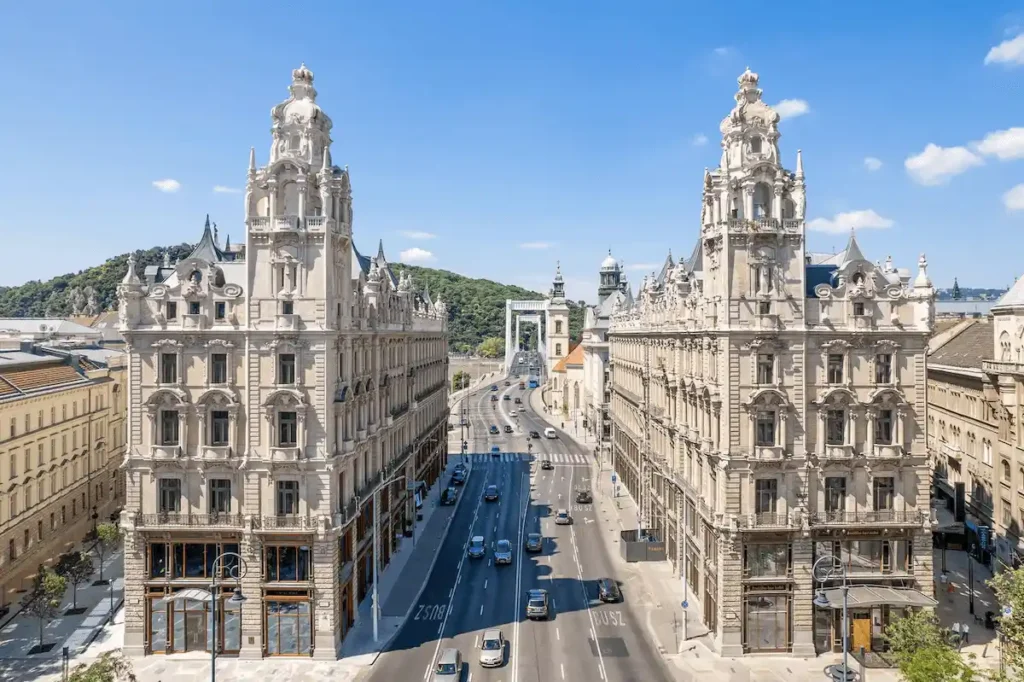
The Matild Palace Budapest stands as a deliberate statement of Habsburg authority—a neo-baroque twin palace commissioned in 1902 by Archduchess Maria Klotild to create an architectural “gate” at the foot of Elisabeth Bridge. Designed by Flóris Korb and Kálmán Giergl, the architects behind the Liszt Academy, this UNESCO-protected structure anchors the entrance to Váci utca with the same imperial precision that once defined the monarchy’s approach to urban dominance.
Following a five-year restoration, the palace reopened in 2021 as a 130-room luxury hotel where regal 19th-century aesthetics meet signature turquoise Zsolnay ceramic accents. Guests now inhabit the same spaces where Hungarian intellectuals gathered for over a century at the legendary Belvárosi Kávéház. For travelers seeking properties where historical weight translates to contemporary prestige, explore our guide to the best historic hotels in Budapest.
Matild Palace Budapest ★★★★★
The authority of Matild Palace begins at street level, where the original 1902 wrought-iron gate and stone staircases remain intact—a deliberate restoration choice that signals the building’s protected UNESCO status. The twin palace structure, mirrored across the street by Klotild Palace, was conceived as an architectural power statement marking the Pest entrance to the city center. This wasn’t residential construction; it was imperial urban planning executed at scale.
Matild Palace Hotel is a UNESCO World Heritage site and a neo-baroque architectural jewel, originally commissioned by Her Imperial and Royal Highness Maria Klotild of Saxe-Coburg and Gotha to serve as the social gateway of the city.
The palace’s 111 guest rooms and 19 signature suites occupy spaces originally designed for elite society gatherings. The Loft rooms, integrated into the historic attic structure, feature large sloping windows that follow the roofline’s original geometry—bohemian space reinterpreted for modern luxury.
The Maria Klotild Royal Suite extends this concept, placing guests within the palace’s protected roof structure where original timber beams and modern infrastructure coexist.
Guest rooms feature custom-made Zsolnay ceramics in signature turquoise—a contemporary interpretation using Hungary’s most prestigious porcelain manufacturer. The bathrooms and decorative elements reference the factory’s imperial commissions, connecting today’s stay to the same aesthetic vocabulary that defined turn-of-the-century Habsburg luxury. Many rooms include Juliet balconies with direct sightlines to the Danube, Gellért Hill, and Elisabeth Bridge—the same river panorama that established this location’s strategic value in 1902.
The ground floor houses Spago by Wolfgang Puck, the first European outpost of the Beverly Hills institution. The restaurant occupies renovated café space where the Belvárosi Kávéház operated for over a century as a gathering point for Hungarian intellectuals and artists. The conversion maintains the original café’s social positioning while introducing international culinary standards executed with Hungarian seasonal ingredients.
The Duchess, a hidden rooftop bar accessed via unmarked elevator, functions as a modern interpretation of exclusive society spaces. The “liquor library” concept and 360-degree city views position the venue as Budapest’s contemporary answer to historic private clubs—access controlled, atmosphere refined, panorama absolute.
The Matild Café & Cabaret revives Belle Époque performance culture with a classic stage, live entertainment, and authentic Hungarian pastries. This isn’t nostalgic recreation; it’s a functional continuation of the building’s century-long role as a cultural anchor point.
The Swan Spa extends this restoration philosophy underground, where hammam, sauna, and therapy rooms use Omorovicza products to connect Hungarian bathing traditions to modern wellness standards.
The palace’s neo-baroque architecture, protected under UNESCO’s Danube banks designation, ensures that every restoration decision maintains the building’s 1902 imperial character. The original twin-palace concept—two structures creating an urban gateway—remains visually dominant at the Elisabeth Bridge approach. Guests don’t just stay in a restored building; they occupy a protected monument where Archduchess Maria Klotild’s architectural commission continues to define the city’s most prestigious entrance.
Check Availability & Rates →Where Habsburg commission created Budapest’s grand entrance, the palace continues its century-long role as the city’s architectural threshold—imperial geometry preserved, modern prestige executed, UNESCO protection guaranteeing that every stay inhabits verified historical authority rather than manufactured heritage.
FAQ: Matild Palace Budapest
What makes Matild Palace Budapest historically significant?
Commissioned in 1902 by Archduchess Maria Klotild, the palace was designed by Flóris Korb and Kálmán Giergl as part of a twin-palace structure creating an imperial architectural gateway at Elisabeth Bridge. The UNESCO-protected building housed the Belvárosi Kávéház for over a century, functioning as Budapest’s primary intellectual gathering space. Its neo-baroque design and protected heritage status establish it as a documented seat of cultural and architectural authority.
Who designed the Matild Palace and what is its architectural style?
Architects Flóris Korb and Kálmán Giergl, who also designed Budapest’s Liszt Academy, created the palace in neo-baroque style. The 1902 twin-palace structure features original wrought-iron gates, stone staircases, and protected roofline geometry. Following a five-year restoration completed in 2021, the building maintains its UNESCO-designated architectural character while integrating signature turquoise Zsolnay ceramic accents throughout 130 guest rooms and public spaces.
What dining and amenities distinguish the Matild Palace?
Spago by Wolfgang Puck occupies the ground floor as the restaurant’s first European location, while The Duchess rooftop bar provides 360-degree city views from a hidden top-floor venue. The Matild Café & Cabaret revives Belle Époque performance culture with live entertainment and authentic Hungarian pastries. The Swan Spa features hammam, sauna, and therapy rooms using Omorovicza products, connecting Hungarian bathing traditions to modern wellness standards within the palace’s historic structure.
Where is Matild Palace located in Budapest?
The palace stands at the Pest-side foot of Elisabeth Bridge (Erzsébet híd), marking the entrance to Váci utca shopping district. Its twin-palace structure with Klotild Palace creates an architectural gateway to Budapest’s city center, with many rooms offering Juliet balconies and direct Danube River views toward Gellért Hill. The UNESCO-protected location on the Danube banks established its strategic importance in 1902 and maintains its role as the city’s most prestigious architectural entrance.
Where Imperial Architecture Commands Modern Budapest
The Matild Palace executes what few properties achieve—translating Habsburg-era architectural dominance into contemporary luxury without diminishing either era’s authority. The UNESCO protection, the century of intellectual legacy through Belvárosi Kávéház, and the deliberate twin-palace urban planning establish a stay grounded in verified historical weight rather than decorative nostalgia.
Travelers seeking properties where royal commission translates to modern prestige should also consider the Four Seasons Gresham Palace Budapest and Párisi Udvar Hotel Budapest, where similar architectural authority defines the contemporary stay.
For more curated itineraries and luxury-focused travel insights, visit Your Luxury Guide. For official travel information and destination updates, visit Hungary tourism-info.
Your Luxury Guide — Where Exceptional Travel Begins.