Mandarin Oriental Ritz Madrid opened October 2, 1910, not as a commercial venture but as a royal mandate. King Alfonso XIII personally commissioned César Ritz to build Spain’s first palace hotel grand enough to house European royalty for his wedding—a building that would define Madrid’s social apex for the next century.
Today, you inhabit the same halls where emperors negotiated, where Mata Hari spied under an alias, and where the King of Spain still maintains a private office during national celebrations. This is the definitive authority on best historic hotels in Madrid.
Mandarin Oriental Ritz Madrid ★★★★★
Built by architects Charles Mewès and Luis de Landecho, this palace holds the distinction of being Spain’s first building constructed with a reinforced steel frame—a structural revolution disguised in Belle Époque opulence. For over a century, the Ritz has operated as Madrid’s unofficial annex of power: a diplomatic salon, a royal guesthouse, and the city’s most exclusive private stage.
Mandarin Oriental Ritz is blending César Ritz’s original 1910 opulence with contemporary Spanish artistry in the heart of the Golden Triangle of Art.
The Palm Court anchors the experience. Its massive crystal canopy—covered from the 1940s until the 2021 restoration—now floods the space with light as it did on opening day. Beneath it, Traditional Afternoon Tea is served not as a tourist ritual but as a continuation of the hotel’s original function: a gathering place for those who shape policy, not follow it. The Ritz Garden extends this authority outdoors—a rare private enclave in central Madrid where al fresco dining occurs behind walls that have shielded monarchs for generations.
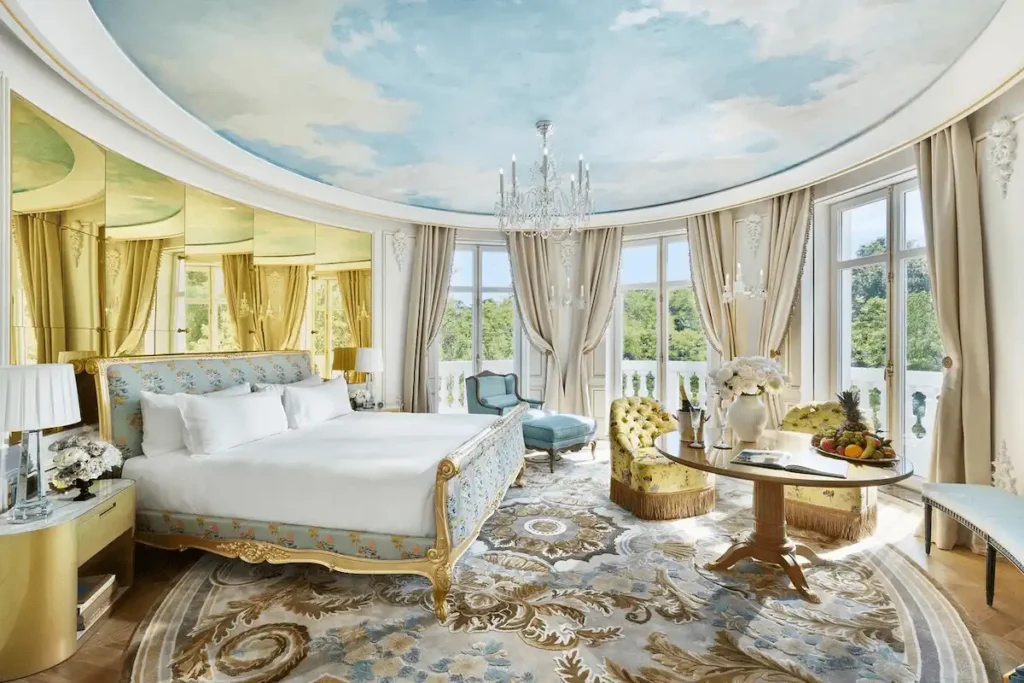
Each suite translates the hotel’s diplomatic legacy into spatial command. High ceilings, restored original moldings, and sight lines designed for formal reception create rooms that function as private salons. The accommodations are not “charming” or “cozy”—they are chambers built to host treaties, not travelers.
Restoration architect Rafael de La-Hoz and designers Gilles & Boissier executed the €115 million renovation with surgical precision: modernizing infrastructure while preserving the 1910 floor plan that once segregated royalty from staff with labyrinthine service corridors.
The hotel’s wartime conversion into a military hospital during the Spanish Civil War (1936–1939) left its mark. Structural reinforcements installed to support medical equipment remain embedded in the foundation—hidden proof of the building’s role as a national strategic asset during Spain’s most volatile decade.
The “No Actor” policy that followed—refusing accommodation to “show business” figures—was not snobbery but brand protection. The Ritz positioned itself as sanctuary for heads of state, and that exclusivity created the scarcity that still drives its appeal.
Mata Hari’s 1916 stay in Room 114 under the alias “Countess Masslov” exemplifies the hotel’s historic function as a neutral zone for espionage and diplomacy. Salvador Dalí’s residencies, where he transformed suites into working studios, prove the Ritz’s tolerance for eccentricity—as long as it was genius-grade. The Emperor of Japan, Grace Kelly, Frank Sinatra, Ernest Hemingway: the guest ledger reads like a treaty signing roster, not a hotel registry.
Pictura, the gilded bar, operates as a modern extension of this legacy. Its “Portrait Gallery”—contemporary Spanish artists rendered in Old Master style—signals continuity: the Ritz remains the institution where Spain’s cultural authority is displayed.
The subterranean spa, the hotel’s first wellness addition, features a white-marble indoor pool and vitality pool designed for recovery, not indulgence. High-performance restoration after high-performance presence—this is infrastructure built for those who govern, not vacation.
The King of Spain’s maintained private office for Día de la Hispanidad underscores the property’s enduring diplomatic utility. You are not booking a hotel. You are reserving access to the physical seat of Spanish social power—a building whose walls have witnessed every major European negotiation, scandal, and celebration for 113 years.
Check Availability & Rates →The Ritz does not offer escape. It offers elevation—to the same stratosphere where royalty once negotiated empires beneath a crystal dome, where Mata Hari worked in shadow, and where Spain’s elite still convene to decide the future.
FAQ: Mandarin Oriental Ritz Madrid
What makes Mandarin Oriental Ritz Madrid historically significant?
Built by royal decree in 1910 for King Alfonso XIII’s wedding, the Mandarin Oriental Ritz Madrid was Spain’s first reinforced steel-frame building and remains the country’s definitive Belle Époque palace hotel. It has hosted European royalty, served as a military hospital during the Spanish Civil War, and continues to maintain a private office for the King of Spain during national celebrations.
Who designed Mandarin Oriental Ritz Madrid?
Architects Charles Mewès (designer of the Ritz Paris) and Luis de Landecho designed the Mandarin Oriental Ritz Madrid, which opened October 2, 1910. The 2021 €115 million restoration was led by Rafael de La-Hoz and design firm Gilles & Boissier, reinstating the historic Palm Court glass dome covered since the 1940s.
Which famous guests stayed at Mandarin Oriental Ritz Madrid?
Mata Hari spied from Room 114 in 1916 under the alias “Countess Masslov.” Salvador Dalí used suites as art studios. The hotel has hosted the Emperor of Japan, Grace Kelly, Frank Sinatra, Ernest Hemingway, and nearly every European royal house across 113 years of operation.
What is unique about the Palm Court at Mandarin Oriental Ritz Madrid?
The Palm Court features a massive original crystal canopy from 1910, which was covered for 80 years and reinstated during the 2021 restoration. It serves Traditional Afternoon Tea beneath the historic glass dome and functions as the hotel’s diplomatic salon—the same space where royalty and heads of state have convened for over a century.
The Institutional Authority of Madrid’s Royal Palace Hotel
Mandarin Oriental Ritz Madrid does not compete with other luxury hotels. It defines the category. From its opening by royal mandate to its present role as a diplomatic staging ground, the Ritz has operated as Madrid’s institutional seat of social power. The restoration preserved what matters: the steel-frame foundation, the Palm Court dome, the strategic floor plan that once separated monarchs from servants. You enter as a guest and depart having inhabited the same command structure that shaped a century of European history.
For parallel experiences of institutional authority in Madrid’s hotel landscape, explore Four Seasons Hotel Madrid and The Palace Madrid.
More curated itineraries and luxury-focused travel insights at Your Luxury Guide. For official travel information and destination updates, visit Spain tourism-info.
Your Luxury Guide — Where Exceptional Travel Begins.