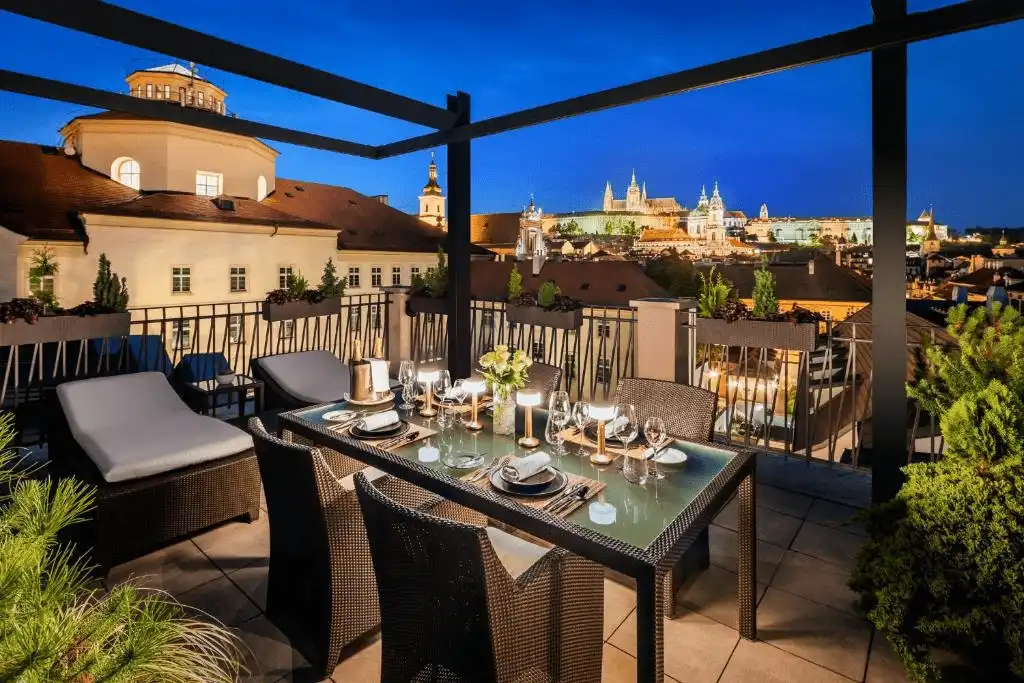
The Mandarin Oriental Prague occupies what was once the spiritual and intellectual fortress of the Dominican Order of Preachers—a 14th-century monastery complex that anchored medieval religious authority in Malá Strana. Six-centuries of architectural continuum where Gothic foundations, Renaissance expansion, and Baroque grandeur converge beneath ultra-modern design discipline.
The building itself is a protected cultural monument, its restoration executed under the direct supervision of Prague’s Monuments Preservation Office to ensure that every vaulted ceiling, every arched window, and every medieval stone remains intact. You are inhabiting a seat of medieval intellectual dominance where centuries of contemplative power now serve a different elite.
Mandarin Oriental Prague ★★★★★
The Mandarin Oriental Prague operates as a sprawling three-wing monument spanning 600 years of architectural evolution: the original 14th-century Dominican monastery core, a 16th-century Renaissance extension, and a 17th-century Baroque wing—each era physically layered into the property’s DNA.
This structural depth translates directly into guest experience: 99 suites across three historic epochs, many retaining original vaulted ceilings up to 5 meters high, tall Gothic arched windows, and hand-restored parquet floors that would cost millions to commission today.
The monastery’s original spatial generosity—designed for contemplative silence—gives every room the kind of cubic volume and natural light penetration that modern luxury developers can only simulate.
Mandarin Oriental Prague is a meticulously preserved 14th-century monastery-turned-sanctuary, offering travelers a rare stay within six centuries of architectural history in the quiet, prestigious heart of the Lesser Quarter.
The location strategy is surgical: tucked onto a quiet cobblestone street in Malá Strana’s protected historic zone, the property sits five minutes on foot from Charles Bridge and Prague Castle, yet completely insulated from the tourist density that suffocates riverfront properties. The hotel’s private flower garden and secluded patios offer a level of urban silence rare in any European capital, let alone one as compact as Prague. This is the advantage of monastic architecture—these walls were engineered for silence, and they still deliver it 700 years later.
The spa occupies a former Renaissance chapel—not themed as one, but literally carved into the 16th-century sacred space where monks once gathered for vespers. Treatment rooms are set against exposed Gothic brickwork and original stone archways, with therapy sessions conducted beneath candle-lit porticoes.
Beneath the spa floor lies a glass-covered excavation site revealing the foundations of St. Mary Magdalene Church, one of Prague’s oldest Gothic structures, now preserved as a subterranean visual anchor for wellness treatments. This is not “spa atmosphere”—this is performing self-care atop verifiable 14th-century ruins.
Monastiq restaurant operates within the monastery’s refectory zone, where the kitchen applies contemporary techniques to traditional Bohemian and Moravian recipes that predate the Czech Republic itself. The private dining wine cellar is carved directly into the 16th-century foundation stones, complete with a preserved medieval well discovered during excavation—a literal aperture into the property’s hydraulic past.
For corporate gatherings, the hotel offers 424 square meters of Baroque-vaulted conference space, including banquet halls with crystal chandeliers where high-stakes decisions are made beneath ceilings that once framed religious councils.
The design vocabulary merges Asian-inspired minimalism with Czech material heritage: woven rugs, locally sourced crystal, and natural textiles that complement rather than compete with the building’s raw Gothic and Renaissance bones. The result is a property that respects both the Mandarin Oriental’s global brand discipline and the architectural authority of a 14th-century religious stronghold.
The concierge provides specialized limousine service and 20-minute airport transfers, ensuring that logistical efficiency matches the property’s historical gravitas.
Check Availability & Rates →To occupy a suite within these walls is to inherit the spatial legacy of medieval scholarship—where silence was engineered, contemplation was architectural, and authority was measured in stone thickness and ceiling height. The Mandarin Oriental Prague does not offer history as decoration; it delivers it as infrastructure.
FAQ: Mandarin Oriental Prague
What makes the Mandarin Oriental Prague historically significant?
The property is a protected 14th-century Dominican monastery complex featuring three architectural eras—Gothic, Renaissance, and Baroque—spanning over 600 years. Its restoration was supervised by Prague’s Monuments Preservation Office, preserving original vaulted ceilings, Gothic arches, and Renaissance stonework. The hotel’s spa is built inside a former Renaissance chapel, and beneath it lie the excavated ruins of St. Mary Magdalene Church, one of Prague’s oldest Gothic structures.
Where is the Mandarin Oriental Prague located?
The hotel occupies a secluded cobblestone street in Malá Strana (Lesser Quarter), Prague’s protected historic district. It sits within a five-minute walk of Charles Bridge and Prague Castle, yet remains insulated from tourist crowds due to its monastery-origin seclusion and private garden courtyards.
What is unique about the spa at Mandarin Oriental Prague?
It is the world’s only luxury spa located inside a former Renaissance chapel. Treatment rooms are set against exposed 16th-century Gothic brickwork and stone archways, with a glass floor revealing the excavated foundations of a 14th-century church directly beneath the spa facilities.
How many rooms does the Mandarin Oriental Prague have?
The hotel features 99 suites and guest rooms spread across three historic wings. Many retain original architectural elements including vaulted ceilings up to 5 meters high, tall Gothic arched windows, and hand-restored parquet flooring—spatial luxuries rare in central Prague properties.
The Enduring Command of Monastic Silence
The Mandarin Oriental Prague delivers what centuries of religious discipline engineered: silence, scale, and the structural authority of stone that has outlasted empires. This is not a hotel that borrows history—it is the history, with every suite, spa treatment, and private dinner conducted within walls that once governed medieval intellectual life. For those seeking the convergence of verified provenance and contemporary luxury execution, this property stands without peer in Central Europe.
Explore similar Dominican and monastic heritage at Augustine Hotel Prague and the alchemical grandeur of Alchymist Grand Hotel & Spa.
For more curated itineraries and luxury-focused travel insights, visit Your Luxury Guide. For official travel information and destination updates, visit Czechia tourism.
Your Luxury Guide — Where Exceptional Travel Begins.