Mandarin Oriental Munich commands the 1875 Neo-Renaissance “Centralsäle”—the theatrical social stage architect Johann Kilian Stützel built for King Ludwig II’s debutante elite. Beneath suites engineered with Japanese precision rest 56 meters of Munich’s 13th-century medieval city wall, preserved in the cellars where bankers once stored gold and generals planned campaigns.
The convex facade that once announced royal balls now frames rooftop terraces where champagne trolleys deliver Moët beneath Alpine horizons. This is not heritage tourism—this is inhabiting the architectural command center where Bavarian power performed itself for 150 years.
Discover the selection of best historic hotels in Munich that translate royal lineage into modern authority.
Mandarin Oriental Munich ★★★★★
The Mandarin Oriental Munich doesn’t merely occupy a historic building—it controls the Neo-Renaissance fortress where Munich’s elite exercised social dominance from 1875 until the Kaim Orchestra’s last crescendo. Johann Kilian Stützel designed the “Centralsäle” under King Ludwig II’s patronage as a ballroom empire: 20-foot ceilings staged debutante presentations, sweeping theatrical staircases announced arrivals, and the convex facade declared to Maximilianstrasse that Bavaria’s aristocracy had assembled. The building wasn’t architecture—it was performance infrastructure for power.
Mandarin Oriental Munich is a boutique Neo-Renaissance masterpiece in the historic Altstadt, where the city’s 19th-century ballroom heritage meets the world-renowned Japanese-Peruvian cuisine of Matsuhisa and a rooftop terrace with views reaching the Alps.
That spatial authority persists. The Tower Suites occupy the original stone turrets, circular rooms where Prince Charles reportedly stayed in what staff still call “Room 608.” These aren’t novelty accommodations—they’re architectural singularities, bedrooms curved into 19th-century defensive positions now upholstered in custom Nymphenburg porcelain reliefs depicting Alpine massifs.
The Royal Porcelain Manufactory doesn’t manufacture for hotels; they manufacture for dynasties. Your suite contains the same commissioning authority.
Beneath the Japanese soaking tubs and state-of-the-art Toto technology installed during the 2020 renovation lies 56 meters of Munich’s 13th-century medieval city wall—discovered during restoration and preserved as foundation evidence. You’re not sleeping above history; you’re inhabiting a site where city defenses became banking vaults became ballroom foundations. The vertical timeline is conquest.
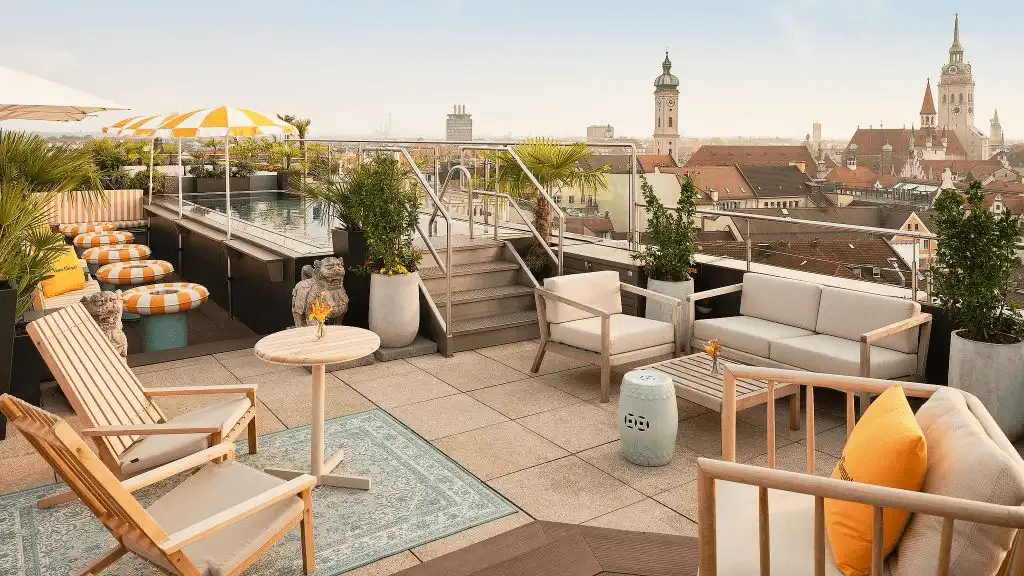
The rooftop Terrace operates as spatial dominance: 360-degree command of Munich’s red-tiled Altstadt, the twin domes of Frauenkirche, and on cloudless days, the Bavarian Alps themselves. This isn’t a view—it’s a territorial map from the elevation where the city’s original social architects surveyed their domain. The daily champagne trolley service (a custom-made cart delivering chilled Moët directly to suites each afternoon) translates 19th-century aristocratic entitlement into contemporary guest protocol.
Matsuhisa Munich anchors the ground floor—Nobu Matsuhisa’s first German venture, chosen specifically for this building’s gravity. Black Cod Miso and Yellowtail Sashimi with Jalapeños aren’t fusion experiments; they’re power cuisine served in rooms where the Kaim Orchestra (predecessor to the Munich Philharmonic) once rehearsed Wagner.
The Ory Bar extends this authority into cocktail ritual: geometric materials and dark green velvet designed to match the building’s original 1875 elegance, where avant-garde mixology operates under Neo-Renaissance vault ceilings.
The building’s biography maps Munich’s century of transformation: the municipal opera house became WWI office space for thread manufacturers, WWII damage, the failed “Antique Haus” shopping experiment, the 1990 Hotel Rafael conversion, until the Mandarin Oriental Hotel Group’s $142.5 million acquisition in 2000. Each iteration stripped away pretense until only the essential framework remained: stone turrets, medieval foundations, theatrical staircases, and the convex facade that still announces arrival authority to Maximilianstrasse.
The 100 miniature mountain paintings by Felix Rehfeld in the lobby aren’t decoration—they’re territorial markers, Alpine topography rendered as art collection. Stützel’s original vision was a social command center where Bavarian power families performed status. The Mandarin Oriental Munich inherits that function. You’re not booking a luxury hotel—you’re occupying the architectural seat where Munich’s elite have always assembled to exercise authority.
Check Availability & Rates →Where Ludwig II’s debutante elite commanded Neo-Renaissance ballrooms above medieval battlements, the Mandarin Oriental Munich translates 150 years of Bavarian social dominance into suites where Nymphenburg porcelain, rooftop Alpine vistas, and champagne trolley rituals confirm: this building still operates as Munich’s architectural power seat.
FAQ: Mandarin Oriental Munich
What makes Mandarin Oriental Munich historically significant?
The hotel occupies the 1875 “Centralsäle,” a Neo-Renaissance ballroom complex built by architect Johann Kilian Stützel under King Ludwig II for Munich’s aristocratic elite. The building originally functioned as the city’s municipal opera house and debutante presentation venue. Restoration revealed 56 meters of Munich’s 13th-century medieval city wall preserved in the cellars, making it one of the few hotels globally where guests inhabit a site with verified 800-year foundations. The Tower Suites occupy original stone turrets from the building’s defensive architecture.
What are the Tower Suites at Mandarin Oriental Munich?
The Tower Suites are circular accommodations built into the hotel’s original 1875 Neo-Renaissance stone turrets. These architectural singularities feature curved bedrooms and sitting rooms with custom Nymphenburg Royal Porcelain Manufactory reliefs depicting Bavarian Alpine massifs. Prince Charles reportedly stayed in Room 608, the most distinctive turret suite. The circular design wasn’t aesthetic choice—it was 19th-century defensive architecture now converted into guest quarters, making them unreplicable accommodations that can’t exist in modern construction.
Does Mandarin Oriental Munich have a Michelin-starred restaurant?
The hotel houses Matsuhisa Munich, celebrity chef Nobu Matsuhisa’s first German restaurant. While not Michelin-starred, it serves globally recognized Japanese-Peruvian fusion cuisine including signature Black Cod Miso and Yellowtail Sashimi with Jalapeños. The restaurant occupies ground-floor spaces where the Kaim Orchestra (predecessor to the Munich Philharmonic) once rehearsed. The Ory Bar offers avant-garde cocktails in a setting designed with geometric materials matching the building’s original 1875 Neo-Renaissance elegance.
What views does the rooftop terrace offer?
The 7th-floor Terrace provides 360-degree command of Munich’s Altstadt, including direct sightlines to the Frauenkirche’s twin domes and the Bavarian Alps on clear days. This elevation represents the same vantage point where the building’s original architect Johann Kilian Stützel designed the “Centralsäle” to dominate Maximilianstrasse. The terrace operates as spatial authority—territorial mapping from the city’s historic social command center—not merely scenic observation. Daily champagne trolley service delivers chilled Moët directly to this rooftop position.
The Architecture Where Bavarian Power Still Assembles
From Ludwig II’s debutante stages to medieval foundations supporting Japanese soaking tubs, the Mandarin Oriental Munich operates as Munich’s uninterrupted seat of architectural authority. The convex facade still announces the same message Stützel designed in 1875: Bavaria’s elite have assembled.
For stays that inherit similar royal lineage and territorial command, explore Hotel Bayerischer Hof and Vier Jahreszeiten Kempinski Munich—where Munich’s historic power architecture continues to define modern prestige.
For more curated itineraries and luxury-focused travel insights, visit Your Luxury Guide. For official travel information and destination updates, visit Germany tourism-info.
Your Luxury Guide — Where Exceptional Travel Begins.