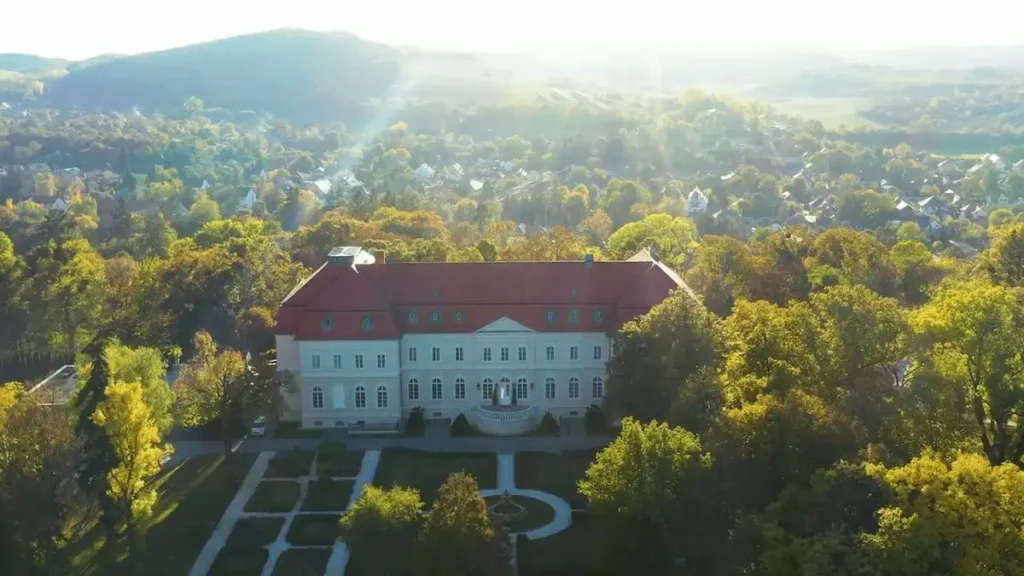
La Contessa Castle Hotel restores the 19th-century hierarchical order of Hungarian landed aristocracy, where the manor house functioned as the administrative and social nucleus of vast territorial holdings. Located in Szilvásvárad within the Bükk National Park, this estate represents the architectural consolidation of regional authority—a physical manifestation of the agrarian elite’s dominance over the surrounding forests, waterways, and villages.
The thick masonry walls and elevated positioning replicate the defensive logic of earlier fortifications while asserting social separation from the common world below. Today’s guest occupies the same commanding position once reserved for the landowning class, inhabiting spaces designed to enforce hierarchy through scale, material permanence, and strategic landscape control.
Discover more properties where historical authority translates into modern exclusivity at the best castle hotels across Hungary.
La Contessa Castle Hotel ★★★★
The estate’s 19th-century construction coincided with Hungary’s post-revolutionary consolidation, when aristocratic families reasserted territorial control through architectural statements of permanence. La Contessa functions as a preserved example of the manor house typology—not a defensive military structure, but a social fortress designed to maintain class boundaries through spatial organization.
The La Contessa’s original purpose as the administrative center of extensive forest and agricultural holdings remains legible in its layout: formal reception spaces that demonstrated wealth to visiting peers, private family quarters insulated from service areas, and utilitarian wings housing the estate’s operational machinery.
The Bükk Mountain location provides natural barriers that enhance the property’s isolation, with the surrounding national park creating a modern equivalent of the historical estate’s controlled territory. The manor’s elevation and positioning replicate medieval defensive advantages while serving 19th-century social requirements—visibility from the approach road established the owner’s dominance long before visitors reached the entrance. This geographic authority remains intact, with contemporary guests inheriting the same psychological command over the landscape.
Interior restoration maintains the hierarchical spatial logic: grand staircases designed to showcase arriving elite, high-ceilinged public rooms that dwarf individual presence, and private chambers scaled to assert personal dominance.
The property’s integration of modern amenities occurs within original structural frameworks—spa facilities occupy former service wings, contemporary dining operates in historic reception halls, and guest suites inhabit the family quarters where landed families once planned territorial management. Every architectural decision reflects the original mandate: demonstrate authority through material investment, enforce social hierarchy through spatial control, and establish permanent family legacy through structural permanence.
The surrounding Szilvásvárad village retains the settlement pattern typical of Hungarian estate towns—compact worker housing clustered around the manor’s resource extraction operations, with the castle maintaining physical and visual dominance. The nearby Lipizzaner stud farm represents another layer of aristocratic authority, as horse breeding operations functioned as status demonstrations among competing noble families.
La Contessa’s guests now occupy the apex of this preserved social geography, inhabiting the building designed to command both landscape and local population.
Check Availability & Rates →La Contessa Castle Hotel preserves the territorial psychology of Hungarian landed aristocracy, where manor house masonry enforced social separation and architectural scale demonstrated permanent regional dominance over forest, field, and settlement.
FAQ: La Contessa Castle Hotel
What historical significance does La Contessa Castle Hotel hold?
La Contessa Castle Hotel occupies a 19th-century Hungarian manor house that served as the administrative center for aristocratic territorial holdings in the Bükk Mountains. The estate represents post-revolutionary consolidation architecture, where landed families reasserted social dominance through permanent masonry structures that commanded forests, agricultural operations, and local settlements.
What makes La Contessa Castle Hotel architecturally significant?
The property exemplifies Hungarian manor house typology designed to enforce class hierarchy through spatial organization—formal reception spaces for peer demonstration, elevated positioning for landscape dominance, and thick masonry construction that replicated defensive fortress logic for social rather than military purposes.
What amenities does La Contessa Castle Hotel offer?
Contemporary facilities integrate within original estate structures: spa services in converted service wings, dining in historic reception halls, and guest suites occupying former family quarters. The property maintains its geographic authority within Bükk National Park, providing the territorial isolation once created by private landholdings.
How does La Contessa Castle Hotel’s location enhance exclusivity?
Positioned in Szilvásvárad within protected national parkland, the estate replicates historical isolation through natural barriers. The surrounding village preserves 19th-century settlement patterns centered on manor dominance, with the castle maintaining its original visual and physical command over the regional landscape and the renowned Lipizzaner horse breeding operations.
From Bükk Mountain Authority to Lillafüred Legacy
La Contessa Castle Hotel demonstrates how 19th-century Hungarian aristocracy translated territorial control into architectural permanence, creating manor houses that functioned as regional command centers. The guest inherits this hierarchical positioning, occupying spaces designed to assert social dominance through material investment and strategic landscape control.
For those seeking properties where architectural legacy extends beyond single estates into broader regional authority, explore Hotel Palota Lillafüred, where palace-scale construction consolidated industrial and administrative power within a single monumental structure overlooking managed forest territories.
For more curated itineraries and luxury-focused travel insights, visit Your Luxury Guide. For official travel information and destination updates, visit Hungary tourism-info.
Your Luxury Guide — Where Exceptional Travel Begins.