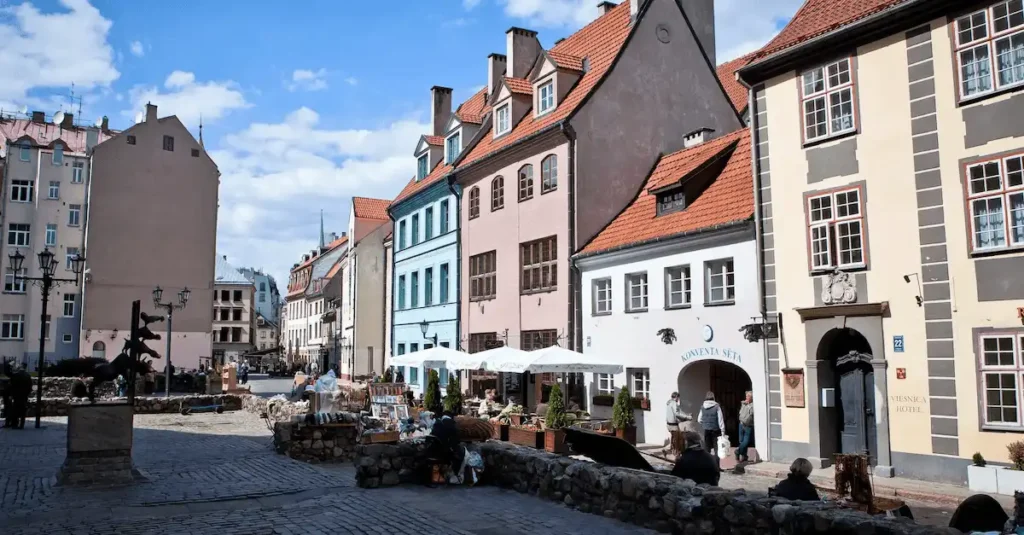
Konventa Seta Hotel operates across seven interconnected 13th-century buildings that once housed the Order of Brothers of the Sword, the crusader knights who conquered Riga. After the knights relocated, the site became the Holy Spirit Convent, serving widows and the poor for centuries.
Today, following a 2023 renovation that exposed original city wall fragments and medieval timber beams, the property functions as a 161-room urban sanctuary. Guests navigate private courtyards and cobblestone alleys unchanged since the 1700s, inhabiting the same defensive architecture that sheltered Baltic nobility and religious orders for eight centuries.
Konventa Seta Hotel ★★★★
This is not a hotel adapted from history—it is history adapted for modern residence. Konventa Seta occupies the first fortified compound built by the Livonian Order after their 1201 conquest of Riga. When the crusader knights outgrew this cluster of defensive structures and moved to their larger castle, they left behind a maze of stone buildings that became the Holy Spirit Convent.
Konventa Seta Hotel provides a unique “city-within-a-city” experience, housing guests inside a meticulously restored 13th-century complex that has evolved from a crusader castle to a serene sanctuary in the heart of Riga’s Old Town.
For the next 800 years, this site served as a shelter for widows, a blacksmith’s forge, a stable complex, and eventually a residential quarter managed by the “Grey Sisters”—the nuns who gave one of the seven buildings its enduring name.
The 2023 transformation by the Keystone Collection stripped away centuries of plaster to reveal what had been sealed inside: fragments of the original 13th-century city wall, hand-hewn oak beams blackened by age, and limestone masonry carved when Riga was nothing more than a wooden riverside settlement.
These elements now form the structural vocabulary of 161 rooms and suites, where exposed medieval stone meets Scandinavian minimalism. The layout is deliberately disorienting—a vertical labyrinth of split-level corridors, narrow staircases, and internal courtyards that reflect eight centuries of unplanned urban growth. Guests do not walk through hallways; they navigate lanes.
The property’s defensive architecture creates an unintended modern luxury: acoustic isolation. Because the seven buildings form an inward-facing courtyard circle—a medieval design meant to repel attackers—the rooms facing the internal alleys are insulated from the tourist traffic that saturates Old Riga’s main streets. You are 200 meters from the Riga Cathedral and the House of the Blackheads, yet the soundscape inside resembles a Scandinavian countryside retreat. This is urban living designed for silence, preserved by accident and now marketed as intentional exclusivity.
The ground floor integrates contemporary Riga culture without disrupting the medieval framework. “Two More Beers” occupies the former stable vaults, functioning as a specialized beer restaurant with 30+ Baltic craft taps. Next door, “Cruffins” operates a patisserie concept in what was once a convent kitchen.
Both venues serve the internal courtyard terrace, the largest private outdoor dining space in Old Riga, where breakfast tables sit beneath the same stone arches that once sheltered Hanseatic merchants and Livonian knights.
This is not a historic hotel that merely references its past in lobby plaques. The past is the architecture. You sleep within the city wall. You descend staircases carved before the Reformation. You drink coffee in courtyards where medieval widows once queued for bread. The history is not curated—it is structural, unavoidable, and still functional after 800 years.
Check Availability & Rates →Konventa Seta does not ask you to imagine medieval Riga—it locks you inside its original defensive perimeter, where the crusader knights first slept, and where the city wall still stands as your bedroom’s fourth side.
FAQ: Konventa Seta Hotel
What makes Konventa Seta Hotel historically significant?
The property occupies the first fortified residence built by the Livonian Order (Order of Brothers of the Sword) after they conquered Riga in 1201. After the knights relocated, the site became the Holy Spirit Convent, serving as a refuge for widows and the poor. The seven buildings preserve 13th-century city wall fragments, medieval timber beams, and the original courtyard layout from the 1700s.
How many buildings make up Konventa Seta Hotel?
Seven interconnected historic structures form the complex, including the House of the Grey Sisters and the “White Dove” and “Black Dove” buildings. These structures were originally constructed between the 1200s and 1700s as residences, forges, stables, and religious shelters, creating a private urban enclave within Old Riga.
What type of rooms does Konventa Seta offer?
The hotel provides 161 rooms and suites across its seven buildings, ranging from compact boutique singles to expansive family suites. All rooms feature exposed medieval masonry, individual climate control, high-speed WiFi, espresso makers, and smart TVs integrated into the 13th-century stone architecture.
Is Konventa Seta Hotel pet-friendly?
Yes. Unlike most heritage properties in Old Riga, Konventa Seta maintains a pet-friendly policy, allowing guests to stay with animals while accessing the surrounding pedestrian-only cobblestone zones immediately outside the property’s private courtyards.
The Last Crusader Compound Still Standing
Konventa Seta is not a reconstruction. It is the only surviving residential complex from Riga’s crusader period still functioning as originally designed—a fortified urban retreat where narrow lanes protect residents from the chaos beyond the gates. The stones remember the Livonian knights. The courtyards still shelter guests the way they sheltered nuns and merchants. History here is not decorative. It is load-bearing.
If you seek accommodations where the past is structural rather than cosmetic, consider the Grand Palace Hotel Riga or Dome Hotel Riga, both offering similar heritage authenticity within minutes of this medieval quarter.
For more curated itineraries and luxury-focused travel insights, visit Your Luxury Guide. For official travel information and destination updates, visit Latvia tourism-info.
Your Luxury Guide — Where Exceptional Travel Begins.