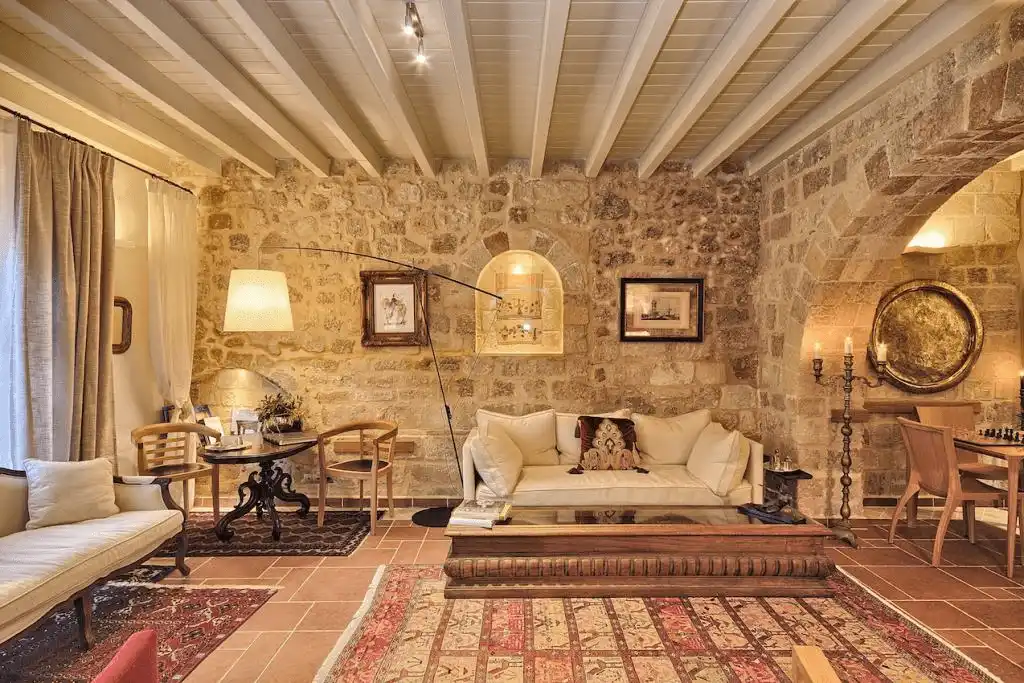
Kokkini Porta Rossa stands at the southern threshold of Rhodes’ Medieval Old Town, a meticulously preserved 14th-century residence built in 1340 for the Knight commanding St. John’s Gate—the Red Gate that still guards the UNESCO fortress.
With only six suites named after the residence’s historical occupants and a Michelin Key distinction, this is not accommodation but inhabitation of verified military authority.
Travelers seeking properties where historical command translates into modern exclusivity will find further options among the best historic hotels in Rhodes.
Kokkini Porta Rossa ★★★★★
The residence operates from a position of architectural scarcity. In 1340, when the Knights Hospitaller fortified Rhodes as their Mediterranean stronghold, this building was constructed not as decoration but as functional command—the private quarters of the Knight responsible for defending the southern gate.
Kókkini Porta Rossa offers a rare stay within a 14th-century Knight’s residence, where just six suites provide an ultra-private sanctuary steeped in the 700-year history of the Rhodes Old Town.
The structure’s proximity to St. John’s Gate was deliberate: the occupant needed immediate access to the fortification he controlled. Guests today sleep in rooms where military decisions were made, where the defense of one of medieval Europe’s most strategic outposts was coordinated.
The building presents six suites, each carrying the name of a documented resident. This is nomenclature as provenance—every suite title references a verified individual who inhabited these walls during the Knights’ 213-year occupation of Rhodes. The property does not invent heritage; it catalogs it.
The suites themselves marry museum-grade preservation with contemporary infrastructure: original stone archways frame climate-controlled interiors, medieval flagstones lie beneath underfloor heating, fortress walls now insulate against sound rather than siege.
Spatial positioning reinforces exclusivity. The southern edge of the Medieval Old Town receives a fraction of the foot traffic that floods the northern commercial quarters, yet remains inside the UNESCO-protected fortress perimeter.
St. John’s Gate—Kokkini Porta—functions as both historical landmark and private threshold. Guests enter the Old Town through the same aperture the Knight once defended, crossing from modern Rhodes into a preserved medieval grid where the residence sits within 40 meters of the gate itself.
The Michelin Key designation confirms what structural evidence already establishes: this is hospitality executed at the intersection of historical authenticity and operational precision. The recognition was not awarded for luxury alone but for the property’s successful translation of 14th-century architecture into 21st-century utility without aesthetic compromise.
The six-suite limitation is not boutique branding but physical reality—the original footprint cannot support expansion without destroying the fabric that justifies the stay.
Check Availability & Rates →To occupy Kokkini Porta Rossa is to inhabit the calculus of medieval defense—where proximity to the gate meant proximity to power, and the Knight’s residence stood as the first line of command in a fortress that controlled Mediterranean passage for two centuries.
FAQ: Kokkini Porta Rossa
What makes Kokkini Porta Rossa historically significant?
Built in 1340 as the private residence for the Knight commanding St. John’s Gate, Kokkini Porta Rossa served as both living quarters and strategic command post during the Knights Hospitaller’s fortification of Rhodes. Its location directly inside the gate it defended makes it one of the few properties where medieval military function and modern hospitality occupy the same physical footprint.
How many suites does Kokkini Porta Rossa offer?
The property contains six individually designed suites, each named after a documented historical resident of the house. The limited number reflects the building’s original 14th-century structure, which cannot accommodate expansion without compromising the architectural integrity that earned it Michelin Key recognition.
Where exactly is Kokkini Porta Rossa located within Rhodes Old Town?
The residence sits at the quiet southern perimeter of the UNESCO-listed Medieval Old Town, within 40 meters of St. John’s Gate (Kokkini Porta). This positioning places guests inside the fortress walls while avoiding the commercial density of the northern quarters, offering both historical immersion and practical seclusion.
What does the Michelin Key designation indicate about Kokkini Porta Rossa?
The Michelin Key confirms the property’s successful integration of museum-grade heritage preservation with high-end operational standards. The recognition acknowledges not just luxury but the rare execution of historical authenticity without sacrificing modern utility—a balance particularly difficult to achieve in a 680-year-old structure.
The Authority of Position
Kokkini Porta Rossa preserves the physical infrastructure of medieval command. The Knight who first occupied these rooms in 1340 required immediate access to the gate, direct sightlines to approaching threats, and residential space that doubled as tactical headquarters. Those requirements shaped the building’s architecture, and that architecture now shapes the guest experience.
To stay here is to occupy the same spatial logic that once governed the defense of Rhodes, where position determined power and proximity to the gate meant proximity to authority.
Travelers seeking similar properties where historical function defines modern prestige should consider Grande Albergo delle Rose, another Mediterranean landmark where institutional legacy elevates the contemporary stay.
For more curated itineraries and luxury-focused travel insights, visit Your Luxury Guide. For official travel information and destination updates, visit Greece tourism-info.
Your Luxury Guide — Where Exceptional Travel Begins.