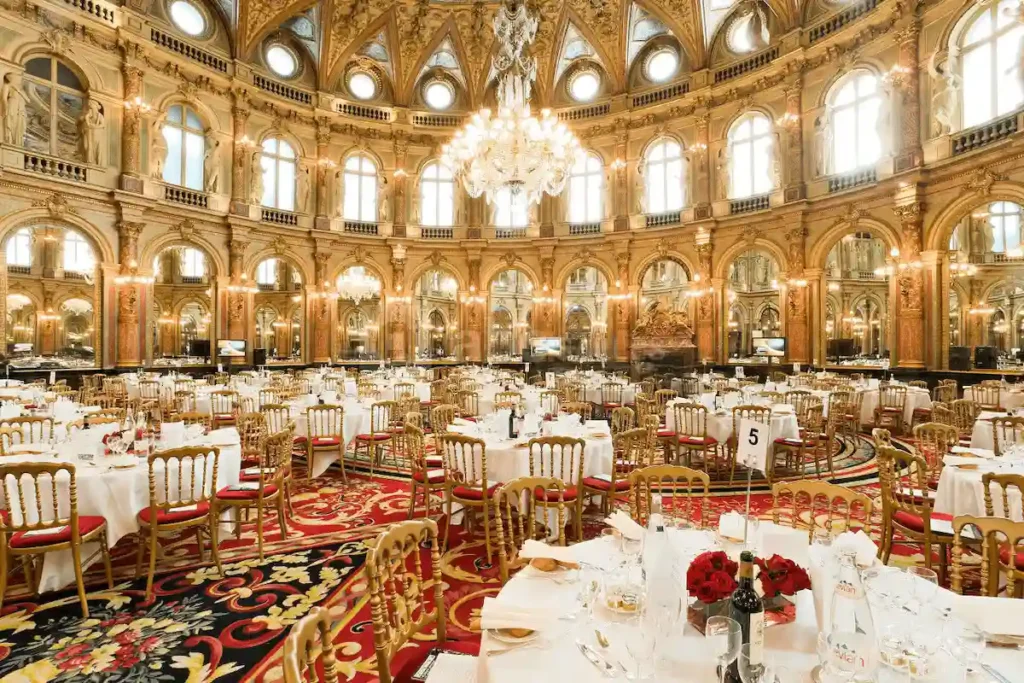
The InterContinental Paris Le Grand occupies the apex of Haussmann’s Second Empire Paris—commissioned in 1862 by Napoleon III as Grand Hôtel de la Paix to serve as the official hospitality monument for his reconstruction of the capital. Positioned directly on Place de l’Opéra, this was not merely a hotel but the empire’s formal reception hall where heads of state and industrial magnates convened during Paris’s ascent as Europe’s power center.
The building’s 470 rooms hosted world expositions, diplomatic negotiations, and the cultural elite who defined the Belle Époque. Today’s guest inhabits the same command geography where imperial authority once orchestrated France’s industrial and cultural dominance.
Discover more properties of this caliber among the best historic hotels in Paris.
InterContinental Paris Le Grand ★★★★★
When Napoleon III commissioned architect Alfred Armand to design Grand Hôtel de la Paix in 1862, the directive was explicit: create the most technologically advanced hospitality structure in Europe to announce France’s Second Empire supremacy. Armand delivered a 700-room palace engineered with hydraulic elevators, central heating, and private bathrooms—unprecedented infrastructure that positioned the property as a mechanical marvel.
The hotel opened in May 1862 as the centerpiece of Baron Haussmann’s urban transformation, anchoring the newly created Place de l’Opéra where twelve radiating boulevards converged. This was strategic urban dominance: the hotel commanded sightlines to Palais Garnier while providing direct access to the financial district, establishing it as the operational headquarters for visiting diplomats and industrialists.
InterContinental Paris Le Grand has served as a center of Parisian social life since its inauguration, housing the legendary Salon Opéra, the city’s most spectacular protected ballroom.
The property’s public spaces were designed as extensions of imperial state rooms. The 380-square-meter Salon Opéra, with its 6-meter-high ceilings, soaring columns, and original 1867 crystal chandeliers, functioned as the empire’s unofficial reception hall—hosting treaty signings, royal delegations, and the 1878 Universal Exposition’s central banquets.
The adjacent Café de la Paix, opened simultaneously in 1862 under Empress Eugénie’s patronage, became the documented gathering point for Émile Zola, Guy de Maupassant, and Oscar Wilde—writers who leveraged the café’s central location to observe and document Paris’s transformation into Europe’s cultural capital. These were not decorative spaces but functional command centers where political and artistic authority intersected.
Today’s 478 rooms and suites occupy the same architectural footprint, with Grand Deluxe Suites positioned in original corner turrets that offer unobstructed views across Place de l’Opéra to Palais Garnier. The 180-square-meter Opéra Suite maintains its Second Empire ceiling frescoes and marble fireplace while integrating contemporary infrastructure—climatization systems concealed within original moldings, fiber-optic networks embedded in 19th-century parquet.
The 1,200-square-meter wellness level, installed in former basement service quarters, features hammam chambers and treatment rooms positioned within the original stone vaults that once stored provisions for state banquets. This is not retrofitted luxury but architectural continuity where modern utility operates within imperial-scale infrastructure.
The hotel’s position at 2 Rue Scribe places guests at the literal center of Parisian command geography. Palais Garnier stands 150 meters east; the Louvre’s Richelieu Wing 800 meters west; Place Vendôme’s haute joaillerie district 600 meters south. This proximity is inherited advantage—Napoleon III designed Haussmann’s boulevards to radiate from this exact intersection, making the hotel’s entrance the fixed point from which imperial Paris was measured.
Guests occupy the same strategic coordinates where 19th-century power exercised spatial dominance over Europe’s most influential city.
Check Availability & Rates →To stand in the Salon Opéra is to inhabit the precise coordinates where Second Empire authority staged its diplomatic theater—where crystal chandeliers illuminated treaty negotiations and Belle Époque society formalized its cultural hierarchies beneath 6-meter coffered ceilings that still echo with the measured cadence of imperial command.
FAQ: InterContinental Paris Le Grand
What is the historical significance of InterContinental Paris Le Grand?
Commissioned by Napoleon III in 1862 as Grand Hôtel de la Paix, the property served as the official hospitality monument for Second Empire Paris, positioning it at Place de l’Opéra as the strategic center of Haussmann’s urban reconstruction and hosting diplomatic delegations during France’s industrial ascendancy.
What original architectural features remain at the InterContinental Paris Le Grand?
The 380-square-meter Salon Opéra retains its 1867 crystal chandeliers, 6-meter coffered ceilings, and original marble columns. Grand Deluxe Suites preserve Second Empire ceiling frescoes, period fireplaces, and Haussmann-era window configurations overlooking Place de l’Opéra.
Why is the InterContinental Paris Le Grand’s location historically important?
The hotel occupies the exact intersection of twelve Haussmann boulevards radiating from Place de l’Opéra, making it the geometric center of Napoleon III’s Paris redesign and providing direct sightlines to Palais Garnier, the Louvre, and the financial district—strategic positioning that defined imperial urban command.
What notable figures have stayed at the InterContinental Paris Le Grand?
The property’s guest registers document visits from Empress Eugénie, who patronized Café de la Paix; writers Émile Zola, Guy de Maupassant, and Oscar Wilde, who used the café as their Parisian base; and international heads of state attending the 1878 Universal Exposition hosted in the Salon Opéra.
Napoleon III’s Architecture Commands Modern Paris
The InterContinental Paris Le Grand translates Second Empire engineering into contemporary operational advantage—where 1862’s most advanced hospitality infrastructure establishes today’s standard for Place de l’Opéra access and Belle Époque spatial authority. This is inherited command geography: the exact coordinates where Napoleon III positioned his empire’s diplomatic reception hall now define modern Paris’s most strategically located luxury accommodation.
Continue exploring this echelon of Parisian authority at Le Bristol Paris and Shangri-La Paris.
For more curated itineraries and luxury-focused travel insights, visit Your Luxury Guide. For official travel information and destination updates, visit France tourism-info.
Your Luxury Guide — Where Exceptional Travel Begins.