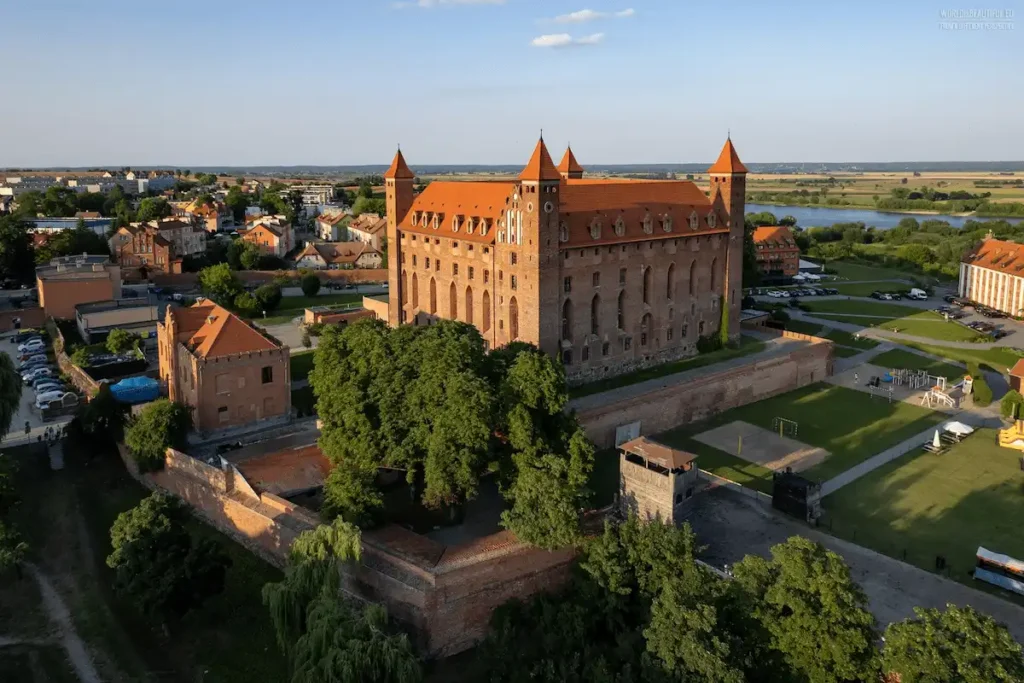
Hotel Zamek Gniew delivers territorial authority within a 1290 Teutonic Order fortress. This is not decorative medievalism—you occupy the defensive architecture that controlled the lower Vistula trade corridor for three centuries. The castle’s 40-meter brick walls, perimeter towers, and strategic elevation above the river represent the physical infrastructure of medieval martial dominance.
The Teutonic Knights constructed this site as an administrative and military command center, one of 18 fortress-monasteries that enforced Order rule across Prussia and Pomerania. Modern guests inherit the spatial hierarchy: vaulted ceremonial halls where Grand Masters received tribute, tower chambers that surveyed enemy movements, battlements designed to repel siege warfare. This is verified 13th-century sovereign architecture adapted to four-star residential luxury. Explore the complete portfolio of best castle stays across Poland.
Hotel Zamek Gniew ★★★★
The castle’s founding reflects calculated territorial expansion. In 1290, the Teutonic Order acquired Gniew (then Mewe) and immediately commenced construction of a brick fortress using Gothic defensive engineering—perpendicular walls reinforced by corner towers, interior courtyards designed for garrison assembly, dual-gate barbican systems preventing direct entry penetration.
By 1340, the castle functioned as the administrative seat for the Gniew Commandery, managing surrounding agricultural estates and river tolls that financed crusade operations. The structure’s strategic value derived from its elevation: positioned 30 meters above the Vistula, the fortress commanded unobstructed sightlines across 8 kilometers of river traffic, enabling control of grain shipments moving from Polish territories toward Baltic ports.
Hotel Zamek Gniew stands as one of Poland’s most formidable Gothic strongholds, offering a regal experience that spans three historic buildings: the medieval Teutonic Castle, the Baroque Marysieńka Palace, and the four-star Knights’ Hotel.
The architectural footprint confirms institutional permanence. The main residential wing housed the castle commander and knight-brothers in individual cells arranged along defensive galleries. The refectory occupied the eastern wing—a triple-vaulted hall where communal meals reinforced monastic discipline. The chapel tower rose five stories, its bells summoning troops and marking liturgical hours that structured garrison life.
Guest accommodations now occupy the former knight quarters and commander chambers. Rooms feature exposed medieval brickwork, timber beam ceilings original to the 14th-century construction, and views across the Vistula floodplain that once required constant military surveillance. The Great Hall functions as the primary banquet venue—14-meter vaulted ceilings, stone fireplace reconstructed using period masonry techniques, capacity for formal dining beneath heraldic banners.
The castle courtyard hosts medieval reenactments and tournament demonstrations that utilize the original jousting grounds, allowing guests to witness armored combat within authentic defensive perimeters.
The property’s restoration maintains defensive authenticity. The perimeter walls retain their full circuit walk, accessible via stone staircases worn by seven centuries of sentry rotations. Tower chambers have been converted to specialty suites, preserving original arrow-slit windows and conical roof structures.
The gatehouse barbican—twin towers flanking the entrance passage—operates as the reception area, guests entering through the same fortified threshold that received Teutonic supply convoys and diplomatic delegations.
Modern amenities integrate without architectural compromise. The wellness center occupies reconstructed storerooms beneath the north wing, vaulted cellars that originally held grain reserves and armament supplies. The restaurant sources ingredients from surrounding Pomeranian estates, continuing the castle’s historical role as an agricultural command hub. Meeting facilities utilize the Chapter House, where Teutonic commanders once convened to adjudicate land disputes and plan military campaigns.
The castle’s dissolution came in 1454 when the Prussian Confederation seized Gniew during the Thirteen Years’ War, transferring control to the Polish Crown. Despite subsequent Swedish occupation during the Deluge (1655–1660) and Prussian annexation in 1772, the fortress infrastructure survived largely intact, its masonry quality ensuring structural permanence through regime changes.
Modern guests occupy a verified Teutonic command center, its defensive architecture unaltered by cosmetic medievalism.
Check Availability & Rates →Hotel Zamek Gniew positions you within the Teutonic Order’s territorial machinery—authentic 13th-century fortifications where medieval martial authority becomes residential sovereignty, commanding the Vistula from battlements that once enforced crusader dominance across Prussia.
FAQ: Hotel Zamek Gniew
Is Hotel Zamek Gniew an authentic Teutonic castle?
Yes. The fortress was constructed in 1290 by the Teutonic Order as the administrative seat of the Gniew Commandery. Original defensive walls, towers, and vaulted halls remain structurally intact, with documented evidence confirming continuous occupation since the 13th century.
What medieval architectural features are preserved at the castle?
The property retains its 40-meter brick perimeter walls, corner defense towers, dual-gate barbican entrance, vaulted refectory hall, chapel tower, and courtyard jousting grounds. Guest rooms occupy restored knight quarters with exposed 14th-century brickwork and original timber ceilings.
What historical role did Gniew Castle serve for the Teutonic Knights?
Gniew functioned as a strategic command fortress controlling Vistula River trade routes. The castle administered surrounding agricultural estates, collected river tolls, and garrisoned troops defending the Order’s southern frontier against Polish and Lithuanian forces during the 14th century.
What modern amenities does Hotel Zamek Gniew provide?
The castle offers four-star accommodations within medieval chambers, a wellness center in reconstructed vaulted cellars, restaurant serving Pomeranian cuisine, Great Hall banquet venue, and conference facilities in the historic Chapter House. All modern services integrate without compromising architectural authenticity.
The Sovereign Architecture of Medieval Poland
Hotel Zamek Gniew confirms that authentic Teutonic fortress architecture translates directly into residential command. This is territorial authority verified through 730 years of strategic dominance—documented military infrastructure where guests now exercise the spatial privileges once reserved for Grand Masters and knight-commanders.
The castle’s unbroken defensive perimeter, original garrison quarters, and Vistula command position deliver an experience unavailable in reconstructed properties: you inhabit verified crusader sovereignty within a fortress designed to enforce institutional permanence through siege-resistant masonry and military-grade territorial control.
Continue your command of Poland’s fortress heritage at Hotel Zamek Ryn.
For more curated itineraries and luxury-focused travel insights, visit Your Luxury Guide. For official travel information and destination updates, visit Poland tourism-info.
Your Luxury Guide — Where Exceptional Travel Begins.