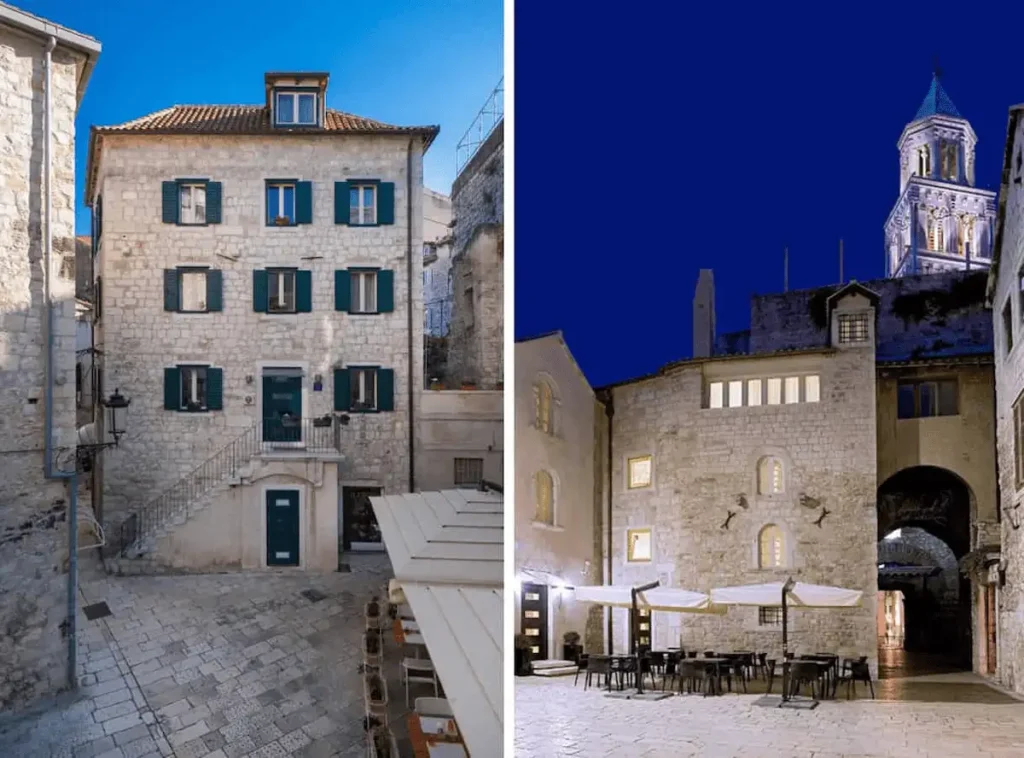
Hotel Vestibul Palace is not adjacent to history—it is history. Built directly into the Vestibul, the 4th-century imperial entrance hall of Emperor Diocletian’s Palace, this 7-room property occupies one of the most architecturally significant positions in Roman antiquity.
The structure merges three construction periods—Roman, Romanesque, Gothic—into a single UNESCO-protected address. Guests inhabit the exact threshold where Roman officials once crossed into imperial quarters. This is not heritage-themed luxury; this is certified monument accommodation where every stone carries documented imperial function. Explore more exceptional properties among the best historic hotels in Split.
Hotel Vestibul Palace ★★★★
The Hotel Vestibul Palace operates within Emperor Diocletian’s original entrance hall—a circular, domed rotunda constructed in 305 AD to regulate access to the imperial residential wing. This is not architectural proximity; this is structural integration. The building’s position between the Peristyle square and the Emperor’s private apartments made it the empire’s most scrutinized threshold. Every visitor to Diocletian passed through this exact space under imperial review.
Hotel Vestibul Palace is an architectural marvel located in the literal heart of Diocletian’s Palace, where guest rooms are carved into 1,700-year-old Roman stone walls once used as the private quarters of the Emperor.
The property consists of only 7 guest rooms in the main Palace structure, plus 4 additional rooms in the adjacent Villa and Annex. This scarcity is not marketing; it is architectural constraint. The UNESCO World Heritage designation limits all modifications, meaning the hotel preserves the original Roman floor plan, wall thicknesses, and load-bearing patterns.
The restoration strategy was minimalist precision—exposed stone walls remain “naked,” stripped to their 4th-century brick patterns, while modern interventions use glass and steel to create high-contrast luxury without competing with ancient textures.
Guest rooms feature in-wall Roman niches and original brickwork that have remained exposed for nearly two millennia. The central lobby operates beneath a glass roof that opens directly to the ancient Vestibul tower’s circular aperture, allowing unobstructed vertical views through Roman engineering. Furniture is custom-fabricated from dark oak and steel, designed specifically to maintain visual subordination to the monumental stone architecture.
The adjacent Vestibul rotunda functions as a living acoustic instrument. Its natural reverberation properties—created by precise Roman dome geometry—attract daily performances by traditional Klapa a cappella groups. Guests experience this phenomenon from within their rooms, where ancient stone amplifies vocal harmonics through structural resonance.
The hotel’s restaurant and bar occupy additional Roman chambers within the palace complex, sourcing micro-regional Dalmatian ingredients and premium local olive oils. Despite operating in a pedestrian-only UNESCO zone, the property provides specialized porter service and private vehicle transfers to designated parking outside the medieval walls. The concierge arranges private after-hours access to Diocletian’s Palace cellars and restricted medieval passageways not available during public visiting hours.
Rooms integrate smart lighting, high-speed WiFi infrastructure engineered through 1.7-meter-thick fortification walls, and luxury bathrooms with walk-in showers and designer toiletries. The property maintains what can be measured as the highest “history-per-square-meter” density of any luxury hotel in Croatia—a function of operating inside a continuously inhabited Roman imperial complex for 1,700 years.
This is not a hotel near a landmark. Hotel Vestibul Palace is a structural component of one of the world’s best-preserved monuments of Roman architecture, where guests sleep within stone walls that once separated emperors from subjects.
Check Availability & Rates →To stay at Hotel Vestibul Palace is to inhabit the threshold of imperial command—where Roman authority was architecturally enforced through monumental stone, acoustic dominance, and the calculated grandeur of Diocletian’s entrance hall.
FAQ: Hotel Vestibul Palace
What makes Hotel Vestibul Palace historically significant?
Hotel Vestibul Palace occupies the original 4th-century entrance hall (Vestibul) to Emperor Diocletian’s residential quarters. Built in 305 AD, this circular domed structure served as the formal imperial gateway where all visitors were screened before entering the emperor’s private apartments. The building is a UNESCO-protected component of Diocletian’s Palace, one of the best-preserved Roman architectural complexes in the world.
How many rooms does Hotel Vestibul Palace have?
The hotel features only 7 guest rooms in the main Palace building, plus 4 additional rooms in the nearby Villa and Annex, totaling 11 rooms. This limited capacity is determined by the building’s protected status and original Roman architectural layout, which cannot be altered under UNESCO World Heritage regulations.
Can guests access parts of Diocletian’s Palace not open to the public?
Yes. Hotel Vestibul Palace concierge arranges private, after-hours guided tours of restricted areas including the palace cellars and hidden medieval walkways that are not accessible during standard public visiting hours, providing exclusive access to archaeological features within the UNESCO complex.
What architectural periods are represented in the hotel structure?
The building integrates three distinct construction periods: Roman (4th century original structure), Romanesque additions (11th century), and Gothic elements (15th century). The restoration uses minimalist glass and steel interventions to preserve and expose these layered historical periods without concealment or thematic decoration.
The Living Monument Experience
Hotel Vestibul Palace represents the convergence of imperial Roman engineering and contemporary luxury standards within a structure that has continuously functioned for seventeen centuries. Guests do not visit history here—they reside within its documented architectural authority.
For those seeking similar caliber properties where modern hospitality meets verified historical significance, consider Hotel Park Split, another distinguished address where architectural legacy defines the guest experience.
For more curated itineraries and luxury-focused travel insights, visit Your Luxury Guide. For official travel information and destination updates, visit Croatia tourism-info.
Your Luxury Guide — Where Exceptional Travel Begins.