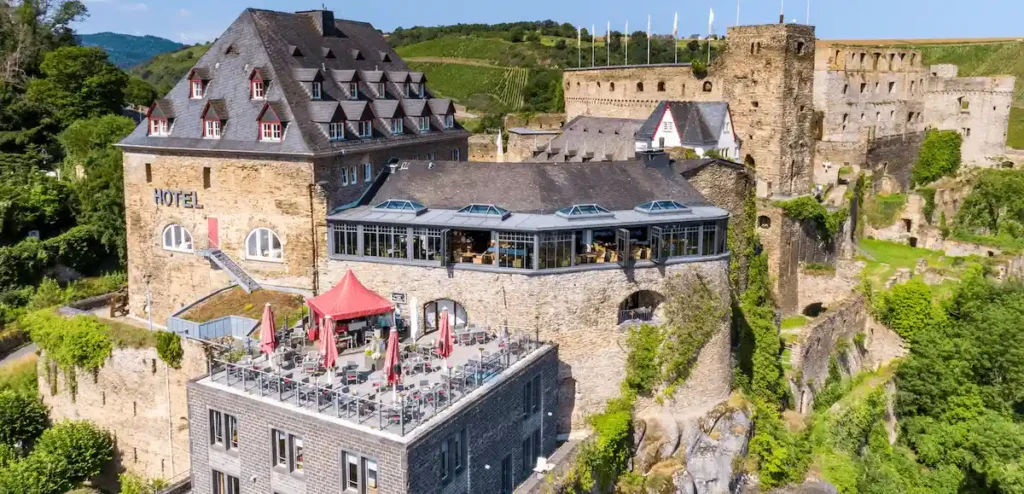
Hotel Schloss Rheinfels stands on the site where Count Diether V of Katzenelnbogen constructed the largest fortress complex on the Rhine in 1245. The castle’s strategic position 120 meters above the river controlled the narrowest navigable passage of the Middle Rhine Valley—every merchant vessel, every military flotilla, every ecclesiastical delegation passed under the visual command of this fortress.
For six centuries, Rheinfels dictated the economic flow of Northern Europe’s most vital trade artery. The modern hotel preserves this territorial authority: your suite occupies battlements where fortress commanders once levied tolls on kingdoms.
Explore the best castle hotels in Rhine Valley for similar command positions.
Hotel Schloss Rheinfels ★★★★
The fortress complex originally sprawled across five defensive rings totaling 50,000 square meters—larger than any contemporary castle on the Rhine. When French forces besieged Rheinfels in 1692 with 28,000 troops, the garrison of 4,000 defenders held the walls for six months before forcing a French withdrawal. This was not a ceremonial estate; it was engineered military dominance. The underground galleries still extend three stories beneath the hotel—650 meters of defensive tunnels where garrison troops moved unseen between bastions.
The four-star hotel operates within the original 19th-century residential wing, constructed after Napoleon’s armies finally demolished the fortress in 1797. The architecture retains the fortress scale: vaulted stone corridors, walls measuring 2.4 meters thick, and Gothic windows that frame the Rhine 120 meters below. Each of the 62 guest rooms occupies former officers’ quarters or noble apartments, with modern renovations that preserve the weight-bearing masonry and original sight lines across the gorge.
The wellness area utilizes the castle’s natural defensive topography. The indoor pool sits within a barrel-vaulted chamber hewn from Rhine Valley slate—the same geological formation that made Rheinfels impregnable to medieval siege engines. Sauna facilities occupy spaces where medieval kitchens once fed 1,200 garrison members daily. The thermal environment mirrors the fortress function: total enclosure, strategic control of access, absolute privacy from the external world.
Restaurant Landgraf commands the western tower position. The dining hall’s panoramic windows survey a 180-degree sweep of the Rhine gorge—the identical tactical vantage point where fortress commanders monitored river traffic for toll collection. Modern guests dine on regional Rhineland cuisine within a space purpose-built for territorial observation. The wine list emphasizes Rheingau and Mittelrhein appellations, the same vineyard districts that paid feudal tribute to Rheinfels for 400 years.
The castle terrace extends along the original outer battlements. From this elevation, you occupy the visual command center of the Middle Rhine: Sankt Goarshausen village lies directly below, Lorelei Rock rises 1.5 kilometers south, and river traffic moves through the narrow passage exactly as it did when fortress cannons aimed at every approaching sail. The spatial relationship between castle, river, and gorge walls creates what military engineers call “interlocking fields of fire”—you inhabit the strategic apex of the valley.
Check Availability & Rates →Rheinfels does not offer a view of the Rhine; it enforces surveillance over it. You occupy the same stone position where counts and commanders dictated passage for six centuries—the weight of fortress masonry beneath your feet is the physical architecture of medieval authority over Europe’s commercial lifeline.
FAQ: Hotel Schloss Rheinfels
What makes Hotel Schloss Rheinfels historically significant?
Hotel Schloss Rheinfels occupies the largest fortress ever constructed on the Rhine River. Count Diether V built the complex in 1245 to control the Middle Rhine toll system. The fortress successfully defended against a 28,000-strong French siege in 1692, establishing its military superiority over contemporary European powers. The hotel preserves the fortress scale and strategic position 120 meters above the river.
What fortress features are accessible to hotel guests?
Guests access 650 meters of original underground defense tunnels extending three stories beneath the hotel. The fortress ruins remain the largest castle complex in the Rhine Valley, with five defensive rings spanning 50,000 square meters. The hotel’s terrace follows the outer battlements, providing the commanding view that made Rheinfels the strategic center of Rhine Valley control.
How does the hotel’s position differ from other Rhine castle properties?
Rheinfels sits 120 meters above the narrowest navigable passage of the Middle Rhine—every vessel traveling between Basel and the North Sea passed directly beneath the fortress. This elevation created absolute visual command over river traffic. The castle’s position was selected for military dominance, not aristocratic leisure, making the hotel’s territorial authority fundamentally different from residential manor estates.
What dining experience does the castle location provide?
Restaurant Landgraf occupies the western fortress tower, offering 180-degree surveillance of the Rhine gorge from the original military observation position. The dining hall’s panoramic windows maintain the tactical sight lines fortress commanders used for toll collection. Regional Rhineland cuisine sources from the same vineyard districts and agricultural zones that paid feudal tribute to Rheinfels for four centuries.
The Rhine Fortress Circuit: Territorial Command Positions
Hotel Schloss Rheinfels defines the strategic category of Rhine Valley castle stays—properties engineered for military dominance rather than aristocratic residence. Your castle accommodation is not decorative heritage; it is the physical infrastructure that controlled Europe’s commercial lifeline for 600 years. The fortress position creates an irreversible spatial relationship: you occupy the command center, and the Rhine flows beneath.
For similar territorial command in the Moselle Valley, Schloss Lieser preserves the baronial seat that administered Moselle wine appellations. In the Ruhr industrial corridor, Schlosshotel Hugenpoet represents the moated fortress model where medieval lords enforced water-based defensive perimeters. Each property translates military architecture into the modern reality of exclusive territorial access.
For more curated itineraries and luxury-focused travel insights, visit Your Luxury Guide. For official travel information and destination updates, visit Germany tourism-info.
Your Luxury Guide — Where Exceptional Travel Begins.