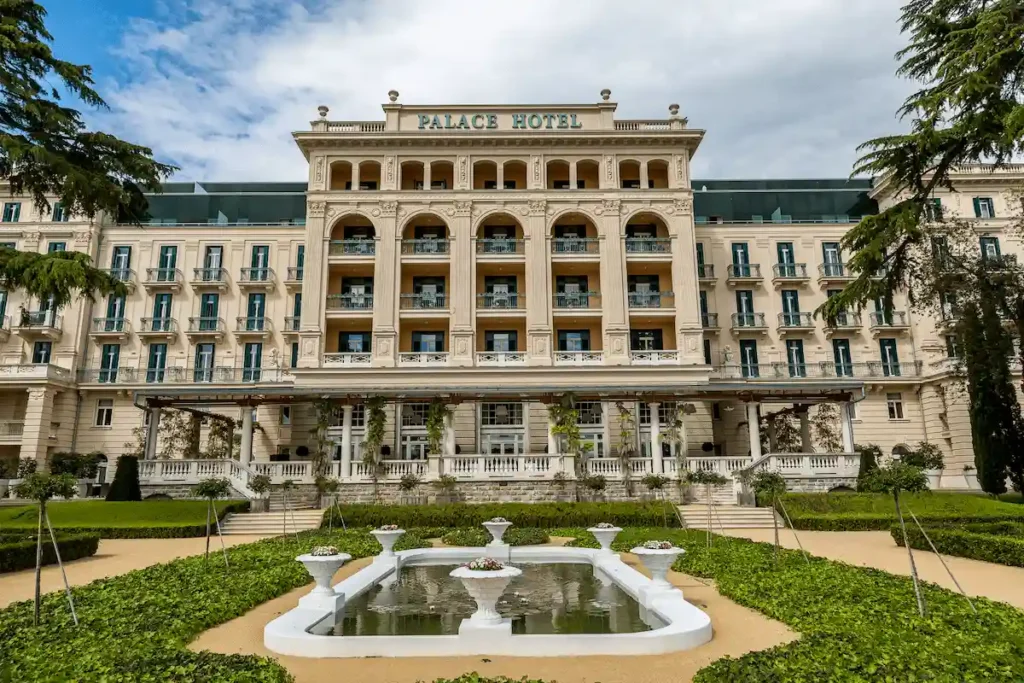
In 1910, when Johannes Eustacchio completed the Hotel Palace Portorož, he delivered the Austro-Hungarian Empire its answer to Venice’s grandest addresses. Archduke Franz Ferdinand—heir to the throne—arrived as one of its first guests, establishing the property as the coastal seat for imperial authority along what was then known as the Austrian Riviera.
Today, the Hotel Palace Portorož operates as Slovenia’s most historically significant coastal estate, where 113 years of documented dominance translate into modern exclusivity. The building’s verified lineage—from imperial playground to Tito’s private retreat, from postwar casino capital to Sophia Loren’s Adriatic sanctuary—establishes a tier of prestige unrepeatable in the region. This is where Slovenia’s elite history resides.
For comprehensive context on the country’s most authoritative historic properties, see our guide to the best historic hotels in Slovenia.
Hotel Palace Portorož ★★★★★
The Palace Hotel inherited grandeur. Eustacchio’s 1910 design fused Secession, Art Nouveau, and nascent Art Deco into a 19th-century facade that commanded the Gulf of Piran. When the Austro-Hungarian elite required coastal authority, they commissioned this palace. When Archduke Franz Ferdinand needed an Adriatic base, he chose these halls.
The building’s original Crystal Hall—still operational with its 1910 chandeliers and gold-leaf ornamentation—served as the social nerve center for imperial society. This wasn’t decoration; it was spatial dominance.
Hotel Palace Portorož is a landmark 1910 Austro-Hungarian palace and the only five-star deluxe hotel on the Slovenian Adriatic coast.
The estate’s 4.2-acre Mediterranean garden, granted “monument of designed nature” status in 1983, functions as a protected heritage park. The scale alone—mature pines, curated walking paths, direct sea access—establishes the property’s territorial command. Modern guests inhabit the same footprint where European royalty once exercised social power.
World War II brought requisition and military headquarters status. The palace survived looting, postwar restoration in the 1950s, and a transformative role as Slovenia’s first casino from 1964 to 1972, when Portorož became the Adriatic’s high-stakes destination for international players.
The jet-set era brought Sophia Loren, whose presence in the 1950s remains memorialized in the hotel’s signature fine-dining venue, Sophia.
Yugoslav leader Josip Broz Tito maintained a suite here—now the Tito Suite—using the palace for state functions and private retreats. Marcello Mastroianni, Yul Brynner, and Orson Welles followed. Chess grandmaster Bobby Fischer resided here during the 1958 Portorož Interzonal Tournament, adding intellectual weight to the property’s cultural capital.
The building’s most dramatic chapter came between 1990 and 2008, when the palace stood empty—a “sleeping beauty” for 18 years. The €70 million renovation completed in 2008 didn’t erase history; it weaponized it. The minimalist modern wing contrasts deliberately with Eustacchio’s Secession facade, creating architectural tension that mirrors the property’s dual timeline: imperial past, contemporary authority.
The 230-square-meter Presidential Suite—one of the Adriatic’s most expansive—includes a private library and an 180-degree terrace overlooking the Gulf of Piran. These aren’t amenities; they’re spatial statements.
The Rose Spa’s 1,500 square meters deliver treatments sourced from local organic ingredients and seaweed extracts, while interconnected indoor-outdoor pools use heated Mediterranean seawater year-round. The exclusive Palace Beach facility, directly across from the heritage park, offers private cabanas with the same Adriatic access the Archduke’s circle once commanded.
Fleur de Sel, the rooftop restaurant, sources salt from the 700-year-old Sečovlje Salt Pans, anchoring its Istrian-Mediterranean fusion in verified regional provenance.
This is the only Adriatic estate where Franz Ferdinand, Tito, Loren, and Fischer’s documented presence converges. The palace doesn’t promise luxury—it delivers inherited authority.
Check Availability & Rates →At Hotel Palace Portorož, guests don’t check into rooms; they assume residency within a 113-year lineage of imperial command, cinematic legend, and political power—where the Adriatic’s most verified heritage becomes the foundation of modern prestige.
FAQ: Hotel Palace Portorož
What makes Hotel Palace Portorož historically significant?
Built in 1910 by Austrian architect Johannes Eustacchio for the Austro-Hungarian Empire’s elite, Hotel Palace Portorož served as Archduke Franz Ferdinand’s Adriatic retreat. The property later hosted Yugoslav leader Tito, actress Sophia Loren, and chess grandmaster Bobby Fischer, establishing it as Slovenia’s most documented coastal power seat with 113 years of verified imperial, political, and cultural dominance.
What architectural styles define the Hotel Palace?
The palace represents a rare architectural fusion: Eustacchio’s original 1910 design combines Secession, Art Nouveau, and early Art Deco elements in a grand 19th-century facade. The 2008 renovation added a contrasting minimalist modern wing, creating deliberate architectural tension between imperial heritage and contemporary authority while preserving the original Crystal Hall with its 1910 chandeliers.
What is the Tito Suite at Hotel Palace Portorož?
The Tito Suite commemorates Yugoslav leader Josip Broz Tito’s frequent stays at the palace, where he conducted state functions and private retreats. This suite represents the property’s postwar political significance when Portorož functioned as an international diplomatic destination, attracting not only political leaders but also film stars like Marcello Mastroianni and Orson Welles.
What happened to the palace between 1990 and 2008?
Hotel Palace stood vacant for 18 years—a period called the “sleeping beauty” era—before a €70 million renovation restored and modernized the property in 2008. Rather than erase history, the restoration preserved original elements like the Crystal Hall while adding contemporary luxury infrastructure, transforming the derelict imperial landmark into Slovenia’s premier coastal heritage hotel.
The Adriatic’s Only Imperial-Era Command Post
Hotel Palace Portorož doesn’t compete with other luxury hotels—it operates in a category defined by 113 years of documented dominance. From Archduke Franz Ferdinand‘s 1910 arrival to Tito‘s state functions, from Sophia Loren‘s Dolce Vita presence to Bobby Fischer‘s residency during the 1958 chess championship, the palace accumulates authority through verified lineage. The 4.2-acre protected heritage park, the original Crystal Hall, and the 230-square-meter Presidential Suite aren’t amenities—they’re inheritances.
For travelers seeking similar historical weight on the coast, Hotel Piran offers Venetian-era maritime provenance, while Grand Hotel Toplice in Bled delivers alpine imperial legacy. At Portorož, you inhabit the seat where empires, republics, and cinematic legends all exercised coastal authority.
For more curated itineraries and luxury-focused travel insights, visit Your Luxury Guide. For official travel information and destination updates, visit Slovenia tourism-info.
Your Luxury Guide — Where Exceptional Travel Begins.