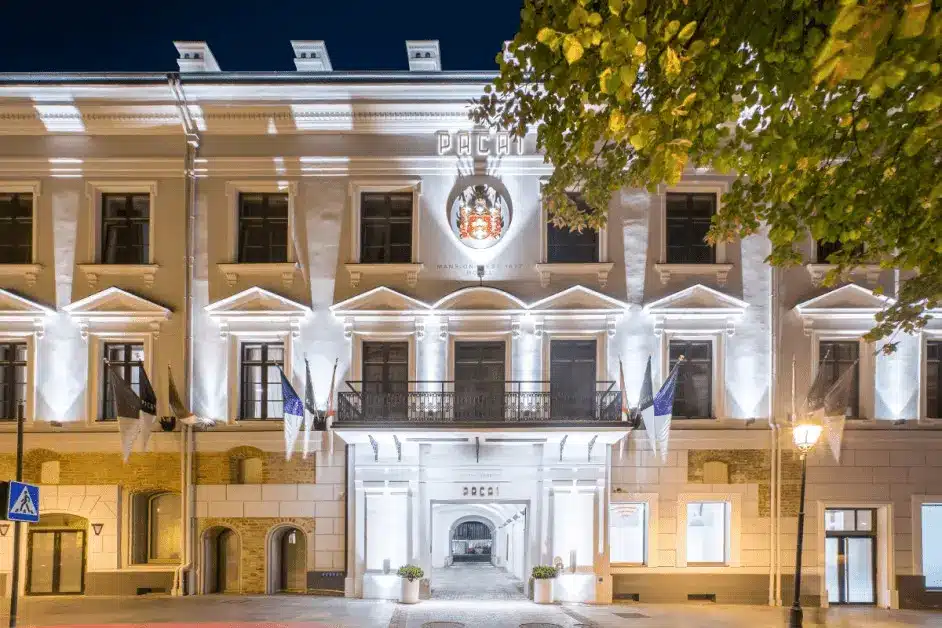
The Hotel Pacai Vilnius occupies the 1667 palace commissioned by Mykolas Kazimieras Pacas, a Lithuanian military commander whose battlefield dominance translated into architectural permanence. The Italian sculptors who created the Church of St. Peter and St. Paul decorated these walls with frescoes that remain visible today.
The building’s guest register includes Tsar Peter I, Emperor Alexander I, and Napoleon Bonaparte—each using the palace as a regional command center. Behind the Baroque facade, the 2018 conversion by architect Saulius Mikštas deliberately exposes 15th-century stone foundations and cracked pilasters, creating 104 rooms where guests inhabit the physical timeline of Baltic power. This is not restored nostalgia; it is verifiable heritage anchored by modern infrastructure.
Hotel Pacai Vilnius ★★★★★
The five-story Baroque complex spans a central courtyard on Didžioji Street, directly opposite Vilnius Town Hall within the UNESCO-protected Old Town core. The building’s massive structural arches and reconstructed red-tile roof dominate the streetscape, establishing immediate visual authority. Inside, the 2018 transformation strips away 19th-century paint layers to reveal authentic Baroque and Classicist frescoes—original “living” art that frames every corridor and suite.
Hotel Pacai Vilnius redefines Baltic luxury by placing guests inside a 17th-century noble palace where authentic Baroque art meets the world-class comfort of Hästens beds and Biologique Recherche wellness.
The design philosophy is “honest materials”: clay, tin, stone, and reclaimed barn wood contrast with smooth green marble bathrooms and custom-woven carpets. Rooms are categorized by historical volume, from compact Noble Rooms to 120-square-meter suites with 4-meter ceilings that echo the palace’s aristocratic proportions.
The guest experience is defined by material contrasts. Exposed 400-year-old crumbling brick and timber beams sit alongside premium Hästens beds in select suites—handcrafted using layers of horsehair and pine, providing the highest physical recovery standard available in the Baltics.
Despite the 17th-century shell, modern soundproofing and smart climate control ensure the thick-walled rooms remain silent, thermally stable sanctuaries. The enclosed stone courtyard functions as a wind-shielded microclimate, a private social hub entirely removed from public street traffic.
The building’s guest history establishes rarity. Tsar Peter I, Emperor Alexander I, and Napoleon Bonaparte each occupied these rooms as regional headquarters, their presence marking the palace as a seat of strategic command. The design deliberately preserves “historical scars“—uneven stone textures and cracked ancient pilasters serve as physical evidence of survival through Tsarist and Soviet eras. This is not decorative history; it is structural proof of institutional permanence.
The PACAI SPA occupies vaulted basement masonry, offering Biologique Recherche clinical skincare—the first such facility in Lithuania. The on-site restaurant, 14 Horses, focuses on Nordic-Baltic gastronomy, using farm-to-table ingredients like horseradish and dill for high-concept seasonal tasting menus.
The Soft-Tone Bar utilizes deep lighting and original stone arches to create an atmospheric cocktail lounge for high-society gathering. Executive infrastructure includes a 24-hour fitness center with professional-grade equipment and specialized meeting spaces that retain the palace’s original aristocratic proportions and natural acoustics.
The rooms translate grand hallways, historic stairs, and frescoed suites into environments where the Baltic elite have always exercised authority. The thick masonry ensures sound integrity; the courtyard provides spatial separation from the city; the exposed foundations provide historical legitimacy. This is where military power became architectural permanence, and where that permanence now defines a contemporary luxury stay.
Check Availability & Rates →The Pacai is not a museum replication—it is the physical archive of Baltic command, where 15th-century stone foundations and Baroque frescoes frame a modern refuge. Guests inhabit the same volumes where emperors strategized, surrounded by material evidence of institutional survival.
FAQ: Hotel Pacai Vilnius
What makes Hotel Pacai Vilnius historically significant?
Hotel Pacai Vilnius is a 1667 Baroque palace commissioned by military commander Mykolas Kazimieras Pacas, decorated by Italian master sculptors. The building served as headquarters for Tsar Peter I, Emperor Alexander I, and Napoleon Bonaparte. The 2018 renovation exposed authentic Baroque and Classicist frescoes and 15th-century stone foundations, preserving physical evidence of Baltic institutional power.
What is unique about the rooms at Hotel Pacai?
Rooms are categorized by historical volume, ranging from Noble Rooms to 120-square-meter suites with 4-meter ceilings. The design exposes 400-year-old brick and timber beams alongside modern Hästens beds in premium suites. Despite the 17th-century architecture, rooms feature soundproofing and smart climate control, ensuring thermal stability and silence within the thick masonry walls.
What dining and wellness options does Hotel Pacai offer?
The 14 Horses restaurant focuses on Nordic-Baltic gastronomy with farm-to-table seasonal menus. The PACAI SPA, located in vaulted basement masonry, is the first in Lithuania to offer Biologique Recherche clinical skincare. The Soft-Tone Bar provides an atmospheric cocktail lounge with original stone arches, and the enclosed courtyard serves as a wind-shielded private dining space.
Where is Hotel Pacai located in Vilnius?
Hotel Pacai occupies a dominant position on Didžioji Street in Vilnius Old Town, directly opposite the Town Hall. It sits within the UNESCO-protected heritage zone, providing immediate access to the capital’s primary historic core while maintaining spatial separation through its private enclosed courtyard and thick masonry construction.
Inhabiting Baltic Command: The Pacai Legacy
The Hotel Pacai Vilnius translates 350 years of institutional permanence into a contemporary luxury stay. The building’s guest register—tsars, emperors, and military commanders—establishes verifiable social authority. The 2018 architectural intervention exposes rather than conceals this history, creating 104 rooms where structural arches, frescoed walls, and 15th-century foundations define the physical environment. This is where Baltic power became Baroque architecture, and where that architecture now frames a modern refuge for those seeking heritage anchored by evidence.
Explore alternative historic properties in the capital, Stikliai Hotel Vilnius and Narutis Hotel Vilnius.
For more curated itineraries and luxury-focused travel insights, visit Your Luxury Guide. For official travel information and destination updates, visit Lithuania tourism-info.
Your Luxury Guide — Where Exceptional Travel Begins.