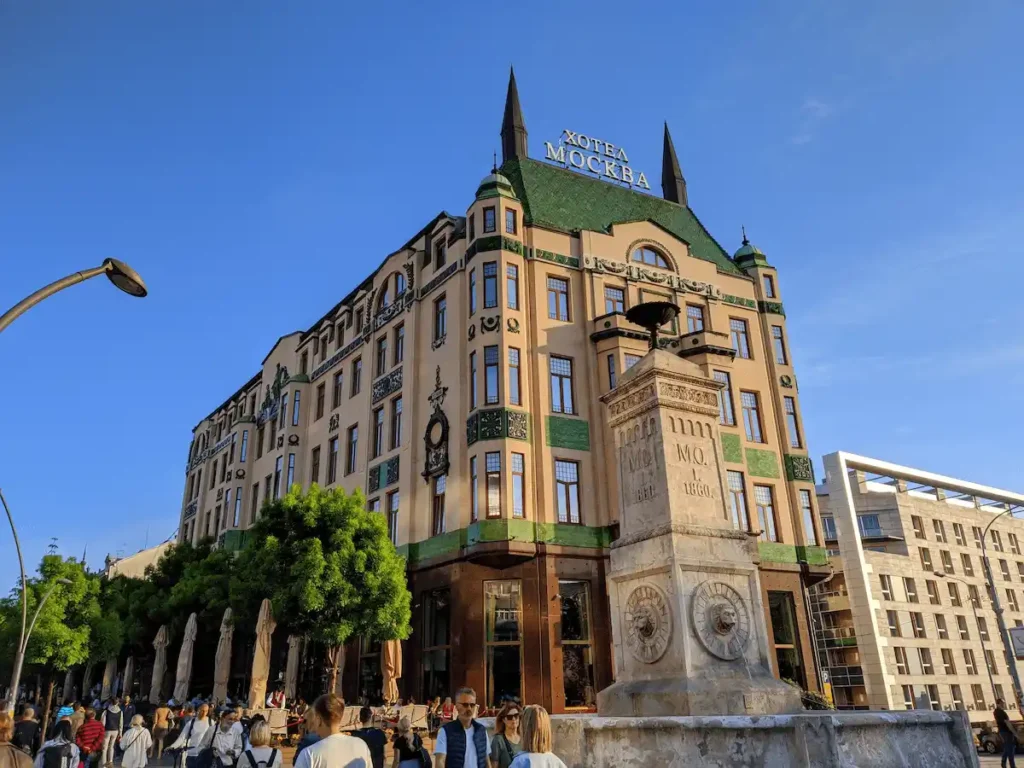
Hotel Moskva has commanded Belgrade’s most strategic intersection since King Peter I Karađorđević personally inaugurated this Russian Secession monument in 1908. The emerald Zsolnay-tiled facade overlooks Terazije Square—the city’s historical seat of commerce and power—where 40 million guests have inhabited suites that sheltered Einstein, Hitchcock, and Gandhi.
The building has never closed. Not through two World Wars. Not through regime changes. Its marble interiors and imperial proportions remain the physical manifestation of pre-war European authority, now offering modern travelers the same commanding presence that defined early 20th-century elite society.
Hotel Moskva ★★★★
The power of Hotel Moskva lies not in symbolic heritage, but in documented permanence. Since 1908, this Russian Secession structure has occupied the geographic and social center of Belgrade without interruption—a feat of institutional dominance that no other property in the Balkans can claim. When architect Jovan Ilkić completed the “Rossiya Palace,” he created more than a hotel; he established a permanent observation point over Serbia’s transformation from kingdom to republic to modern capital.
Hotel Moskva is Belgrade’s most famous architectural landmark that has remained a symbol of Serbian hospitality and a meeting place for the global elite since its grand opening in 1908.
The building’s exterior speaks the visual language of imperial confidence: hand-crafted Hungarian Zsolnay porcelain tiles in emerald green and golden yellow, a color combination so distinctive that locals navigate by it. This wasn’t decorative excess—it was architectural branding at the scale of state power. The ceramic work has survived over a century of Belgrade winters because Zsolnay’s pyrogranite process creates a surface harder than natural stone, the same technology used on the Austro-Hungarian National Museum in Budapest.
Inside, the spatial hierarchy reveals the original multifunctional design. The ground floor Viennese café—with its vaulted ceilings and live piano accompaniment—operates as Belgrade’s most elite social sorting mechanism. Politicians, artists, and global executives conduct informal power negotiations over the hotel’s signature Moskva Šnit cake, a 1974 creation that remains under proprietary recipe protection. The terrace extends this authority outdoors, offering the city’s premium “people-watching” position where guests observe Terazije Square‘s constant circulation of Belgrade society.
The 123 rooms and suites occupy the upper floors, several redesignated with the names of their most significant former occupants. These aren’t generic “celebrity suites”—they’re documented historical spaces where Einstein calculated, where Hitchcock observed human behavior, where Indira Gandhi strategized. The hotel maintains period-appropriate furniture in these quarters, creating spatial continuity with early 20th-century European luxury. Original 19th-century paintings and sculptures line the corridors, turning circulation spaces into curated galleries.
Modern infrastructure integrates without architectural compromise. The wellness center offers Finnish sauna, Turkish steam bath, and specialized urban recovery treatments in basement spaces originally designed for hotel service operations. The Tchaikovsky Restaurant occupies the historic dining hall, where Serbian ingredients meet international preparation techniques under restored frescoed ceilings. Every contemporary amenity exists within the building’s original 1908 footprint—no annexes, no modern wings, no architectural dilution.
The hotel’s statistical claim—40 million guests without a single day of closure—represents more than operational consistency. It documents institutional survival through the assassination of Archduke Franz Ferdinand, two Balkan Wars, Nazi occupation, Communist transformation, and Yugoslav dissolution.
Properties close. Regimes change. Hotel Moskva remained operational, its lobby serving as the unchanging stage where Serbia’s entire 20th-century drama unfolded. Guests don’t visit history here; they inhabit the physical space where it occurred, where the Zsolnay tiles still catch morning light exactly as they did when King Peter I first walked these halls.
Check Availability & Rates →To occupy a suite at Hotel Moskva is to claim a seat at Serbia’s permanent geographic and social center—the emerald-tiled monument where European imperial design meets Balkan institutional permanence, unchanged since 1908.
FAQ: Hotel Moskva
What makes Hotel Moskva historically significant in Belgrade?
Hotel Moskva has operated continuously at Terazije Square since its 1908 inauguration by King Peter I Karađorđević, surviving two World Wars and multiple regime changes without closing for a single day. The Russian Secession building features authentic Zsolnay ceramic tiles and has hosted over 40 million guests including Albert Einstein, Alfred Hitchcock, and Indira Gandhi, making it Belgrade’s most documented historic luxury property.
What is the architectural style of Hotel Moskva?
Hotel Moskva represents pure Russian Secession (Art Nouveau) architecture designed by Jovan Ilkić. The facade features hand-crafted Hungarian Zsolnay porcelain tiles in emerald green and golden yellow, using pyrogranite technology that creates surfaces harder than natural stone. The marble-clad interior preserves its original 1908 spatial hierarchy with vaulted ceilings, period frescoes, and an extensive collection of 19th and 20th-century art.
What is the famous Moskva Šnit cake?
The Moskva Šnit is a proprietary fruit cake created in 1974 at Hotel Moskva’s pastry shop, protected under secret recipe status. It has become a culinary landmark in Belgrade, served exclusively at the hotel’s Viennese-style café where live piano music accompanies the experience. The cake represents the property’s evolution from imperial hospitality to modern cultural institution.
Which famous historical figures stayed at Hotel Moskva?
Hotel Moskva’s guest registry includes Albert Einstein, Alfred Hitchcock, Robert De Niro, Indira Gandhi, and numerous heads of state and cultural figures throughout the 20th century. Several suites are named after their most significant former occupants and feature period-appropriate furniture, creating documented historical continuity with early European luxury hospitality standards.
Experience Belgrade’s Imperial Heritage
Hotel Moskva’s unbroken operation since 1908 at Terazije Square establishes it as Serbia’s definitive historic luxury property—where Zsolnay-tiled permanence meets documented institutional authority. From Einstein’s calculations to modern executive retreats, the marble corridors preserve the physical spaces where power always resided. Discover how Hotel Leopold I, Novi Sad and Metropol Palace Belgrade continue this tradition of imperial architecture serving contemporary prestige throughout the region.
For more curated itineraries and luxury-focused travel insights, visit Your Luxury Guide. For official travel information and destination updates, visit Serbia tourism-info.
Your Luxury Guide — Where Exceptional Travel Begins.