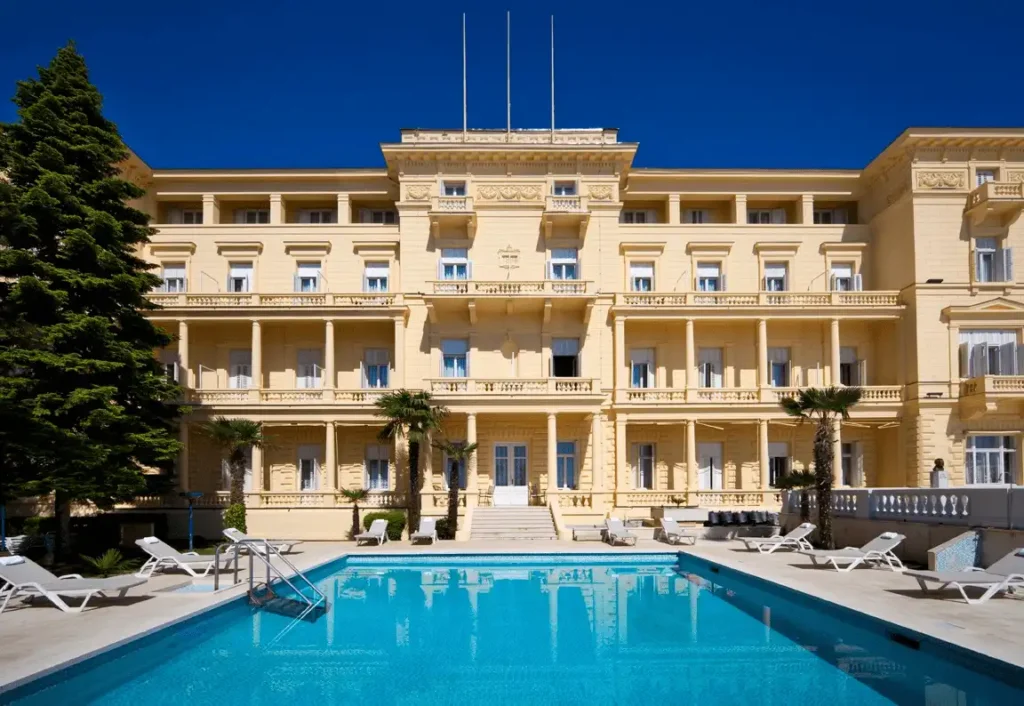
Built in a decisive 10-month construction campaign by the Southern Railway Society, Hotel Kvarner Opatija established the Adriatic’s first purpose-built imperial resort in 1884. Emperor Franz Joseph I selected this neoclassical structure as his official winter residence, transforming a fishing settlement into the Austro-Hungarian Empire’s premier coastal authority seat.
The property’s legendary Crystal Hall—with its original gold-leaf moldings and grand chandeliers—remains Croatia’s most significant ballroom space where European royalty exercised social command for 140 years. Today’s guests occupy the same imperial volumes, seafront sightlines, and territorial advantage that defined Central European power at its zenith. Discover more prestigious properties among the best historic hotels in Opatija.
Hotel Kvarner Opatija ★★★★
Architect Franz Wilhelm delivered a neoclassical masterpiece in just 10 months, opening “Hotel Quarnero” on December 20, 1884, as the Adriatic coast’s first grand resort hotel. The Southern Railway Society commissioned the property specifically to anchor Opatija as a high-society health destination, positioning the structure to command unobstructed views across Kvarner Bay toward the islands of Cres and Krk.
Emperor Franz Joseph I immediately designated the hotel as his official winter retreat, establishing a precedent that brought Europe’s ruling families to occupy its suites throughout the empire’s final decades.
Hotel Kvarner is the legendary birthplace of Adriatic tourism as the first luxury hotel in the region and remaining a symbol of Austro-Hungarian imperial elegance in the heart of Opatija.
The building’s 54 rooms and suites operate as a boutique-scale fortress of exclusivity, rejecting high-density tourism in favor of imperial spatial generosity. Original 19th-century architectural volumes remain intact—soaring ceilings, grand marble staircases, and period-accurate ironwork transport guests into the physical environments where European aristocracy conducted diplomatic negotiations and social strategy.
The property’s unusually wide corridors and expansive terrace spaces were engineered for social promenading, where visibility and territorial display functioned as core elements of elite gatherings.
The Crystal Hall (Kristalna dvorana) represents the property’s undisputed centerpiece—a ballroom designed for imperial-scale ceremonies with magnificent chandeliers suspended from ornate stucco ceilings and intricate gold-leaf moldings covering every architectural surface. For 140 years, this space has hosted Austro-Hungarian balls, international summit receptions, and major televised cultural festivals, maintaining its status as the region’s definitive power venue.
Modern guests access the same ballroom floor where Franz Joseph I received foreign dignitaries, inhabiting a legacy of centralized authority that extends unbroken from empire to contemporary luxury.
The hotel’s strategic seafront position on the Lungomare promenade—between the Church of St. James and Angiolina Park—secures total coastal dominance. Its legendary terrace functions as one of Europe’s most famous outdoor social spaces, where Viennese-style coffee service and local seafood are presented against panoramic Kvarner Bay sightlines.
The property provides exclusive access to a private rocky beach area directly below the terrace, where guests command their own section of Adriatic coastline as imperial visitors did generations before.
Wellness infrastructure includes an outdoor swimming pool positioned directly above the waves and a premium wellness center delivering Mediterranean-inspired treatments within historic architectural shells. Executive conference facilities within the Crystal Hall combine 19th-century ballroom grandeur with modern AV technology, offering contemporary professionals the same command presence European royalty once exercised.
Every spatial decision—from the placement of seafront balconies to the scale of the grand staircase—reinforces the property’s function as a territorial asset where social power and architectural authority converge.
Hotel Kvarner doesn’t recreate history; it continues operating the same imperial infrastructure that defined Opatija’s emergence as a world-class resort. Guests don’t visit a museum; they occupy the functioning seat of coastal authority where Central Europe’s elite established their winter dominance 140 years ago.
Check Availability & Rates →The Crystal Hall’s gold-leaf moldings and marble staircases don’t merely reference imperial grandeur—they physically embody the architectural command structure where Franz Joseph I and European royalty exercised social authority across 140 years of uninterrupted operation.
FAQ: Hotel Kvarner Opatija
What makes Hotel Kvarner historically significant in Opatija?
Hotel Kvarner opened in 1884 as the Adriatic’s first grand resort hotel, officially launching Opatija as a world-class health destination for European aristocracy. Emperor Franz Joseph I selected it as his winter residence, transforming the property into the Austro-Hungarian Empire’s premier coastal authority seat and establishing the architectural precedent for the region’s entire luxury hospitality sector.
What is the Crystal Hall at Hotel Kvarner?
The Crystal Hall (Kristalna dvorana) is Hotel Kvarner’s original imperial ballroom featuring magnificent chandeliers, intricate gold-leaf moldings, and ornate stucco ceilings. For 140 years it has served as Croatia’s most significant ceremonial space, hosting Austro-Hungarian balls, international summits, and major cultural festivals while maintaining its function as the region’s definitive power venue for high-society events.
What views does Hotel Kvarner Opatija offer?
The hotel commands unobstructed panoramic views across Kvarner Bay toward the islands of Cres and Krk from its seafront position on the Lungomare promenade. Original 19th-century architectural design specifically positioned private balconies and the legendary seafront terrace to maximize coastal sightlines, providing guests with the same territorial advantage European royalty valued during the Austro-Hungarian Empire.
Does Hotel Kvarner provide beach access?
The property offers exclusive access to a private rocky beach area located directly below its famous seafront terrace. Guests command their own section of Adriatic coastline with immediate proximity to the outdoor swimming pool positioned above the waves, maintaining the same coastal territorial control that defined the hotel’s function as an imperial retreat for 140 years.
The Empire’s Coastal Command Continues
Hotel Kvarner Opatija maintains its operational legacy as the architectural foundation of Adriatic luxury, where guests continue to inhabit the imperial volumes and territorial sightlines that defined European authority at its zenith.
For a complete exploration of Opatija’s historic prestige properties, consider Hotel Imperial Opatija and Hotel Bellevue Opatija, each representing distinct chapters in the coast’s evolution as Central Europe’s premier winter destination.
For more curated itineraries and luxury-focused travel insights, visit Your Luxury Guide. For official travel information and destination updates, visit Croatia tourism-info.
Your Luxury Guide — Where Exceptional Travel Begins.