Hotel Kristály Imperial holds the documented distinction of being Hungary’s oldest continuously operating hotel, functioning without interruption since 1770 as the premier guesthouse for the noble Esterházy family. This late-Baroque landmark stands as the original accommodation for Central Europe’s political and cultural elite visiting Tata’s “City of Waters.”
Over 255-year-old structure preserves authentic imperial architecture—grand 18th-century arches, palatial ceiling heights, and vaulted wine cellars—while delivering modern 4-star superior amenities. Guests inhabit the same spaces where aristocrats and heads of state have exercised influence for over two and half centuries.
Hotel Kristály Imperial ★★★★
The Hotel Kristály Imperial represents the longest unbroken hospitality legacy in Hungary—over 255-years of operational continuity that establishes it as the country’s definitive historic accommodation. Commissioned in 1770 as the official guesthouse for the Esterházy family’s Tata estate, this late-Baroque structure served a singular strategic purpose: hosting the dynasty’s high-ranking international visitors in a setting that reflected their territorial authority over the region.
Hotel Kristály Imperial in Tata holds the prestigious title of Hungary’s oldest continuously operating hotel, a late-baroque jewel that has welcomed aristocrats, artists, and travelers into its regal atmosphere since 1770.
The Esterházy family, one of Central Europe’s most influential aristocratic houses, controlled vast estates across Hungary and Austria. Their Tata holdings—centered around the Old Lake and an imposing Renaissance castle—functioned as both administrative headquarters and cultural retreat.
The Kristály Imperial occupied the critical social infrastructure: providing elite-level accommodation for diplomats, military commanders, and noble families navigating the political networks of the Habsburg Empire. The building’s architectural language—monumental facade, grand arches, and soaring ceiling heights—communicated immediate social hierarchy.
The property’s “Esterházy Wing” preserves the original spatial configurations. Rooms in this section maintain authentic 18th-century structural elements: palatial proportions, period ceiling heights, and the precise window placements designed to capture views of the Old Lake and surrounding estate grounds. These are not recreations; they are the verified environments where successive generations of European nobility conducted private negotiations and social positioning.
The hotel’s authentic 18th-century wine cellar, featuring original vaulted brick construction, functioned as a secure storage facility for the Esterházy family’s wine reserves. Today, this atmospheric subterranean space hosts private tastings that connect guests directly to the estate’s material culture.
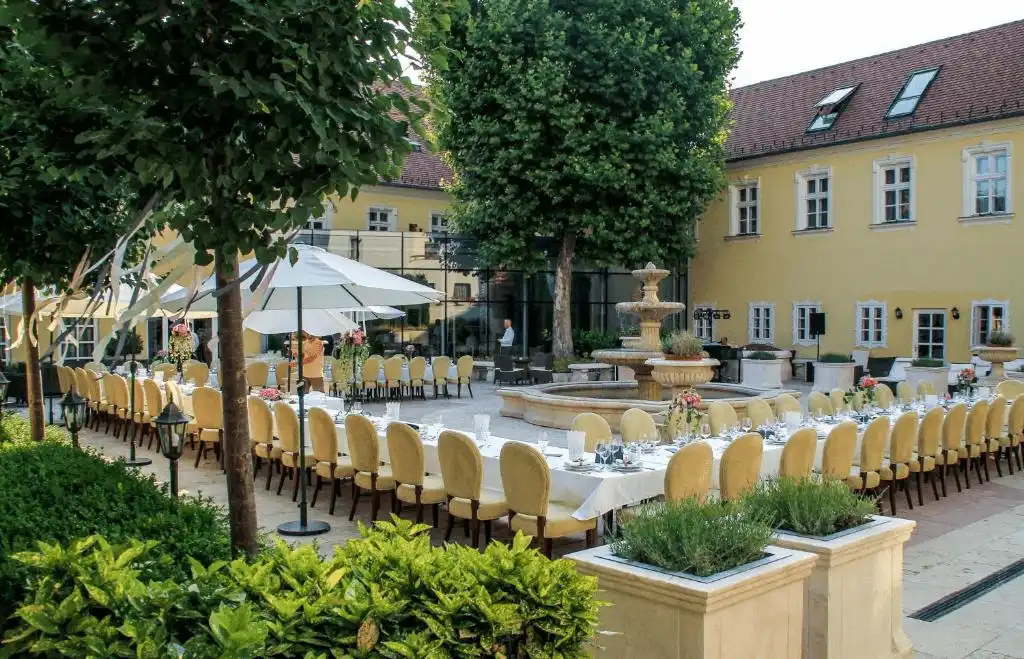
The central courtyard—a tranquil, enclosed sanctuary within the property’s footprint—provided discrete outdoor access for high-ranking visitors requiring privacy during politically sensitive periods.
Modern integration respects this legacy. The 4-star superior classification delivers contemporary wellness infrastructure: an indoor pool utilizing Tata’s historic mineral water resources, a comprehensive spa with salt chamber and multiple saunas, and climate-controlled suites with advanced technology. The Esterházy Restaurant maintains the property’s elite culinary tradition, specializing in regional game dishes and Hungarian-French fusion that reflects the estate’s historical cross-border influence.
The Pálma Event Center—a striking glass-and-iron structure on the property—provides 21st-century event capabilities while maintaining visual dialogue with the Baroque main building. This architectural contrast demonstrates the hotel’s operational philosophy: preserving historical authority while delivering modern utility to guests accustomed to international luxury standards.
Tata’s position as a “City of Waters,” with its network of mineral springs and pristine lake, attracted Central European elite seeking health-focused retreats since the 18th century. The Kristály Imperial anchored this ecosystem, providing the requisite social infrastructure for aristocratic wellness culture.
Guests today access the same geographic advantages—lakefront proximity, castle district walking routes, and therapeutic water resources—that established Tata’s original appeal to power networks.
Over 255-years of unbroken operation, verified through municipal records and architectural surveys, creates an unmatched historical continuity. This is not a converted palace or repurposed monastery; it is a purpose-built hospitality structure that has fulfilled its original elite-accommodation function across three centuries of Hungarian history.
Check Availability & Rates →Standing within the Esterházy Wing’s palatial chambers, where original 18th-century proportions frame views of the Old Lake, guests inhabit the precise spatial environments that housed Central Europe’s most influential families—a 255-year legacy of aristocratic hospitality preserved in verified architectural authenticity and continuous operational excellence.
FAQ: Hotel Kristály Imperial
What makes Hotel Kristály Imperial historically significant in Hungary?
Hotel Kristály Imperial is officially recognized as Hungary’s oldest continuously operating hotel, functioning without interruption since 1770. Originally built as the premier guesthouse for the noble Esterházy family’s Tata estate, it has served elite accommodation purposes for over 255 years—an unmatched operational continuity that establishes it as Hungary’s most authentic historic hospitality property.
What original 18th-century features are preserved at the hotel?
The Esterházy Wing maintains authentic structural elements including palatial ceiling heights, grand late-Baroque arches, original spatial configurations, and period window placements. The hotel also preserves its 18th-century vaulted wine cellar with original brick construction, and a central courtyard that provided discrete outdoor access for aristocratic visitors during the Habsburg era.
How does the hotel connect to the Esterházy family legacy?
The Kristály Imperial was purpose-built in 1770 to accommodate high-ranking international visitors to the Esterházy family’s Tata estate. As one of Central Europe’s most powerful aristocratic dynasties, the Esterházys required elite-level hospitality infrastructure to host diplomats, military commanders, and noble families. The hotel’s architecture and spatial hierarchy directly reflected their territorial authority and social position.
What modern amenities complement the historic property?
The 4-star superior hotel integrates comprehensive wellness facilities including an indoor pool utilizing Tata’s mineral water heritage, spa with salt chamber, multiple saunas, and climate-controlled suites. The Esterházy Restaurant offers Hungarian-French fusion cuisine, while the modern Pálma Event Center provides glass-and-iron architectural contrast for contemporary luxury events.
Experience Hungary’s Longest Hospitality Legacy
The Hotel Kristály Imperial delivers what no other Hungarian property can claim: over 255 years of continuous elite accommodation in its original purpose-built structure. From the Esterházy Wing’s authentic palatial chambers to the preserved 18th-century wine cellar, this Tata landmark translates Central European aristocratic authority into a modern luxury experience anchored by verified historical continuity.
Guests seeking similar imperial heritage combined with contemporary wellness excellence, the Anna Grand Hotel in Balatonfüred offers another distinguished destination within Hungary’s aristocratic hospitality tradition.
For more curated itineraries and luxury-focused travel insights, visit Your Luxury Guide. For official travel information and destination updates, visit Hungary tourism-info.
Your Luxury Guide — Where Exceptional Travel Begins.