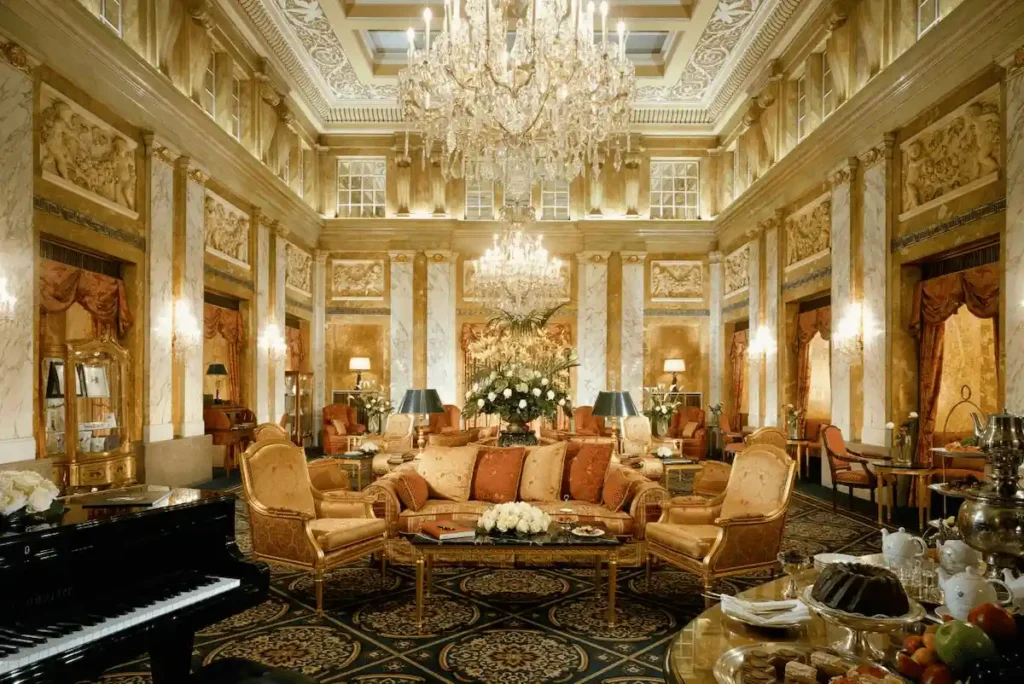
Hotel Imperial Vienna commands Palais Württemberg, the 1863 ducal palace that became Austria’s constitutional guest house for visiting sovereigns in 1873. This Ringstrasse landmark preserves 59 imperial suites with 7-meter ceilings, a clandestine corridor into the Musikverein, and the unbroken protocol of state hospitality spanning three centuries of European power.
Explore properties where historical dominance translates into modern exclusivity in our curated collection of the best historic hotels in Vienna.
Hotel Imperial Vienna ★★★★★
The Palais Württemberg was erected in 1863 as Duke Philipp of Württemberg’s private Viennese residence—a statement address on the newly constructed Ringstrasse, the boulevard designed to showcase Habsburg imperial grandeur. Ten years later, in advance of the 1873 Vienna World’s Fair, the palace underwent conversion into Hotel Imperial, conceived explicitly to house the crowned heads and ministerial delegations converging on the capital of the Austro-Hungarian Empire. From opening day, it functioned as Austria’s de facto state guest house, a role codified by the Austrian Republic and maintained without interruption.
Hotel Imperial Vienna, is a 19th-century royal palace on the Ringstrasse that served as the ancestral home of the Duke of Württemberg, featuring the palatial 1873 Hallensalon and the legendary Imperial Torte.
The hotel’s physical architecture encodes this legacy of diplomatic authority. The Royal Staircase, illuminated by cascading crystal chandeliers and crowned by the marble “Danube Mermaid” sculpture, was designed for ceremonial arrivals—where monarchs and heads of state ascended into Austria’s political center stage. The 138 rooms include 59 suites, the largest suite collection in Vienna, retaining the original 7-meter-high ceilings and silk-paneled walls commissioned for ducal entertaining. These spaces were not merely luxury accommodations; they were private chambers where European treaty negotiations and dynastic alliances unfolded behind closed doors.
The hotel’s spatial design includes a concealed internal passage directly into the Musikverein, the concert hall housing the Vienna Philharmonic. This corridor provided aristocratic guests with discreet access to Europe’s premier musical venue—eliminating public thoroughfares and ensuring that elite patrons moved through a continuous, controlled environment of cultural and political dominance. During the Allied occupation (1945–1955), the Imperial served as Soviet military headquarters, its ballrooms converted into command centers administering post-war Central Europe.
The hotel’s Royal Suites occupy the Duke’s original residential apartments, where guests today receive dedicated Personal Butler service—a protocol that includes hand-ironed newspapers delivered before dawn, personalized business cards printed on-site, and 24-hour valet coordination. These are not amenities borrowed from luxury branding; they are the operational systems refined over 150 years of serving heads of state who expected infrastructure built around absolute discretion and instantaneous execution.
Richard Wagner resided at the Imperial for extended periods in 1875 while composing, using the palace’s soundproofed salons for private rehearsals. Brahms and Mahler were documented frequent guests, utilizing the property as their Viennese operational base during concert seasons. Charlie Chaplin‘s 1931 visit attracted 4,000 fans outside the entrance; he later described the Imperial as the finest hotel he had ever inhabited. Wes Anderson explicitly cited the Imperial’s spatial grandeur and operational protocols as the primary design inspiration for The Grand Budapest Hotel, recognizing it as the architectural embodiment of European institutional elegance.
The Café Imperial Wien, operational since 1873, retains its original stucco ceiling and marble columns, serving the Tafelspitz (boiled beef) that was the preferred midday meal of Emperor Franz Joseph I. The Imperial Torte, created in 1873 by a kitchen apprentice in honor of the Emperor, remains prepared according to the undisclosed original formula—a culinary artifact protected with the same seriousness as state documents.
The 1873 HalleNsalon bar operates beneath a 240-light crystal chandelier, offering live piano performances under preserved imperial stucco work. Restaurant OPUS continues the tradition of courtly Austrian gastronomy, its menus designed around archival Habsburg recipes adapted for contemporary palates.
Guests at the Imperial Vienna do not occupy a renovated historic building; they inhabit Austria’s constitutional apparatus for hosting sovereign power, where the operational systems of state hospitality remain active and architecturally intact.
Check Availability & Rates →The Hotel Imperial does not recreate imperial grandeur—it preserves the unaltered infrastructure where European monarchs exercised state authority, offering guests residence within the physical systems designed for continental diplomacy and cultural command.
FAQ: Hotel Imperial Vienna
What makes Hotel Imperial Vienna historically significant?
Built in 1863 as Palais Württemberg for Duke Philipp of Württemberg, Hotel Imperial has served as Austria’s official state guest house since its 1873 conversion for the Vienna World’s Fair. It housed visiting monarchs, operated as Soviet military headquarters during the Allied occupation (1945–1955), and maintains the largest collection of imperial suites in Vienna with original 7-meter-high ceilings.
Does Hotel Imperial Vienna have a connection to the Musikverein?
Yes. Hotel Imperial features a concealed internal passage leading directly into the Musikverein concert hall, home of the Vienna Philharmonic. This private corridor was designed to provide aristocratic guests with exclusive access to performances without using public streets, preserving the continuity of elite cultural participation.
What is the Imperial Torte’s historical significance?
The Imperial Torte was created in 1873 by a kitchen apprentice in honor of Emperor Franz Joseph I during the Vienna World’s Fair. The recipe has remained a protected secret for over 150 years and continues to be prepared exclusively at Hotel Imperial using the undisclosed original formula.
Which notable figures have stayed at Hotel Imperial Vienna?
Hotel Imperial has hosted Richard Wagner (who composed there in 1875), Johannes Brahms, Gustav Mahler, and Charlie Chaplin (1931), who later called it the finest hotel he had experienced. The property also served as the primary architectural inspiration for Wes Anderson’s film The Grand Budapest Hotel.
Imperial Vienna’s Enduring Authority
Hotel Imperial Vienna remains Vienna’s constitutional monument to state hospitality, where the operational systems designed for sovereign power continue to define the guest experience. The preservation of ducal apartments, clandestine musical corridors, and unbroken butler protocols ensures residence within Austria’s architectural seat of diplomatic authority.
For those drawn to properties where historical function dictates modern exclusivity, Vienna’s legacy of imperial infrastructure extends to Hotel Sacher Wien and the restored Habsburg-era grandeur of Park Hyatt Vienna.
For more curated itineraries and luxury-focused travel insights, visit Your Luxury Guide. For official travel information and destination updates, visit Austria tourism-info.
Your Luxury Guide — Where Exceptional Travel Begins.