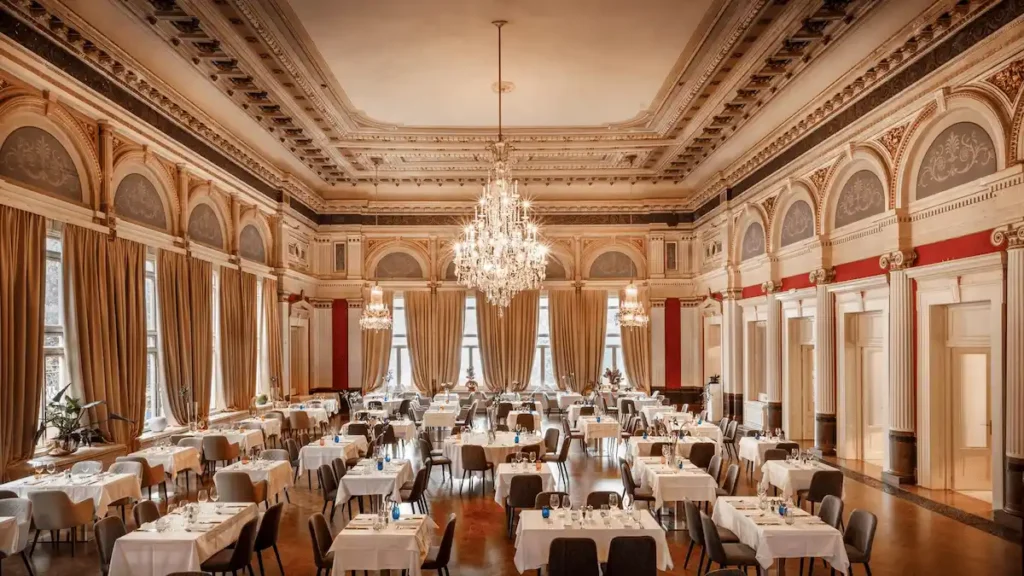
Hotel Imperial Opatija commands Opatija’s historic center from an 1885 Secession palace originally christened after Crown Princess Stephanie of Belgium. Architect Franz Wilhelm engineered this monument as the second jewel in Opatija’s imperial resort expansion, establishing a legacy defined by Emperor Franz Joseph I’s personal patronage and German Emperor Wilhelm II’s diplomatic visits.
The 2018 renovation preserved the stucco-heavy interiors and the acoustically legendary Golden Hall, where European aristocracy gathered for state banquets. Today’s 119-room property translates that imperial infrastructure into a 4-star heritage experience positioned 100 meters from the Lungomare promenade. Discover more properties in our guide to the best historic hotels in Opatija.
Hotel Imperial Opatija ★★★★
The Hotel Imperial Opatija operates from an 1885 Secession palace designed by Franz Wilhelm during the Austro-Hungarian Empire’s expansion of Opatija into a premiere Adriatic resort. Originally named “Kronprinzessin Stephanie” to honor the Belgian-born Austrian Crown Princess, the building was engineered as a direct response to the commercial dominance of the neighboring Hotel Kvarner.
Wilhelm’s architectural mandate delivered monumental marble columns, high-ceilinged public spaces, and expansive window systems that established visual dominance over St. James’s Park directly opposite the main entrance.
Hotel Imperial is a refined 19th-century heritage landmark and the second oldest hotel on the Adriatic, famously housing the “Golden Hall”—regarded as one of Europe’s most beautiful ballroom restaurants—just steps from the iconic Maiden with the Seagull statue.
The property’s imperial registry includes Emperor Franz Joseph I, who utilized the hotel as his preferred Opatija base during extended Adriatic sojourns. German Emperor Wilhelm II conducted diplomatic meetings within these walls, while writer James Joyce documented his stays in correspondence that established the hotel’s literary pedigree.
Following Ranković’s political fall in 1966, the Yugoslav government renamed the property “Imperial,” repurposing it from seasonal aristocratic retreat to year-round venue for state banquets and high-society conventions.
The centerpiece remains the Golden Hall—a banquet space historically celebrated across European society magazines as the continent’s most beautiful restaurant hall. Gilded ornaments cascade across vaulted ceilings above a floor plan engineered for superior natural acoustics. This technical precision transformed the space into Opatija’s premier concert venue, hosting classical performances and diplomatic galas that required zero amplification. The hall’s architectural acoustics deliver clarity that modern sound systems struggle to replicate, a byproduct of Wilhelm’s obsessive spatial calculations.
The 2018 renovation addressed 119 rooms while mandating preservation of original Secessionist flourishes. Stucco work, decorative motifs, and period-accurate detailing survived modernization that installed fiber-optic WiFi, air conditioning, and contemporary bathrooms.
The lobby retains its monumental scale—high ceilings and marble columns that communicated Austro-Hungarian permanence to arriving guests who understood architecture as status verification.
The Imperial Spa occupies basement spaces transformed into a dedicated wellness zone. Finnish sauna, Turkish bath, 4-person whirlpool, and ice fountain systems integrate into relaxation areas that maintain the building’s commitment to comprehensive guest infrastructure. The fitness center and Nordic walking pole rentals acknowledge Opatija’s status as a walking destination, while the pillow menu and valet parking services address modern luxury expectations within a heritage framework.
Location delivers strategic access. The main entrance opens directly onto Opatija’s central artery, with St. James’s Park’s Helios, Selene fountain and the Lungomare promenade. This positioning places guests at the geographic center of the “Imperial Walk“—the architectural circuit connecting Opatija’s Habsburg-era monuments. The property functions as both accommodation and navigational anchor for visitors mapping the city’s Secession legacy.
Check Availability & Rates →Where Crown Princess Stephanie’s name once commanded Austro-Hungarian society, today’s Imperial Opatija preserves the Secession acoustics and marble grandeur that hosted emperors—a 4-star translation of 1885 imperial infrastructure into modern Adriatic heritage.
FAQ: Hotel Imperial Opatija
What is the historical significance of Hotel Imperial Opatija?
Hotel Imperial Opatija opened in 1885 as “Kronprinzessin Stephanie,” designed by architect Franz Wilhelm as a Secession palace honoring Crown Princess Stephanie of Belgium. The property served as Emperor Franz Joseph I’s preferred Opatija retreat and hosted German Emperor Wilhelm II during diplomatic visits, establishing its role as a command center for Austro-Hungarian elite during the empire’s peak Adriatic expansion.
What makes the Golden Hall at Hotel Imperial Opatija unique?
The Golden Hall features acoustically engineered architecture that delivered natural sound clarity without amplification, celebrated historically as Europe’s most beautiful restaurant hall. Gilded ornaments and vaulted ceilings created a performance space that hosted state banquets and classical concerts, with spatial calculations that modern venues struggle to replicate using contemporary sound systems.
What original architectural features survived the 2018 renovation?
The 2018 renovation preserved stucco-heavy Secessionist interiors, monumental marble columns, high ceilings, period-accurate decorative motifs, and the Golden Hall’s gilded ornament systems. Modernization installed fiber-optic WiFi and air conditioning across 119 rooms while maintaining the lobby’s imperial scale and original architectural flourishes that communicated Austro-Hungarian permanence.
Where is Hotel Imperial Opatija located in relation to Opatija’s landmarks?
Hotel Imperial Opatija occupies the absolute center of Opatija on the main road, positioned directly across from St. James’s Park and 100 meters from the Lungomare promenade. This strategic placement anchors the “Imperial Walk” architectural circuit and provides immediate access to the Helios and Selene fountain, establishing the property as both accommodation and navigational reference point for Habsburg-era monument tours.
The 1885 Imperial Infrastructure Endures
Hotel Imperial Opatija translates Crown Princess Stephanie’s 1885 palace into a 4-star heritage property where Secession acoustics and marble grandeur preserve the empire’s Adriatic ambitions. The Golden Hall’s gilded permanence and Emperor Franz Joseph I’s documented patronage establish a stay rooted in verifiable Habsburg command.
Explore adjacent imperial properties at Hotel Kvarner Opatija and Hotel Bellevue Opatija, where Opatija’s Austro-Hungarian legacy continues through preserved architecture and documented aristocratic lineage.
For more curated itineraries and luxury-focused travel insights, visit Your Luxury Guide. For official travel information and destination updates, visit Croatia tourism-info.
Your Luxury Guide — Where Exceptional Travel Begins.