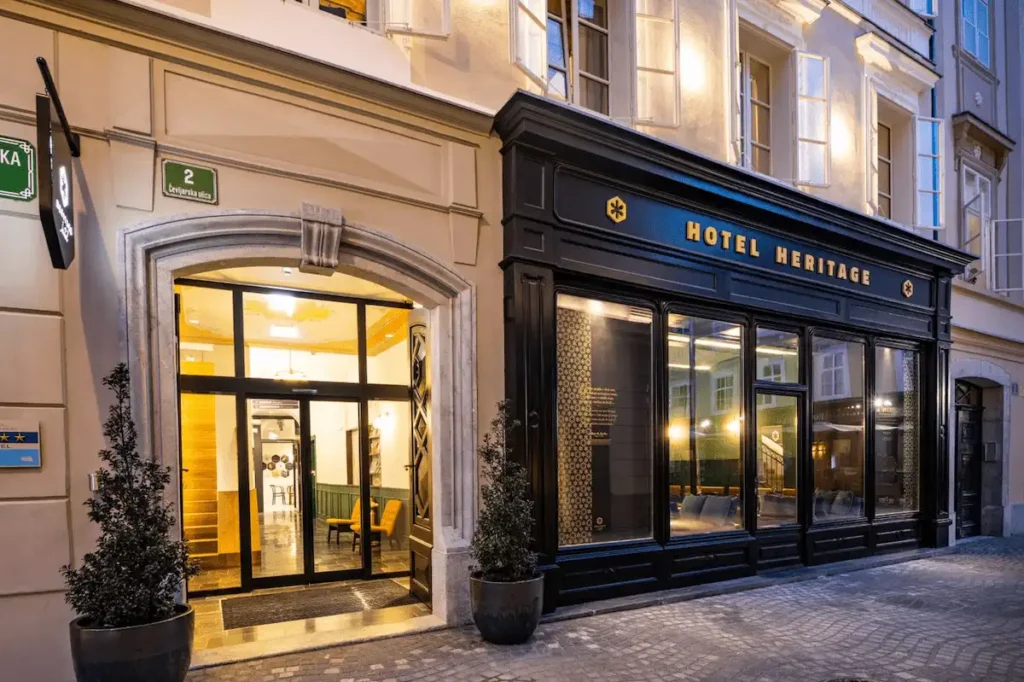
Hotel Heritage Ljubljana at Čevljarska ulica 2 has held its position at the intersection of three medieval squares since 1600. This Renaissance bourgeois townhouse—designated a protected cultural monument—served as the residence and workshop of Fabijan Kirchberger, the 16th-century publisher whose press helped establish printed Slovene during the Protestant Reformation.
The 2021 restoration preserved 400-year-old stone walls while integrating modern systems across five floors of individualized accommodations. Twenty guest rooms now occupy the vertical footprint that once housed aristocratic families, reformers, and 19th-century poets.
For travelers seeking verified historical provenance within walking distance of Ljubljana’s core, this property delivers four centuries of documented occupancy in a structure where linguistic heritage remains embedded in the architectural record. Discover more options among the best historic hotels in Ljubljana.
Hotel Heritage Ljubljana ★★★★
The structure predates the Baroque overlay of Ljubljana’s cityscape by nearly a century. Built around 1600 as a Renaissance townhouse for the city’s merchant class, it served as the operational base for Fabijan Kirchberger’s publishing enterprise—a press that collaborated on some of the earliest Slovene-language religious texts during the Reformation period.
The building’s role in the development of Slovene literacy establishes it as more than architectural heritage; it represents a documented seat of intellectual production at a time when printed language conferred political and social authority.
Hotel Heritage Ljubljana is a family-run boutique retreat set in a 400-year-old Renaissance townhouse, offering 20 unique rooms on Ljubljana’s shortest street for travelers who want a quiet stay in the absolute center of the pedestrian zone.
The 2021 restoration required precision engineering to integrate contemporary hospitality infrastructure within a protected monument framework. The project team preserved the original timber portal at the main entrance—a primary structural artifact of the Renaissance facade—while excavating to reveal stone vaulted ceilings that had been concealed for over two centuries. The interior design strategy employed “Tobacco Oak” veneer paneling across all five floors, custom-profiled cream doors in the traditional “Old Burgher” style, and semi-circular black swing doors in guest corridors that reference the building’s historic circulation patterns.
The property’s location at the terminus of Čevljarska ulica—Ljubljana’s shortest street—places it 30 meters from Shoemaker’s Bridge and within immediate access to Old Square, Town Square, and New Square. This triangulated position within the medieval core was strategically significant for a 16th-century publisher requiring proximity to municipal authorities, religious institutions, and commercial trade routes.
Today, guests occupy the same vertical footprint that facilitated that access, with no two of the 20 rooms sharing identical configurations due to the constraints of the original medieval layout.
Room specifications reflect a modern sleep system layered onto historic structure: memory foam mattresses, a dedicated pillow menu, and hypoallergenic down comforters as standard. The thick stone walls required integrated fiber-optic WiFi installation, while Smart TVs with premium satellite channels provide contemporary media access within chambers framed by exposed masonry.
The micro-lobby bar functions as both an artisanal coffee service and a gallery space for local architectural history, reinforcing the building’s centuries-long role as a site of cultural exchange.
The street-level bicycle fleet and 24/7 reception desk with round-trip airport shuttle service ensure operational mobility, but the property’s essential value proposition remains unchanged from its Renaissance origin: proximity to the centers of power, documented lineage within the protected Old Town, and a structure whose walls have absorbed 400 years of continuous occupancy by figures who shaped the linguistic and political landscape of Slovenia.
Check Availability & Rates →The Renaissance portal frames an unbroken chain of occupancy—from 16th-century publishers to 19th-century poets—within a structure where linguistic heritage remains embedded in the stone itself.
FAQ: Hotel Heritage Ljubljana
What historical significance does Hotel Heritage Ljubljana hold?
The building served as the residence and workshop of Fabijan Kirchberger, a 16th-century publisher who collaborated on early Slovene-language religious texts during the Protestant Reformation. His press operated from this site around 1600, making the structure a documented hub for the development of printed Slovene. The property has maintained continuous occupancy for over 400 years, hosting aristocratic families, religious reformers, and 19th-century poets within its protected Renaissance walls.
What architectural features remain from the original 16th-century structure?
The main entrance retains the fully restored historic timber portal from the original Renaissance facade. The 2021 restoration excavated and preserved stone vaulted ceilings that had been concealed for over two centuries. The building’s four-story vertical layout follows the original medieval footprint, with thick stone walls that dictated the integration of modern systems. Semi-circular black swing doors in guest corridors reference historic circulation patterns, while custom-profiled cream doors follow traditional “Old Burgher” design specifications.
Where exactly is Hotel Heritage Ljubljana located within the Old Town?
The property occupies Čevljarska ulica 2, positioned at the intersection of Ljubljana’s three historic medieval squares: Old Square, Town Square, and New Square. It sits on the city’s shortest street, creating a rare quiet-zone environment just 30 meters from Shoemaker’s Bridge. This triangulated location provided strategic access to municipal, religious, and commercial centers during the Renaissance period and now places guests within immediate walking distance of the Old Town’s primary cultural sites.
What modern amenities are available in the historic rooms?
Each of the 20 rooms features memory foam mattresses, a dedicated pillow menu, and hypoallergenic down comforters. The thick Renaissance walls house integrated fiber-optic WiFi and 47-inch Smart TVs with premium satellite channels. The ground-floor micro-lobby offers an artisanal coffee bar, while operational services include a private bicycle fleet and 24/7 reception desk with round-trip airport shuttle service. The vertical layout ensures no two rooms share identical configurations, with modern systems integrated into the protected 400-year-old structure.
Verified Heritage Within the Medieval Core
The Renaissance townhouse translates 400 years of documented occupancy into 20 individualized accommodations, each configured by the vertical constraints of a protected 16th-century footprint.
The linguistic heritage embedded in these walls—where Fabijan Kirchberger’s press contributed to the foundation of printed Slovene—establishes provenance that extends beyond architectural preservation into the documented record of Slovenia’s intellectual formation.
Explore stays anchored by verified historical authority within the Old Town’s medieval infrastructure, Antiq Palace Ljubljana or Grand Hotel Union Eurostars.
For more curated itineraries and luxury-focused travel insights, visit Your Luxury Guide. For official travel information and destination updates, visit Slovenia tourism-info.
Your Luxury Guide — Where Exceptional Travel Begins.