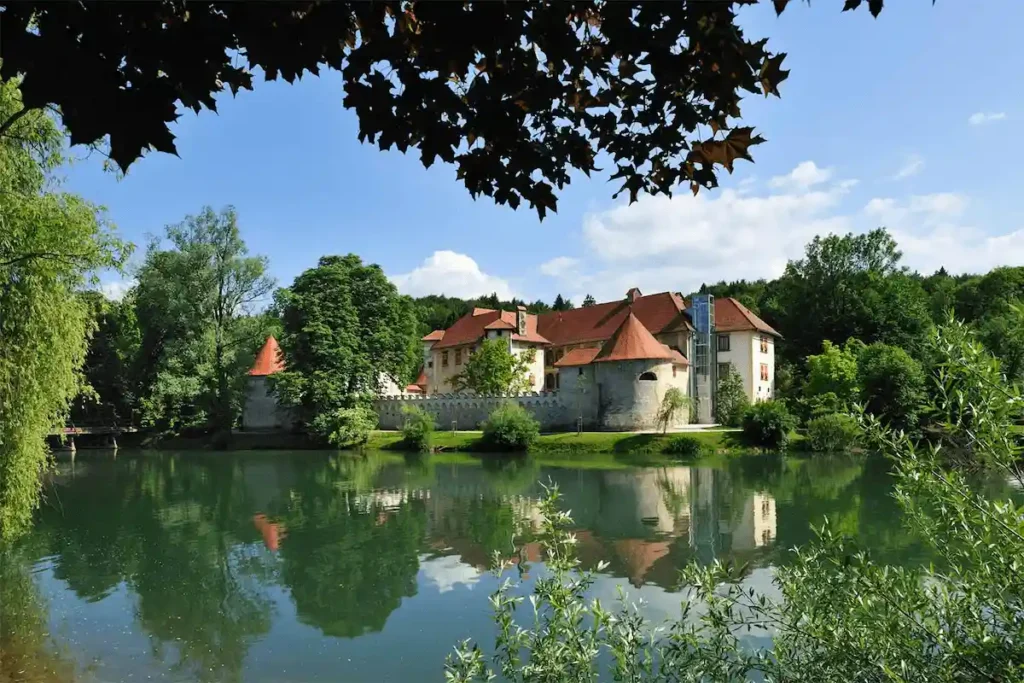
Hotel Grad Otočec stands as Slovenia’s only water castle hotel, occupying an island fortification in the Krka River since 1252. The Renaissance structure enforces complete territorial isolation through its natural moat—a defensive architecture that transforms modern privacy into a sovereign experience. As a Relais & Châteaux property since 1997, the castle’s military origins as a border stronghold now anchor an environment where guests command 800 years of documented nobility. This is not accommodation. This is territorial occupation of verified aristocratic legacy.
Hotel Grad Otočec ★★★★★
The fortress rises from the Krka River on its private island—a geographical fact that has enforced absolute separation since the 13th century. First documented in 1252 under the Counts of Ortenburg, Hotel Grad Otočec functioned as a border defense installation controlling the Lower Carniola territories.
The water barrier was not decorative. It was a military necessity that prevented unauthorized entry, a physical moat that today provides the only hotel environment in Slovenia where the grounds are literally unreachable without crossing the estate’s controlled stone bridge.
The Renaissance reconstruction under Baron Ivan Lenković in the 16th century established the architectural profile that defines the property today. Lenković served as the Habsburg military commander against Ottoman forces—his fortress was built to withstand siege.
The three-meter-thick walls, the corner towers, and the fortified courtyard were engineered for territorial command. The castle’s military past anchored its social elevation: by the 17th century, the Counts of Lamberg had transformed the stronghold into their summer residence, layering aristocratic refinement onto defensive infrastructure.
Hotel Grad Otočec stands as Slovenia’s only island castle, offering a member of the prestigious Relais & Châteaux collection where guests can sleep within medieval stone walls surrounded by the tranquil flow of the Krka River.
Baron Josef Schauenstein completed the estate’s evolution when he acquired Otočec in 1868, implementing the park landscapes and service quarters that mirror the territorial confidence of the Habsburg elite. The family maintained control until 1942—a lineage that embedded the property into Slovenia’s nobility for 74 uninterrupted years.
When the Republic of Slovenia designated the castle a cultural monument in 1951, it formalized what the architecture already declared: this was a structure of national consequence.
Relais & Châteaux admission in 1997 ratified the property’s operational pedigree against the organization’s 580 global estates. The designation requires documented heritage, architectural integrity, and service standards that reflect the original social function of the building.
Hotel Grad Otočec’s 16 guest rooms occupy the Renaissance chambers where the Lambergs hosted Central European nobility—rooms with direct views over the controlled water perimeter, carved stone fireplaces original to Lenković’s construction, and frescoed ceilings that map the estate’s centuries of aristocratic occupation.
The hotel’s Michelin-rated restaurant operates within the former banquet hall, its vaulted ceilings and period details preserved as evidence of the castle’s hospitality lineage. The wellness facilities occupy the renovated cellar vaults—medieval storage chambers now converted into thermal environments that maintain the estate’s layered historical utility.
The 30-hectare grounds include the 18-hole golf course constructed in 1997, which integrates modern recreation into the territorial expanse that the fortress was built to defend.
Every element confirms that this is a seat of territorial authority, where the guest inhabits a documented chain of command extending back eight centuries.
Check Availability & Rates →Hotel Grad Otočec delivers what no mainland property can replicate: the physical fact of island sovereignty, where Renaissance fortifications and verified nobility converge into an environment of absolute territorial command over Slovenia’s documented defensive heritage.
FAQ: Hotel Grad Otočec
What makes Hotel Grad Otočec historically significant?
Hotel Grad Otočec is Slovenia’s only water castle hotel, documented since 1252 as a defensive border stronghold. The Renaissance fortress served Habsburg military commanders and Slovenian nobility continuously until 1942, with three-meter-thick walls and natural moat fortifications that enforced territorial isolation. As a designated cultural monument since 1951 and Relais & Châteaux member since 1997, the property maintains verified aristocratic lineage spanning eight centuries of documented command.
Is Hotel Grad Otočec a genuine castle or a replica?
Hotel Grad Otočec is an authentic 16th-century Renaissance fortress built by Baron Ivan Lenković, Habsburg military commander. The castle occupies a fortified island position established in 1252, with original defensive architecture including corner towers, vaulted cellars, and perimeter walls engineered for siege resistance. The structure functioned as a military installation and noble residence under the Counts of Lamberg and Baron Schauenstein families for 680 years before hotel conversion.
What defensive features define Hotel Grad Otočec’s architecture?
The castle’s island location creates a natural water moat surrounding the entire property, accessible only via controlled stone bridge. Three-meter-thick perimeter walls, four corner defensive towers, and fortified courtyard layout reflect its 16th-century military engineering under Habsburg command. The Renaissance structure was designed to control Lower Carniola territories—defensive features that now provide unprecedented privacy and territorial separation for modern guests.
What is the Relais & Châteaux designation at Hotel Grad Otočec?
Relais & Châteaux membership since 1997 certifies Hotel Grad Otočec against criteria requiring documented historical heritage, architectural integrity, and service standards reflecting the property’s aristocratic origins. The organization admits only 580 properties worldwide. The castle’s admission validates its operational pedigree as a former noble residence with preserved Renaissance architecture and verified 800-year nobility lineage, positioning it among Europe’s authenticated historic estates.
Sovereign Territory, Verified Command
Hotel Grad Otočec stands as Slovenia’s territorial statement—the only water castle where Renaissance military architecture and eight centuries of documented nobility converge into an environment of island sovereignty. The defensive moat is not historical theater. It is the physical boundary that has enforced elite separation since 1252, now occupied by guests commanding verified aristocratic legacy.
Explore more historic castle estates in Slovenia.
For more curated itineraries and luxury-focused travel insights, visit Your Luxury Guide. For official travel information and destination updates, visit Slovenia tourism-info.
Your Luxury Guide — Where Exceptional Travel Begins.