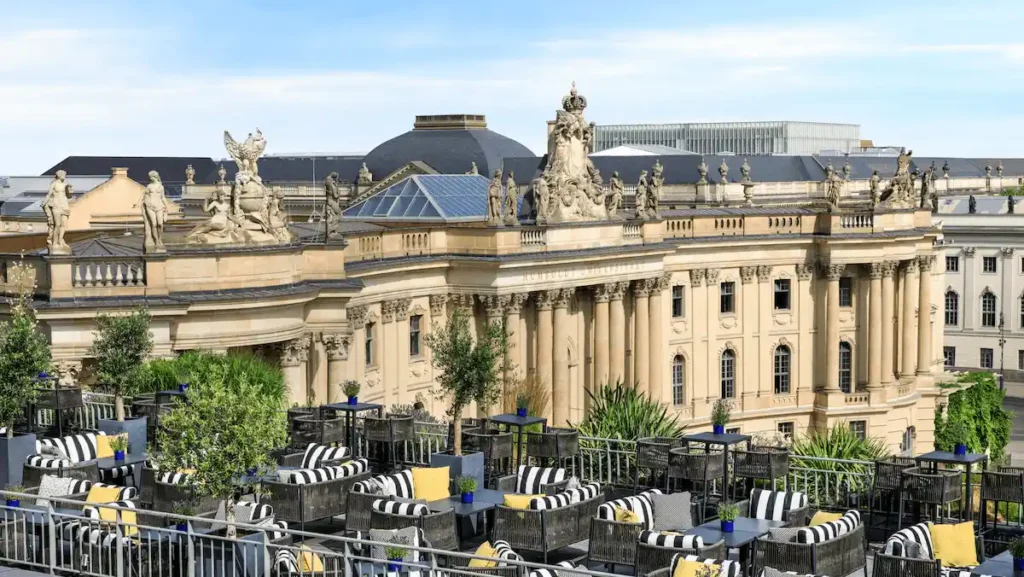
The Hotel de Rome Berlin occupies the 1889 headquarters of Dresdner Bank, where Ludwig Heim built Italy’s High Renaissance into Berlin’s financial district. The marble that once signaled imperial banking power now anchors suites where conductors and creative directors claim temporary residence. This is documented architectural dominance converted into controlled hospitality.
Explore more prestigious addresses among the best historic hotels in Berlin.
Hotel de Rome Berlin ★★★★★
Master builder Ludwig Heim completed the Dresdner Bank headquarters in 1889 with a mandate: project permanence. Italian High Renaissance vocabulary—rusticated stonework, coffered ceilings, triple-height banking halls—was deployed not for aesthetic preference but to communicate institutional weight. The building succeeded. It dominated Bebelplatz until 1945, when the Battle of Berlin left bullet holes in the oak paneling of the directors’ wing. Those scars remain visible in several Historical Suites.
Hotel de Rome Berlin is a masterfully restored 19th-century landmark that once housed the Dresdner Bank headquarters, offering a unique blend of Prussian heritage and contemporary luxury where the original jewel vault now serves as a subterranean spa.
The GDR seized the structure post-war and designated it Staatsbank der DDR. Socialist planners found the marble floors and gilt moldings ideologically problematic—”too capitalist”—so they boarded over everything. That bureaucratic decision accidentally created a hermetic seal. When Rocco Forte acquired the property in 2003, the restoration team from Aukett + Heese discovered neoclassical interiors in near-original condition beneath decades of plywood and linoleum.
The 2006 conversion by Tommaso Ziffer and Olga Polizzi retained the architectural authority while inserting contemporary Italian confidence. Eugen Gutmann’s original executive office—complete with 19th-century parquetry and stucco medallions—is now a signature suite. The grand Cashier’s Hall, where Berliners exchanged currency under a soaring glass atrium, functions as the hotel’s ballroom.
The building’s former jewel vault, fifteen centimeters of steel plating designed to resist dynamite, now contains a 20-meter pool. The vault doors remain in the spa corridors, polished but operational.
The 145 rooms occupy spaces that once held ledgers, safe deposit boxes, and the offices where Five-Year Plans were drafted during the Cold War. Floor-to-ceiling windows overlook Bebelplatz and St. Hedwig’s Cathedral. The Opera Court salon, with original 1889 stucco ceilings, serves afternoon tea to opera directors between rehearsals at the adjacent Staatsoper.
The rooftop terrace—formerly restricted management space—now offers the clearest sightline in Berlin-Mitte, across Humboldt University and the Lustgarten.
CHIARO, the Italian-Japanese restaurant, occupies the building’s former loading bay, now a private courtyard shielded by century-old linden trees. The menu reflects the same precision Heim applied to the façade: controlled, high-impact, built to endure scrutiny.
Fashion Week directors claim the Opera Court for breakfast meetings. Conductors request suites in the former directors’ wing for the acoustic isolation the original walls provide.
The property does not traffic in reinvention myths. It presents verified lineage: from Gutmann’s financial empire through Cold War bureaucracy to Forte’s modern luxury standard. The architecture dictates the experience. The guest inhabits rooms where capital once moved, where socialist officials calculated GDP, where 15-centimeter vault doors still protect what is now recreational space.
This is structural authority made available for temporary residency.
Check Availability & Rates →Hotel de Rome grants entry to the exact halls where 19th-century financiers commanded imperial capital and Cold War planners drafted five-year economic strategies—the marble floors, oak paneling, and bullet-scarred walls remain the same physical infrastructure, now serving those who recognize power’s continuity across regimes.
FAQ: Hotel de Rome Berlin
What makes Hotel de Rome historically significant?
Built in 1889 as Dresdner Bank headquarters by Ludwig Heim, it served as Germany’s financial nerve center until 1945. Post-war, it became Staatsbank der DDR where East German economic policy was formulated. The 2006 Rocco Forte conversion preserved original neoclassical interiors, including directors’ offices now serving as suites and the gold vault transformed into a 20-meter pool. Battle of Berlin bullet holes remain visible in Historical Suite paneling.
Where is the vault spa located in Hotel de Rome?
The spa occupies the building’s original basement-level jewel and gold vault, constructed with 15-centimeter-thick steel plating. The vault’s security doors remain operational in the spa corridors. The former storage chambers now house a 20-meter indoor pool, treatment rooms, and fitness facilities, maintaining the original security infrastructure as architectural features.
Which historic figures are connected to Hotel de Rome?
Eugen Gutmann, Dresdner Bank founder, maintained his executive office in what is now a signature suite. The building served as the operational headquarters for Cold War-era GDR financial planners. Post-conversion, Rocco Forte established it as his German portfolio flagship. Its Bebelplatz location makes it the preferred Berlin residence for Staatsoper conductors and Berlin Fashion Week creative directors.
What dining options reflect the building’s banking history?
CHIARO restaurant occupies the former loading bay, now a private courtyard where financial documents once arrived by secure transport. The Opera Court salon, retaining its 1889 stucco ceiling, serves traditional afternoon tea in the space where bank clients once conducted high-value transactions. The Cashier’s Hall—original glass-roofed currency exchange—functions as the Grand Ballroom for private events.
Authority Documented, Residence Secured
The Hotel de Rome Berlin presents 1889 banking infrastructure converted to modern hospitality without erasing institutional memory. The marble floors Heim installed, the vault Gutmann commissioned, the offices where socialist planners worked—all remain in verified, functional use. This is Berlin’s financial past made available as temporary residence for those who recognize architectural authority when they inhabit it.
Continue exploring similar prestigious conversions at Hotel Adlon Kempinski Berlin and Telegraphenamt Berlin.
For more curated itineraries and luxury-focused travel insights, visit Your Luxury Guide. For official travel information and destination updates, visit Germany tourism-info.
Your Luxury Guide — Where Exceptional Travel Begins.