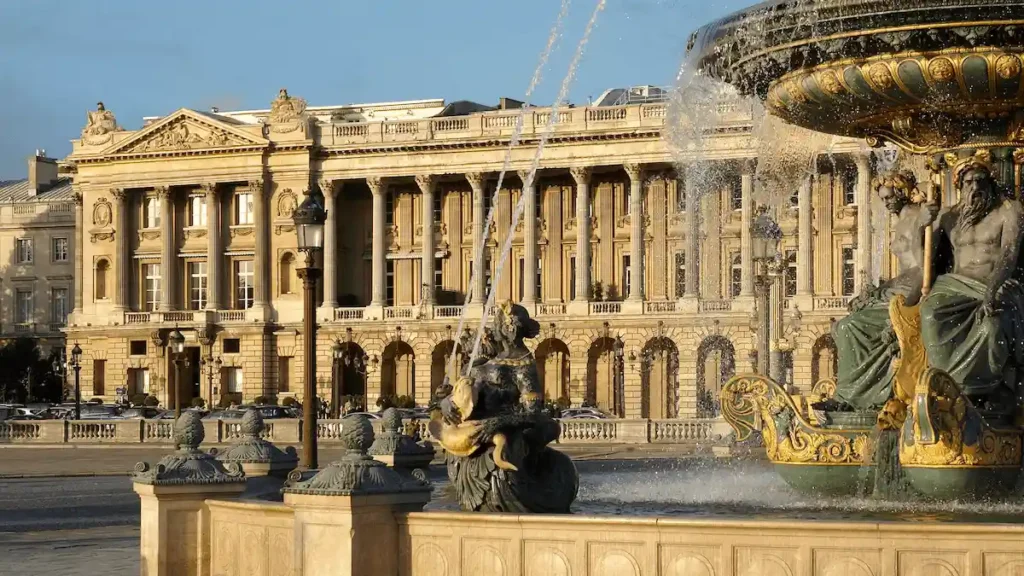
For over 260 years, Hotel de Crillon’s building has functioned as a command center. Commissioned by Louis XV in 1758 as a private palace for the Comte de Crillon, this structure has housed military nobility, hosted treaty signings that redefined global borders, and served as headquarters for France’s Automobile Club—the nation’s first automotive authority.
Today’s guest doesn’t merely book a luxury stay. They inhabit the stone corridors where France’s elite have exercised power for three centuries. Every suite overlooks the site where French monarchy ended and modern governance began. This is not Paris tourism. This is occupation of a verified power address.
Hotel de Crillon ★★★★★
The palace walls hold documented power. Marie Antoinette took piano lessons in these salons under her music master. The Treaty of Friendship between the United States and France was signed here in 1778—the agreement that legitimized American independence through French military support. When the Automobile Club de France established headquarters here in 1907, it positioned the building as the seat of France’s transportation revolution, regulating the country’s first motorized infrastructure.
Hôtel de Crillon remains an incomparable icon of Parisian history, a neoclassical palace on Place de la Concorde where guests reside within the same walls that once hosted Marie Antoinette.
The 124 rooms translate this legacy into physical dominance. Suites in the original Louis XV wing maintain 18-foot ceilings, Carrara marble fireplaces, and crystal chandeliers commissioned for aristocratic entertaining. The Presidential Suite occupies the Comte’s private apartments—656 square meters where military decisions were drafted over three-century occupancy. Rooms facing Place de la Concorde provide direct sight lines to the Luxor Obelisk, a 3,300-year-old monument marking the exact center of Parisian authority.
Karl Lagerfeld designed the Les Grands Appartements suites, embedding haute couture methodology into residential architecture. Each textile, each inlaid wood panel, carries the same precision he applied to Chanel’s atelier operations. The marble spa descends into vaulted chambers that originally functioned as the palace wine cellars—where aristocratic provisions were stored under armed guard. Today’s 2,000-square-meter wellness facility occupies that same secured basement architecture.
L’Écrin restaurant’s menu mirrors the estate’s diplomatic function. Each dish presents French culinary authority through technique that requires years of classical training. The dining room’s 18th-century boiserie panels witnessed negotiations that shaped European borders. Guests consume precision cuisine in the same space where military alliances were formalized over state dinners.
The palace façade itself—designed by Jacques-Ange Gabriel, Louis XV’s First Architect—establishes Place de la Concorde’s architectural identity. This isn’t decorative heritage. It’s the blueprint that every subsequent building around the plaza was required to follow. Staying here positions you at the source code of Parisian urban planning.
Check Availability & Rates →Power does not require announcement. It resides in stone that has witnessed the birth of republics, the death of monarchies, and the rise of nations. These walls have stood as France’s stage for authority. Your occupancy continues that legacy.
FAQ: Hotel de Crillon
What makes Hotel de Crillon historically significant?
Commissioned by Louis XV in 1758, the palace served as private residence for the Comte de Crillon, hosted the 1778 Treaty of Friendship signing between France and America, and functioned as Automobile Club de France headquarters from 1907. The building represents continuous French institutional authority across three centuries.
Which rooms offer the most prestigious experience?
The Presidential Suite occupies the Comte de Crillon’s original 656-square-meter private apartments with Louis XV architectural elements intact. Les Grands Appartements designed by Karl Lagerfeld provide haute couture residential design. All rooms in the original palace wing maintain 18-foot ceilings and Place de la Concorde views.
What distinguishes the property’s location?
The hotel anchors Place de la Concorde’s northern axis—the plaza where French monarchy ended. Designed by Louis XV’s First Architect, the façade established the architectural standard for the entire plaza. The location provides direct access to Rue du Faubourg Saint-Honoré’s haute couture houses and the Tuileries Garden.
How does the hotel maintain its palace character?
Original 18th-century boiserie panels, Carrara marble fireplaces, and commissioned crystal chandeliers remain in active use. The spa occupies the palace’s original vaulted wine cellars. L’Écrin restaurant operates in salons where Marie Antoinette received music instruction and diplomatic treaties were negotiated.
Authority Demands Authenticity
The guest who selects Hotel de Crillon understands that true luxury requires provenance. This is not manufactured prestige. It is verified institutional power embedded in architecture that has shaped French governance, global diplomacy, and urban design standards. From Louis XV’s commission to Lagerfeld’s residential masterwork, every element proves that authority resides in places where history was written—not merely observed.
Consider Le Bristol Paris or Plaza Athénée Paris for similar verified power residency.
For more curated itineraries and luxury-focused travel insights, visit Your Luxury Guide. For official travel information and destination updates, visit France tourism-info.
Your Luxury Guide — Where Exceptional Travel Begins.