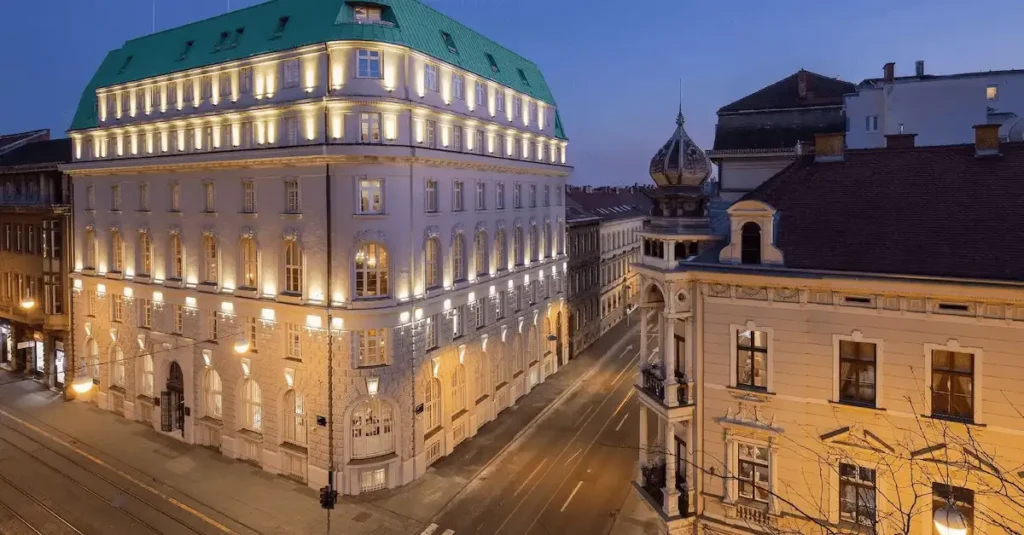
Hotel Capital Zagreb positions you within a 1923 Viennese banking fortress designed to project institutional dominance across Zagreb’s financial district. This isn’t retrofitted heritage—it’s a protected monument where Ernst Gotthilf and Alexander Neumann’s original vault doors, mahogany walls, and Art Deco stained glass still define the spatial experience. Less than 300 meters from Ban Jelačić Square, you occupy the center of power in Croatia’s capital city.
Hotel Capital Zagreb ★★★★
The hotel’s 47 rooms and suites occupy what was once the headquarters of an Austrian insurance and banking conglomerate—a building engineered to communicate financial permanence through massive stone masonry and triple-height banking halls. When the structure underwent transformation in 2018, the developers didn’t erase this history; they weaponized it. Original reinforced steel safes remain embedded in the lobby. Heavy vault doors frame corridors. The basement fitness center operates inside what were once secure deposit chambers.
Hotel Capital Zagreb is a sophisticated heritage hotel housed in a former 1920s bank headquarters, where guests stay in a masterpiece of Viennese Secession and Art Deco architecture just steps from Jelačić Square.
This is banking-glamour architecture: deep emerald wall panels, polished brass fixtures, restored oak parquet flooring from Slavonian forests. The design vocabulary speaks directly to guests who understand that institutional buildings from the 1920s weren’t constructed—they were fortified. Gotthilf and Alexander Neumann, both established Viennese architects, designed this headquarters during Zagreb’s peak economic expansion, when the city was consolidating its position as a central European financial hub under Austro-Hungarian influence.
The accommodations utilize the building’s oversized proportions. Ceilings soar beyond standard hotel measurements. Windows—originally designed to flood banking floors with natural light—now provide panoramic views across Zagreb’s tram-lined streets. Rooms feature high-thread-count bedding, pillow menus, and specialized soundproofing that counters the city’s ambient noise without sacrificing the architectural integrity of the original window frames.
The on-site restaurant occupies the former grand banking hall, where a soaring glass ceiling and marble pillars create the atmosphere of a space designed for serious transactions. You dine where deposit agreements were signed, loan terms negotiated, institutional power exercised. The “Capital” café maintains this tone—serving traditional Zagreb delicacies and international cuisine beneath architectural details that recall when this building was the nerve center of regional finance.
The meeting rooms operate inside historic boardrooms equipped with fiber-optic WiFi and modern AV systems, but the mahogany walls and original brass door handles remain untouched. These are spaces where authority has always been exercised—first by bankers, now by executives who understand that environment shapes outcomes.
Location is tactical. Jurišićeva Street places you in Zagreb’s Donji Grad (lower town), the city’s administrative and commercial core. Ban Jelačić Square—the central meeting point for all tram lines—is a three-minute walk. You’re not staying near the center; you’re occupying it. The National Theatre, Zagreb Cathedral, and the historic Upper Town funicular are all within immediate pedestrian range.
The building’s protected monument status ensures that no future renovation can compromise its structural integrity or architectural character. What you experience today is what will exist tomorrow—a rare guarantee in a hospitality market dominated by constant redesign cycles.
Check Availability & Rates →Hotel Capital Zagreb doesn’t reference its banking past—it inhabits it. The vault doors, the marble columns, the triple-height halls remain functional components of a stay defined by institutional scale. You occupy a monument to financial authority, preserved at the exact moment Zagreb established itself as a central European capital.
FAQ: Hotel Capital Zagreb
What is the historical significance of Hotel Capital Zagreb?
Hotel Capital Zagreb occupies the 1923 headquarters of an Austrian banking and insurance institution designed by Ernst Gotthilf and Alexander Neumann. The building is a protected cultural monument representing Zagreb’s early 20th-century economic expansion. Original features include reinforced steel vaults, Art Deco stained glass, and mahogany interiors that remain integrated into the current hotel design.
What makes Hotel Capital Zagreb’s architecture unique?
The hotel preserves the Secession and Art Deco architectural elements of its 1923 banking origin. Guests experience triple-height ceilings, oversized windows designed for banking floors, original Slavonian oak parquet, and functioning vault doors. The structure follows a corner-bank floor plan, providing rooms with panoramic street views across Zagreb’s central district.
Where is Hotel Capital Zagreb located in relation to Zagreb’s center?
Hotel Capital Zagreb stands on Jurišićeva Street in Donji Grad, less than 300 meters from Ban Jelačić Square—Zagreb’s central tram hub and meeting point. The location provides immediate pedestrian access to the National Theatre, Zagreb Cathedral, and the Upper Town funicular.
What dining and meeting facilities does Hotel Capital Zagreb offer?
The hotel’s restaurant and café occupy the former grand banking hall, featuring a glass ceiling and original marble pillars. Meeting rooms operate inside historic bank boardrooms equipped with modern technology while preserving mahogany walls and brass fixtures. All spaces maintain the institutional scale and material quality of the 1923 original design.
A Monument to Institutional Power in Zagreb’s Historic Core
Hotel Capital Zagreb delivers a stay defined by verifiable architectural permanence—a protected building where banking authority translates directly into modern hospitality command. For guests seeking accommodations that reflect Zagreb’s financial and cultural evolution, explore Esplanade Zagreb Hotel for a parallel experience of early 20th-century European grandeur.
For more curated itineraries and luxury-focused travel insights, visit Your Luxury Guide. For official travel information and destination updates, visit Croatia tourism-info.
Your Luxury Guide — Where Exceptional Travel Begins.