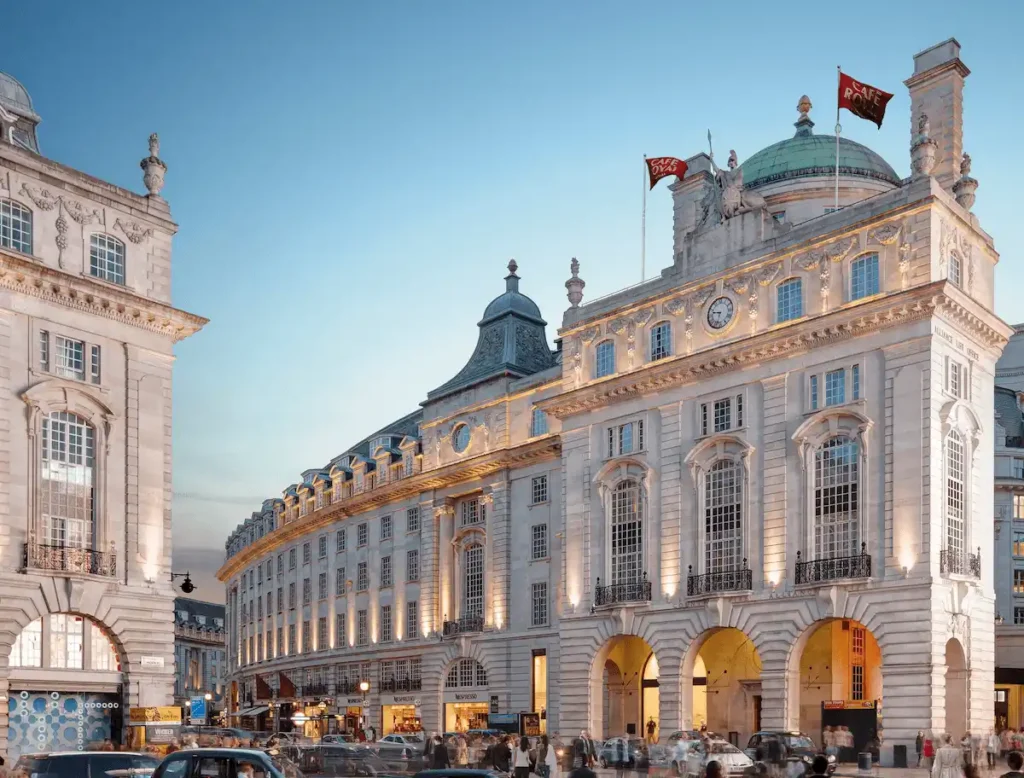
The Hotel Cafe Royal London occupies the triangular command point of Regent Street, a site hand-drawn by John Nash in 1811 to anchor the Crown Estate’s western corridor. This is not decorative heritage. This is verified territorial dominance: the building sits at the convergence of Piccadilly Circus and Air Street, controlling sightlines across one of London’s most trafficked intersections.
The 2012 restoration by David Chipperfield required 1,000 tonnes of Carrara marble and structural floor reinforcement to support the weight—elite-grade materials anchored to a Georgian street grid that still dictates London’s luxury geography.
Hotel Cafe Royal London ★★★★★
Daniel Nicholas Thévenon fled Paris in 1865, anglicized his name to Daniel Nicols, and opened a wine cellar on this Regent Street corner. Within a decade, it housed the finest wine collection in the world. By 1867, the Marquess of Queensberry Rules—the code that formalized modern boxing—were drafted in these rooms. The building became the headquarters of the National Sporting Club, where aristocrats regulated combat sports with the same precision they applied to Parliament.
Hotel Café Royal is a legendary Regent Street landmark where the 19th-century “living room of London” meets 21st-century minimalism.
Oscar Wilde made the Grill Room his daily salon. He drank absinthe beneath Louis XVI gilding, courted Lord Alfred Douglas in mirrored alcoves, and held court in what is now the Oscar Wilde Lounge—a gold-leaf-drenched cocoon of rococo excess where every surface reflects inherited authority.
Winston Churchill favored the same room for election-night steaks and Stilton, treating the space as a secondary command center during wartime London. Princess Diana, King George VI, and the Queen Mother all used this address as a public-facing throne room, knowing the building’s pedigree would authenticate their appearances.
The Dome Penthouse occupies 292 m² beneath the building’s iconic copper dome. This is not a suite; it is a circular residential command post with a private rooftop terrace overlooking Piccadilly Circus. The structure required bespoke engineering: the dome’s curvature dictated custom furniture, curved glass walls, and a 360-degree terrace that functions as a secured observation platform. Heads of state favor the Royal Wing—a 13-bedroom fortress formed by connecting adjoining suites—for maximum security during diplomatic summits.
Akasha Holistic Wellbeing descends 1,200 m² beneath street level. The 18-meter lap pool and London’s first Watsu hydrotherapy pool occupy the original wine cellars where Thévenon stored Bordeaux and Burgundy in the 1870s. The private Hammam uses the same thermal principles that powered Victorian-era Turkish baths, updated with Carrara marble and fumed English oak paneling. This is not a spa. This is a subterranean infrastructure where the elite recalibrate after commanding boardrooms and state dinners.
The Pompadour Ballroom, Grill Room, and Ten Room all hold Grade II-listed status. The 2012 restoration was executed by the same specialist team that rebuilt Windsor Castle after the 1992 fire—a pedigree that ensures every gilded panel, every mirrored wall, and every Louis XVI flourish meets Crown Estate standards.
Alex Dilling, a Michelin-starred restaurant overlooking Regent Street, anchors the property’s culinary authority. Albert Adrià—voted World’s Best Pastry Chef—operates Cakes & Bubbles on the ground floor, his first permanent London establishment.
The lobby’s Murano chandelier weighs 350 kg and cascades through a three-story atrium. It required custom rigging and counterweight engineering to suspend safely. This is not decoration. This is a 350-kilogram declaration that the building’s structural capacity matches its historical weight.
Every detail—from the rusticated Portland stone facade to the fumed oak joinery—reinforces the same message: this is a Crown Estate landmark where architecture, history, and modern luxury converge to create unrepeatable territorial authority.
Check Availability & Rates →To stay at Cafe Royal is to inhabit the command center of Victorian London’s intellectual elite—where Wilde debated art, Churchill strategized wars, and royalty authenticated their public presence beneath John Nash’s original street grid. This is not a hotel. This is Crown Estate infrastructure.
FAQ: Hotel Cafe Royal London
What makes Hotel Cafe Royal historically significant?
Built on John Nash’s 1811 Regent Street plan for the Crown Estate, it housed the world’s finest wine cellar by 1870 and served as the drafting site for the Marquess of Queensberry Rules in 1867. Oscar Wilde, Winston Churchill, and Princess Diana all used its Grade II-listed rooms as public command centers.
Why is the Dome Penthouse unique?
The 292 m² suite occupies the building’s iconic copper dome, requiring custom curved-glass engineering and a 360-degree rooftop terrace. It functions as a secured observation platform overlooking Piccadilly Circus, favored by diplomats and heads of state.
What is Akasha Holistic Wellbeing?
A 1,200 m² subterranean spa built into the original 1870s wine cellars. It features an 18-meter lap pool, London’s first Watsu hydrotherapy pool, and a private Hammam—all clad in Carrara marble used during the 2012 Crown Estate restoration.
Which restaurant holds Michelin stars at Hotel Cafe Royal?
Alex Dilling, a restaurant overlooking Regent Street, specializes in modern French cuisine. The hotel also houses Cakes & Bubbles, Albert Adrià’s first permanent London establishment, operated by the man voted World’s Best Pastry Chef.
The Command Point of London’s Luxury Corridor
Hotel Cafe Royal London does not compete with other historic hotels in the city—it predates most of them. The building occupies John Nash’s original 1811 street grid, anchors three Grade II-listed interiors, and required 1,000 tonnes of marble to meet modern Crown Estate standards. This is territorial authority authenticated by royal patronage, wartime strategy sessions, and Victorian intellectual dominance.
Explore The Ned London and Brown’s Hotel London for parallel heritage positions.
For more curated itineraries and luxury-focused travel insights, visit Your Luxury Guide. For official travel information and destination updates, visit Britain tourism-info.
Your Luxury Guide — Where Exceptional Travel Begins.