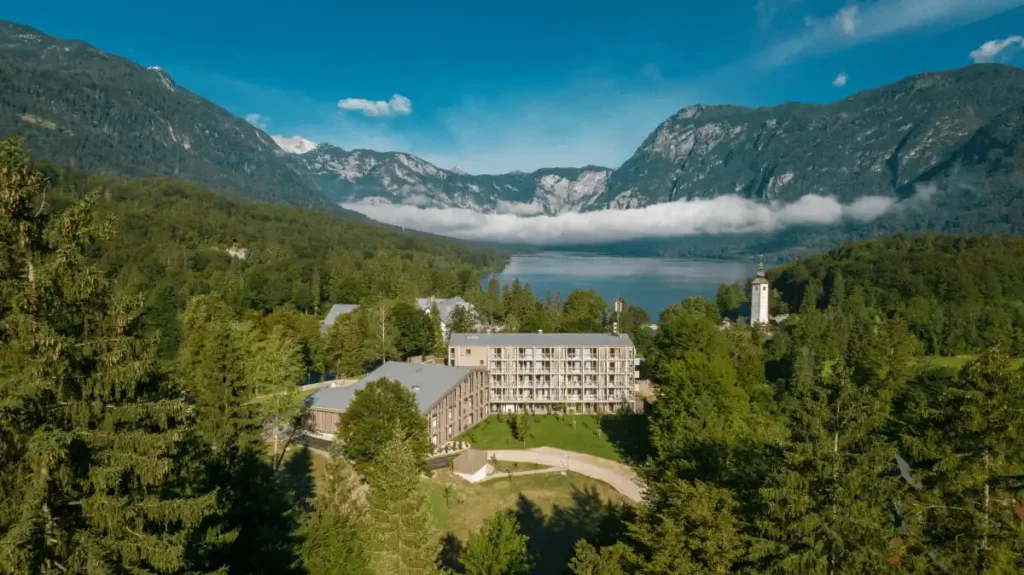
Hotel Bohinj is a 2021 architectural intervention by OFIS Architects, not a renovation. The former Hotel Kompas was stripped to its foundation and rebuilt as a structural exhibition of Slovenian larch, local limestone, and handcrafted furniture. The building sits 300 meters from Lake Bohinj’s shoreline, inside Triglav National Park, where it functions as both a design statement and a base for accessing Slovenia’s largest glacial lake.
The hotel’s public spaces reference the “toplar” (double hayrack), a traditional Slovenian agricultural structure, through geometric patterns in carpets, ceiling slats, and wall textures. Every room has a laser-cut silhouette of the Julian Alps on its headboard, with an ambient light marking the peak of Triglav—Slovenia’s highest mountain. This is spatial architecture built to anchor guests inside the geography they came to experience.
Hotel Bohinj ★★★★
The building’s exterior is encased in a structural frame of Slovenian larch—not cladding, but a seismic shield that integrates all drainage, lighting, and gutters into the wood itself. The design removes visual clutter and produces a facade that reads as a single architectural gesture. Inside, the materials are sourced from Slovenian manufacturers: recycled plastic-felt chairs, acoustic panels from post-consumer textiles, and terrazzo floors made with Alpine limestone aggregate. The ceramic work—sinks, tiles, wall details—was produced by regional craftsmen, not industrial suppliers.
Hotel Bohinj stands as a masterpiece of modern ‘Alpine Brutalism,’ offering a sophisticated retreat that honors Slovenian heritage through its hayrack-inspired architecture, sustainable larch design, and a vibrant social atmosphere at the foot of the Julian Alps.
The lobby floor contains black stone paw prints—a permanent memorial to Max, the resident cat of the original Hotel Kompas. This detail was specified by OFIS Architects to preserve continuity with the site’s former identity.
Each room is outfitted with furniture made from local oak and hand-forged iron. Select suites include wooden stationary bikes, hand-carved dumbbells, and professional yoga mats—equipment designed for guests who train independently and prefer private sessions over group classes. The headboard in every room features a cut-out of the Julian Alps, with a single light pointing to Triglav’s summit. This is a nightly spatial reminder of the 1778 ascent by four men from Bohinj—the first recorded climb of Slovenia’s national peak.
The hotel does not use high-intensity exterior lighting. All outdoor fixtures are restrained to protect the Triglav National Park ecosystem and support “dark sky” protocols. Interior lighting is warm-spectrum LED, designed to reduce blue light exposure and support natural circadian rhythms.
The outdoor fire garden is the hotel’s social center—a stone-lined pit surrounded by circular seating, used year-round for evening gatherings. The on-site heated pool is small and designed for floating, not lap swimming. The hotel describes Lake Bohinj itself as its “Olympic Pool,” emphasizing the 4.2-kilometer shoreline as the primary aquatic amenity. Guests receive custom picnic baskets and floating breakfast trays for use at the lake or in the spa pool.
The hotel maintains a fleet of high-end bicycles and e-bikes for exploring the Sava Bohinjka river trails. Guided botanical walks and mushroom foraging excursions are available through local specialists. Every Sunday, the lobby hosts a farmers’ market where producers from the valley sell Mohant cheese, wildflower honey, and handmade lace directly to guests.
The main restaurant’s menu is built around Bohinj ingredients: smoked trout from the lake, buckwheat žganci (spoonbread), and mountain curd. The second dining space is organized around a traditional terracotta stove, where guests can sample Karakter gin—distilled with Bohinj spring water—and zaseka, a regional lard spread. The wine program focuses on Alpine viticulture, with selections from Gorenjska and Primorska chosen for their mineral profiles.
Check Availability & Rates →Hotel Bohinj is a structural argument for regional materials—Slovenian larch, local limestone, handcrafted furniture—organized inside a brutalist frame that protects the building from seismic stress while removing all ornament. The design honors the valley’s agricultural past without replicating it, and every detail, from the fire garden to the dark-sky lighting, serves the geography the guest came to inhabit.
FAQ: Hotel Bohinj
What makes Hotel Bohinj architecturally significant?
Hotel Bohinj is a 2021 rebuild by OFIS Architects, using a structural frame of Slovenian larch as both seismic protection and façade. The design integrates all drainage, lighting, and gutters into the wood, creating a clean architectural line. Interior spaces reference the toplar (double hayrack), a traditional agricultural structure, through geometric patterns in floors and ceilings.
How far is Hotel Bohinj from Lake Bohinj?
The hotel is 300 meters from the lake’s shoreline. Guests receive custom picnic baskets and floating breakfast trays for lake use. The hotel provides bicycles and e-bikes for accessing the 4.2-kilometer shoreline and surrounding Sava Bohinjka river trails.
What room features are specific to Hotel Bohinj?
Every room has a laser-cut Julian Alps silhouette on the headboard, with an ambient light marking Triglav’s peak. Select suites include wooden stationary bikes, hand-carved dumbbells, and yoga mats for private training. All furniture is made from local oak and hand-forged iron.
Does Hotel Bohinj offer guided outdoor activities?
The hotel organizes botanical walks, mushroom foraging excursions, and cycling routes through Triglav National Park. A Sunday farmers’ market in the lobby connects guests with local producers selling Mohant cheese, honey, and handmade crafts.
The Alpine Brutalist Legacy
Hotel Bohinj is proof that architectural intervention can honor a site’s history without replicating its forms. The 2021 rebuild by OFIS Architects replaced outdated infrastructure with a seismic-resistant larch frame, handcrafted interiors, and materials sourced from Slovenian workshops. The design eliminates decorative excess and focuses on spatial function—every detail, from the fire garden to the paw prints in the lobby floor, serves the guest’s connection to Lake Bohinj and the Julian Alps.
For a comparative perspective on the region’s luxury properties, explore Vila Planinka and Hotel Triglav Bled—both offer distinct approaches to Alpine hospitality within Triglav National Park’s protected landscape.
More curated itineraries and luxury-focused travel insights at Your Luxury Guide. For official travel information and destination updates, visit Slovenia tourism.
Your Luxury Guide — Where Exceptional Travel Begins.