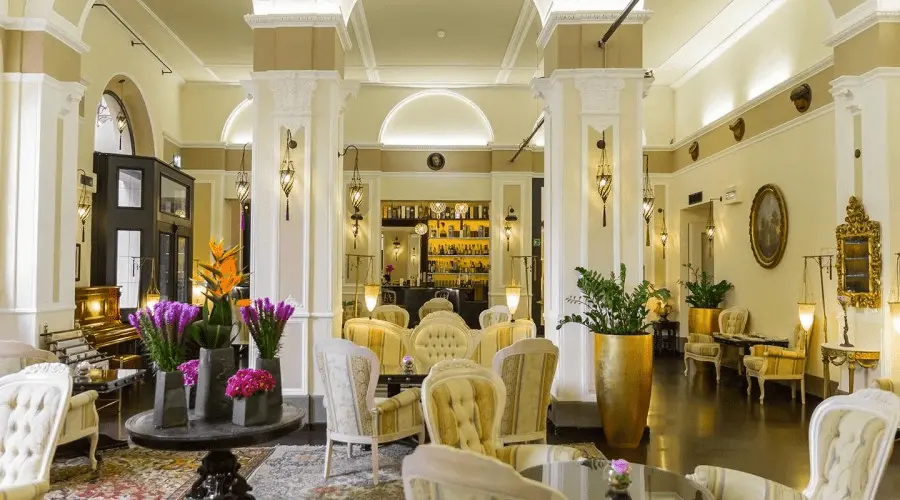
Hotel Bernini Palace Florence occupies a 15th-century palazzo built by the Pera family—Ghibelline nobility mentioned in Dante’s Divine Comedy. Between 1865 and 1871, when Florence served as Italy’s capital, this building housed members of parliament; its Sala del Parlamento, now the breakfast hall, retains original 19th-century frescoes depicting Risorgimento leaders.
The palace blends Florentine Renaissance architecture with Moorish decorative motifs introduced during the capital era. Today’s guests inhabit chambers where senators once debated the future of a unified nation.
Hotel Bernini Palace Florence ★★★★★
When Florence became the Kingdom of Italy’s capital in 1865, the sudden influx of European diplomats and parliamentary officials required immediate aristocratic housing. The 15th-century Palazzo Pera—strategically positioned behind Piazza della Signoria—was selected and transformed into the primary residence for members of parliament.
Hotel Bernini Palace Florence is a prestigious historic residence that offers guests the chance to stay within a 15th-century palace that once served as the meeting place for the Italian Parliament, blending Renaissance elegance with profound political heritage.
For six years, this building operated as the political nerve center of a newly unified Italy. Senators and deputies convened daily in the grand hall; the hotel’s bar, known as “the Buvette,” became the most influential social hub in the nation, where backroom negotiations shaped Italy’s constitutional framework.
The Pera family, original owners and Ghibelline partisans, had occupied this site since the medieval period. Dante Alighieri referenced them in Inferno (Canto XVII), situating the family within Florence’s political elite. The palazzo’s architecture reflects this dual heritage: the Renaissance structure—terracotta floors, wrought iron details, coffered ceilings—overlaid with 19th-century Moorish decorative motifs introduced during the capital transformation. The result is a spatial narrative where medieval Florentine power transitions into modern Italian statehood.
The Sala del Parlamento, today’s breakfast hall, preserves its parliamentary function through original frescoes depicting protagonists of the Risorgimento: Cavour, Garibaldi, Mazzini. Guests take morning espresso beneath the same vaulted ceiling where senators debated constitutional articles. This is not decorative historicism; the room’s political iconography establishes the property as a documented seat of national authority.
Premium Loggia View Rooms offer private balconies overlooking the San Firenze district‘s medieval streets, with direct sightlines to Palazzo Vecchio’s crenellated tower. Several Frescoed Suites feature 18th and 19th-century ceiling paintings and original structural elements that have remained untouched since the parliamentary era. The accommodations are not “themed”; they are the unaltered residential spaces of Italy’s founding political class.
The Panoramic Rooftop Terrace provides 360-degree views of the Florentine skyline—Brunelleschi’s Duomo, the Fiesole hills, the Arno. La Chiostrina Restaurant, set in the palazzo’s inner courtyard, specializes in refined Tuscan preparations: Bistecca alla Fiorentina, pappardelle al cinghiale, traditional antipasti using local silks and terracotta presentations that mirror the building’s material vocabulary.
The Historic Bar maintains the atmosphere of a 19th-century gentlemen’s club, serving Negronis in the same space where parliamentary deputies conducted informal negotiations.
The palazzo sits within Florence’s restricted traffic zone, ensuring quiet while remaining less than five minutes’ walk from the Uffizi Gallery and Ponte Vecchio. This is pedestrian centrality anchored by verifiable historical dominance: guests inhabit the exact building where Italy’s parliamentary elite lived during the capital years, sleeping in chambers where constitutional debates were drafted, dining in halls where senators shaped a nation’s future.
Check Availability & Rates →Here, beneath frescoes of Risorgimento architects and within walls that hosted Italy’s first parliamentary debates, guests inhabit a documented seat of national authority—where 15th-century Pera nobility converges with 19th-century statehood, and the guest becomes a transient steward of Florence’s political legacy.
FAQ: Hotel Bernini Palace Florence
What is the historical significance of Hotel Bernini Palace Florence?
Hotel Bernini Palace Florence occupies a 15th-century palazzo originally owned by the Pera family, mentioned by Dante in the Divine Comedy. Between 1865 and 1871, when Florence served as Italy’s capital, the building housed members of parliament. The Sala del Parlamento, now the breakfast hall, retains original 19th-century frescoes depicting Risorgimento leaders. The hotel’s bar was the era’s most influential political salon.
What architectural styles are featured at Hotel Bernini Palace?
The palazzo blends Florentine Renaissance architecture—terracotta floors, wrought iron, coffered ceilings—with 19th-century Moorish decorative motifs introduced during Florence’s capital transformation (1865-1871). The result is a unique fusion where medieval Ghibelline nobility aesthetics meet the ornamental language of unified Italy’s parliamentary era.
What rooms offer the best views at Hotel Bernini Palace Florence?
Premium Loggia View Rooms feature private balconies overlooking the San Firenze district’s medieval streets, with direct sightlines to Palazzo Vecchio’s tower. The Panoramic Rooftop Terrace provides 360-degree views of the Duomo, Fiesole hills, and the Arno. Frescoed Suites offer ceiling paintings and original structural elements from the 18th and 19th centuries.
How close is Hotel Bernini Palace to Florence’s main attractions?
The palazzo sits within Florence’s restricted traffic zone, ensuring quiet residential character. It is less than a five-minute walk from the Uffizi Gallery and Ponte Vecchio, and directly behind Piazza della Signoria. This central pedestrian location provides immediate access to Florence’s Renaissance core while maintaining the exclusivity of a noble residence.
The Continuity of Florentine Authority
Hotel Bernini Palace Florence is not a hotel with historical elements; it is a parliamentary residence repurposed for contemporary hospitality. The building’s 15th-century Pera origins, its six-year function as Italy’s legislative seat, and its preservation of Risorgimento iconography establish it as a documented seat of national authority.
Guests inhabit the same chambers where senators drafted constitutional articles, dine beneath frescoes of unification leaders, and occupy a palazzo mentioned in Inferno. This is the rare convergence of medieval nobility, 19th-century statehood, and modern luxury—a property where Florentine political legacy defines every spatial experience.
For those seeking similar heritage authority, explore the Brunelleschi Hotel Florence or the hillside grandeur of Villa San Michele Florence.
More curated itineraries and luxury-focused travel insights at Your Luxury Guide. For official travel information and destination updates, visit Italy tourism.
Your Luxury Guide — Where Exceptional Travel Begins.