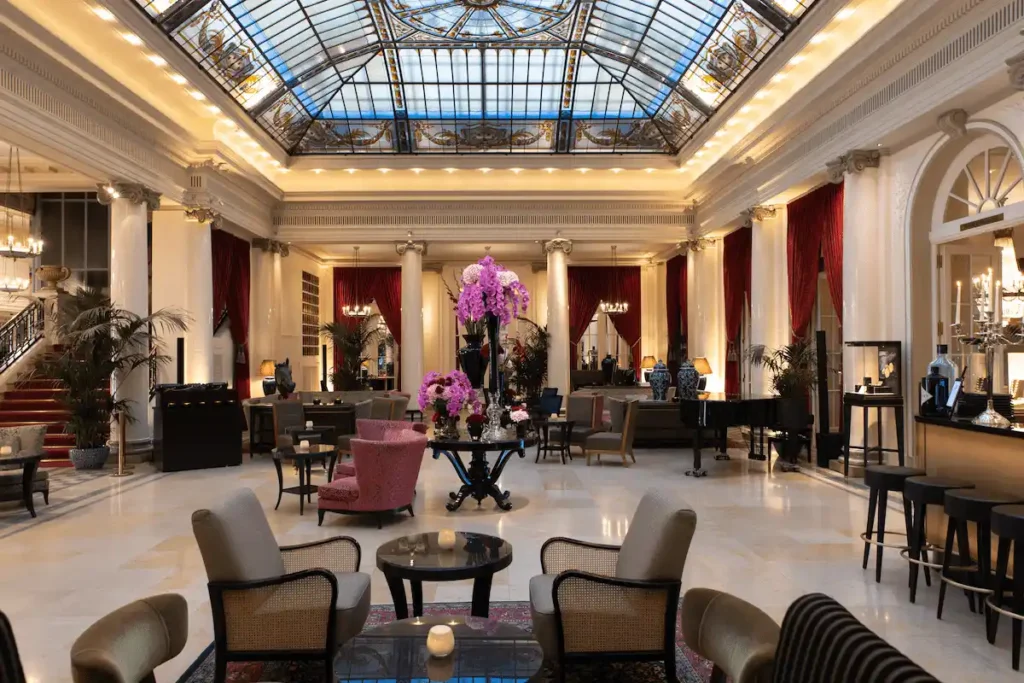
Hotel Bellevue Palace Bern stands as Switzerland’s only state-owned Grand Hotel, a 1913 Neo-Classical fortress that served as General Ulrich Wille’s WWI military headquarters and Allen Dulles’ Cold War intelligence nerve center. The Swiss National Bank purchased it in 1976 to prevent Soviet acquisition—establishing it as the nation’s official diplomatic residence where heads of state inhabit the same 158 sqm Presidential Suite that hosted Gorbachev, Mandela, and Castro.
This is the architectural seat of Swiss neutrality, not a tourist hotel, but the factual command post where global power has been negotiated for 112 years. Explore more properties in our guide to the best historic hotels in Bern.
Hotel Bellevue Palace Bern ★★★★★
The Hotel Bellevue Palace Bern is not simply historic—it is the operational headquarters of Swiss diplomatic power. Opened in 1913 as Switzerland’s first entirely reinforced concrete structure, this Neo-Classical monument was engineered as a fortress of permanence during the final years of Europe’s imperial order. When General Ulrich Wille established his WWI military command center within these walls in 1914, the hotel transitioned from luxury accommodation to strategic infrastructure. That precedent was never reversed.
Hotel Bellevue Palace Bern is the official 19th-century guesthouse of the Swiss government, famously featuring the country’s oldest American bar and a luxury wellness area.
During WWII and the Cold War, the Bellevue Bar became the continent’s most concentrated espionage theater. OSS station chief Allen Dulles operated from its corners, while novelist John le Carré observed the same diplomatic theater that would later define his fiction. The hotel’s proximity to the Federal Palace made it the inevitable meeting ground for intelligence officers, diplomats, and power brokers navigating the razor’s edge of Swiss neutrality.
By the 1970s, Cold War tensions escalated to the point where the Swiss National Bank executed a preemptive acquisition in 1976—purchasing the property outright to block a potential Soviet embassy conversion. The transaction formalized what had always been implicit: this building is a national asset, owned by the Swiss Confederation and designated as the official guesthouse of the Swiss government.
The 158 sqm Presidential Suite is not ceremonial. It is the factual residence for visiting heads of state, featuring direct views of the Bernese Alps and the Aare River—the same sightlines that framed negotiations between Mikhail Gorbachev and Western diplomats. Nelson Mandela occupied this suite. Fidel Castro occupied this suite. Queen Elizabeth II occupied this suite. The architecture does not accommodate guests; it stages authority.
The hotel’s 126 rooms and 25 suites retain their Art Nouveau origins—stained-glass lobby ceilings, parquet floors, and proportions calibrated for turn-of-the-century grandeur. But the real infrastructure is institutional. The top-floor Bellevie Gym and wellness area, featuring Finnish sauna and steam bath, overlook Bern’s rooftops—not for leisure, but as a calculated vertical advantage. The 77 sqm Tower Suite includes its own private fitness area, a spatial luxury reserved for prolonged state visits. These are not amenities; they are the physical requirements of sustained diplomatic presence.
Gastronomy operates at the same elevated threshold. Brasserie VUE holds 15 GaultMillau points, while Noumi Bar & Grill functions as the social nexus for Bern’s political establishment. The hotel terrace is recognized as the capital’s definitive vantage point for Alpine views—a geographic fact that has made it the preferred setting for high-stakes informal diplomacy since 1913. This is where Bruce Springsteen, Sophia Loren, and Charlie Chaplin stayed when their presence in Switzerland required institutional discretion.
The Bellevue Bar remains Switzerland’s oldest American bar, a designation that underscores its role as neutral ground during a century of geopolitical turbulence. During the Cold War, it was designated “the best-protected building in Europe” due to security protocols that transformed the hotel into a civilian fortress. Those protocols persist. State security is woven into the operational fabric of the property, invisible but absolute.
Check Availability & Rates →Swiss neutrality is not passive—it is architecturally enforced. At the Bellevue Palace, you inhabit the same suites where the 20th century’s most consequential power negotiations took place, framed by Alpine vistas that have witnessed 112 years of global realignment. This is not heritage tourism. This is institutional authority made spatial.
FAQ: Hotel Bellevue Palace Bern
Why is Hotel Bellevue Palace Bern owned by the Swiss government?
In 1976, the Swiss National Bank purchased Hotel Bellevue Palace Bern to prevent its acquisition by the Soviet Union for conversion into an embassy. The property now serves as the official guesthouse of the Swiss Confederation, hosting visiting heads of state and maintaining its status as a national diplomatic asset rather than a commercial hotel.
What historical role did Hotel Bellevue Palace Bern play during the World Wars?
During WWI, General Ulrich Wille used Hotel Bellevue Palace Bern as Switzerland’s military headquarters. In WWII and the Cold War, its bar became a central espionage hub where OSS station chief Allen Dulles and international intelligence operatives conducted covert diplomacy. The hotel was dubbed “the best-protected building in Europe” during Cold War summit negotiations.
Which world leaders have stayed at Hotel Bellevue Palace Bern?
The 158 sqm Presidential Suite at Hotel Bellevue Palace Bern has hosted Queen Elizabeth II, Mikhail Gorbachev, Nelson Mandela, Fidel Castro, and numerous other heads of state since 1913. The suite features direct views of the Bernese Alps and Aare River, serving as the factual residence for official state visits to Switzerland.
What makes Hotel Bellevue Palace Bern architecturally significant?
Opened in 1913, Hotel Bellevue Palace Bern was Switzerland’s first building constructed entirely of reinforced concrete—a revolutionary engineering method. Its Neo-Classical design includes 126 rooms and 25 suites with original Art Nouveau details, stained-glass lobby ceilings, and parquet floors, establishing it as a landmark of early 20th-century Swiss architecture.
The Swiss Confederation’s Living Archive
Hotel Bellevue Palace Bern remains the operational standard for state-level hospitality in Switzerland—a property where diplomatic precedent is not remembered but actively maintained. From its 1913 concrete foundation to its Cold War fortress protocols, the hotel represents institutional authority made permanent. For those seeking comparable command of space and legacy, continue to Hotel Schweizerhof Bern.
For more curated itineraries and luxury-focused travel insights, visit Your Luxury Guide. For official travel information and destination updates, visit Switzerland tourism-info.
Your Luxury Guide — Where Exceptional Travel Begins.