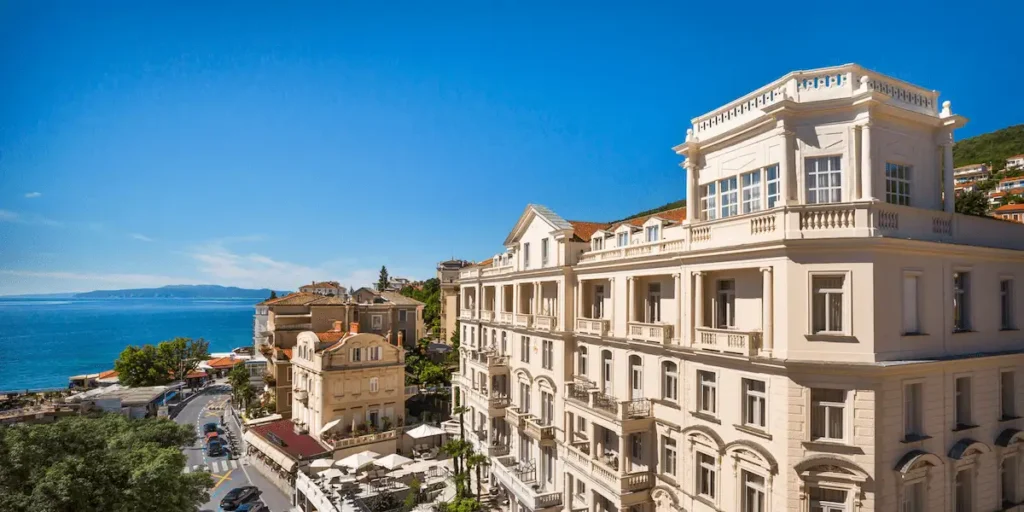
Hotel Bellevue Opatija has dominated the town’s skyline since 1891, when it was erected as a visual beacon for vessels navigating the Kvarner Gulf. Commissioned during Opatija’s transformation into the Austro-Hungarian Empire’s premier health resort, the neo-baroque structure served as both imperial accommodation and social command center.
Today, the 87-room property retains its original high ceilings and romantic Belle Époque interiors while offering direct access to Marshal Tito Street’s urban pulse. This is where Adriatic history meets metropolitan sophistication—explore more at best historic hotels in Opatija.
Hotel Bellevue Opatija ★★★★
The Hotel Bellevue was constructed in 1891 as a deliberate assertion of architectural dominance. Positioned along Marshal Tito Street—Opatija’s central artery—the building was designed to be visible from the Kvarner Gulf, functioning as a maritime landmark for incoming ships during the Austro-Hungarian Empire’s peak. This wasn’t merely decorative ambition; the neo-baroque and Secession styling reflected Vienna’s imperial authority, establishing Opatija as a health resort worthy of Europe’s elite.
Hotel Bellevue is a monumental neo-baroque landmark in the center of Opatija, offering a refined blend of 19th-century imperial charm and modern wellness facilities just steps from the central Slatina beach and the Lungomare promenade.
The building’s original purpose was to accommodate Vienna’s aristocracy and wealthy industrialists seeking therapeutic Mediterranean air. Over 130 years, the Bellevue has retained this function while adapting to modern expectations. The property underwent comprehensive modernization to 4-star standards, yet its romantic interiors—high ceilings, carpeted hallways, and period-inspired furniture—remain intact.
The 87 guest rooms maintain Belle Époque aesthetics with soft color palettes and balconies overlooking both the Adriatic Sea and Opatija’s vibrant street life.
What distinguishes the Bellevue from isolated coastal resorts is its urban integration. Guests inhabit a city-hotel experience where the balcony view captures both maritime tranquility and the social activity of Marshal Tito Street below. This dual perspective—sea and society—was intentional from the building’s inception, positioning guests at the intersection of natural beauty and imperial urban planning.
The hotel’s social infrastructure centers on Café Strauss, a traditional Viennese coffee house that replicates the Habsburg cultural model. Here, homemade desserts and craft coffee are served in an environment designed to evoke the imperial café tradition where political and artistic elites conducted informal business. The café wasn’t added as a thematic attraction; it’s a continuation of the building’s original function as a gathering point for Opatija’s influential visitors.
Physical amenities are mapped directly onto the historic footprint. The large indoor swimming pool uses heated seawater—a therapeutic feature dating to the resort’s early emphasis on health treatments. The comprehensive spa zone includes Finnish sauna, Turkish bath, and specialized massage rooms, all housed within spaces that once served similar purposes for 19th-century guests. The state-of-the-art fitness center occupies what was historically the hotel’s active leisure area, maintaining functional continuity across eras.
The Bellevue’s dining infrastructure reflects its role as a social command center. The buffet restaurant specializes in Mediterranean and Liburnian cuisine, utilizing local ingredients within menus that echo the cosmopolitan gastronomy served to original imperial guests. The Lobby Bar operates as the hotel’s informal gathering point—a spatial role it has maintained since the building’s opening, when hotel lobbies functioned as semi-public social theaters for the elite.
Guest rooms are equipped with climate-controlled air conditioning, flat-screen satellite TVs, high-speed WiFi, and minibars—modern utilities integrated into structures designed for oil lamps and telegrams. This technological layering allows contemporary guests to inhabit a space where historic proportions (high ceilings, grand windows) create a sense of imperial scale while modern systems ensure comfort.
The hotel’s location provides immediate access to the 12 km Lungomare coastal path and the historic Angiolina Park, both of which were engineered as recreational infrastructure for 19th-century resort society. Walking these routes places guests within the same landscape framework that attracted Habsburg aristocracy, though now with cycling paths and modern amenities integrated into the original design.
Check Availability & Rates →The Bellevue commands the Kvarner skyline as it did when Austrian ships first sighted its neo-baroque facade—a maritime landmark where imperial architecture still defines urban prestige along the Adriatic’s most historic boulevard.
FAQ: Hotel Bellevue Opatija
What is the historical significance of Hotel Bellevue Opatija?
Hotel Bellevue was built in 1891 as a neo-baroque landmark designed to be visible from the Kvarner Gulf, serving as both accommodation and visual beacon during Opatija’s rise as the Austro-Hungarian Empire’s premier health resort. For over 130 years, it has functioned as a social command center on Marshal Tito Street, maintaining its role as a gathering point for elite visitors while preserving Belle Époque interiors and imperial architectural proportions.
What makes Hotel Bellevue different from other Opatija properties?
Unlike isolated coastal resorts, Hotel Bellevue offers a city-hotel experience where balcony views capture both Adriatic seascapes and the urban pulse of Marshal Tito Street. The property features Café Strauss, an authentic Viennese coffee house replicating Habsburg café culture, and a heated seawater indoor pool that continues the building’s original therapeutic function as a 19th-century health destination.
What amenities does Hotel Bellevue Opatija provide?
The 4-star property features 87 rooms with Belle Époque decor, high ceilings, and climate-controlled air conditioning. Guests access a comprehensive spa zone with Finnish sauna, Turkish bath, and massage rooms, plus a state-of-the-art fitness center. The on-site buffet restaurant serves Mediterranean and Liburnian cuisine, while Café Strauss offers traditional Viennese coffee culture. All rooms include flat-screen satellite TV, high-speed WiFi, and minibars.
How does Hotel Bellevue connect to Opatija’s historic attractions?
Located on Marshal Tito Street, the hotel provides immediate access to the 12 km Lungomare coastal walking trail and historic Angiolina Park—both engineered as 19th-century recreational infrastructure for Habsburg resort society. Guests inhabit the same spatial framework that attracted Austrian aristocracy, now enhanced with modern cycling paths and urban amenities integrated into the original imperial design.
Imperial Legacy on the Adriatic
Hotel Bellevue Opatija stands where Austro-Hungarian ambition first transformed the Kvarner coast into Europe’s elite health resort. The 1891 structure continues to function as both maritime landmark and social command center, offering modern guests the same skyline dominance and therapeutic infrastructure that attracted Vienna’s aristocracy.
Experience more imperial heritage at Hotel Imperial Opatija and Hotel Kvarner Opatija.
For more curated itineraries and luxury-focused travel insights, visit Your Luxury Guide. For official travel information and destination updates, visit Croatia tourism-info.
Your Luxury Guide — Where Exceptional Travel Begins.