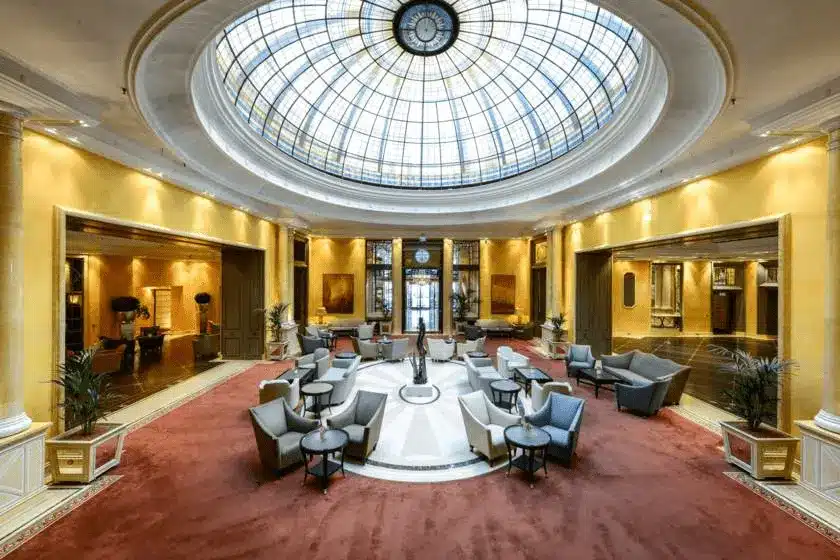
Hotel Bayerischer Hof stands as King Ludwig I’s direct architectural mandate—commissioned October 15, 1841, through royal architect Friedrich von Gärtner to establish Munich’s first institution-grade hospitality. The monarch’s obsession with the property’s modern bathtub facilities drove bi-monthly personal visits, cementing the estate’s role as Bavaria’s official reception ground for European royalty.
Four generations of Volkhardt family stewardship have maintained this unbroken lineage of command, positioning guests within the same halls where Empress Elisabeth and Sigmund Freud once held court.
For those seeking accommodation anchored by verified provenance, explore our curated collection of the best historic hotels in Munich.
Hotel Bayerischer Hof ★★★★★
King Ludwig I didn’t commission hotels—he commissioned instruments of state authority. When Friedrich von Gärtner delivered the Bayerischer Hof blueprint in 1841, he engineered Bavaria’s first purpose-built diplomatic reception facility. The monarch’s twice-monthly bathtub pilgrimages weren’t eccentricity; they were calculated demonstrations that modern hygiene infrastructure equaled civilizational advancement.
Every European head of state traveling through Munich understood the assignment: audiences at the Bayerischer Hof carried the weight of royal endorsement.
Hotel Bayerischer Hof is Munich’s legendary “Grand Dame,” a family-owned icon established at the request of King Ludwig I, where guests can enjoy a retractable rooftop pool and a world-class jazz club in the heart of the historic Altstadt.
The Allied bombing campaign of April 24–25, 1944, reduced the complex to structural skeleton—except the Spiegelsaal. While Munich burned, this Hall of Mirrors remained intact beneath the rubble, its survival interpreted by post-war society as architectural predestination.
Falk Volkhardt reopened the property in October 1945 as the city’s first functioning restaurant, establishing immediate control over Munich’s social reconstruction narrative. The 1969 acquisition and integration of the adjacent Palais Montgelas—built 1811—expanded the family’s territorial footprint while absorbing another layer of Napoleonic-era aristocratic infrastructure.
The current 337-room configuration distributes guests across deliberately segregated design epochs: Cosmopolitan floors for modern authority, Colonial wings for those signaling empire nostalgia, Laura Ashley suites for old-money discretion, and Graf Pilati chambers for guests fluent in European textile heritage.
Belgian master Axel Vervoordt’s 2024/2025 lobby redesign eliminated all mid-century compromise, installing raw materials and monochrome textiles that communicate institutional permanence. His earlier interventions—the Atelier restaurant (Michelin-starred), the 38-seat Cinema Lounge with private screening capability, and both South and North wings—function as integrated power environments where wealthy patrons conduct business across breakfast, film screenings, and late-night negotiations.
The rooftop Blue Spa operates as vertical territory: 1,300 square meters across three floors, crowned by Andrée Putman’s retractable glass dome that transforms Munich’s skyline into proprietary backdrop. This isn’t wellness theater—it’s altitude advantage, where guests physically occupy the city’s highest private bathing ground.
Below, five restaurants segment the culinary hierarchy: Atelier for those requiring Michelin validation, Trader Vic’s authentic Polynesian interiors for guests signaling Pacific corporate ties, and Palais Keller’s 15th-century salt vaults for those demanding literal underground history with their wine cellars.
The Night Club has hosted six decades of international jazz, blues, and soul programming—not as entertainment, but as cultural annexation. When artists perform at the Bayerischer Hof, they enter the Volkhardt family’s curated historical record. The on-site Komödie theatre (600 seats) functions identically: boulevard performances become property legacy.
The Penthouse Garden Suite crowns the entire operation—350 square meters consuming the 8th floor, wrapped by a 360-degree terrace where guests command unobstructed visual control over Munich’s historic center.
The Volkhardt family‘s 127-year unbroken ownership record (1897–2025, now fourth and fifth generation under Innegrit Volkhardt) represents something increasingly rare in European luxury: multi-generational territorial defense. While corporate hospitality groups churn ownership every decade, this property’s decision-making authority has remained within a single family structure across two world wars, Munich’s reconstruction, and the entire modern tourism era.
Guests aren’t booking accommodations—they’re entering a family compound where Empress Elisabeth, Sigmund Freud, and Michael Jackson all previously sought the same protection: proximity to power that predates and will outlast contemporary politics.
Check Availability & Rates →Where King Ludwig I installed Bavaria’s first modern bathtubs to prove civilizational superiority, today’s guests command the same territorial advantage—a rooftop spa, Michelin dining, and private cinema across an estate that survived Allied bombardment to remain Munich’s unbroken seat of hospitality authority for 184 years.
FAQ: Hotel Bayerischer Hof
What makes Hotel Bayerischer Hof historically significant?
King Ludwig I commissioned Hotel Bayerischer Hof on October 15, 1841, through royal architect Friedrich von Gärtner as Bavaria’s first state-grade hospitality facility. The monarch conducted bi-monthly personal inspections, primarily to utilize the property’s pioneering modern bathtub system—establishing the estate as the official reception ground for European royalty. The Volkhardt family has maintained unbroken ownership since 1897, surviving the April 1944 Allied bombing that destroyed the entire complex except the Spiegelsaal (Hall of Mirrors), which remained intact beneath the rubble.
What are Hotel Bayerischer Hof’s key amenities?
The property operates five restaurants including the Michelin-starred Atelier (designed by Axel Vervoordt), Trader Vic’s authentic Polynesian venue, and Palais Keller in 15th-century salt vaults. The rooftop Blue Spa spans 1,300 square meters across three floors with Andrée Putman’s retractable glass dome. Additional facilities include a 38-seat private Cinema Lounge, the 600-seat Komödie boulevard theatre, an international jazz Night Club, and the 350-square-meter Penthouse Garden Suite with 360-degree terrace commanding Munich’s historic center.
Which notable figures have stayed at Hotel Bayerischer Hof?
Empress Elisabeth (Sisi), Sigmund Freud, and Michael Jackson are among the documented high-profile guests. The property serves as official headquarters for world leaders attending the annual Munich Security Conference, maintaining its founding role as Bavaria’s diplomatic reception facility. The estate’s 184-year operational continuity under single-family ownership has established it as Munich’s institutional seat for political, cultural, and economic authority.
What survived the 1944 Allied bombing of Hotel Bayerischer Hof?
The April 24–25, 1944, bombardment reduced the entire complex to ruins except for the Spiegelsaal (Hall of Mirrors), which remained structurally intact beneath the debris. Falk Volkhardt reopened the property in October 1945 as Munich’s first post-war restaurant, establishing immediate control over the city’s social reconstruction. The 1969 acquisition and integration of the adjacent 1811 Palais Montgelas further expanded the estate’s historic territorial footprint.
Enduring Authority at Munich’s Royal Seat
The Volkhardt family’s 127-year territorial defense of King Ludwig I’s original 1841 commission represents what institutional hospitality should be: multi-generational command of infrastructure where European royalty, global diplomats, and cultural authorities have exercised power across two centuries.
Guests seeking equivalent historic weight within Munich’s luxury landscape should consider Mandarin Oriental Munich and Vier Jahreszeiten Kempinski Munich.
For more curated itineraries and luxury-focused travel insights, visit Your Luxury Guide. For official travel information and destination updates, visit Germany tourism-info.
Your Luxury Guide — Where Exceptional Travel Begins.