Hotel Adlon Kempinski Berlin stands on Pariser Platz as the physical monument to Lorenz Adlon’s 20 million gold mark investment—the most expensive hotel construction in European history when it opened in 1907. Kaiser Wilhelm II paid an annual retainer of 150,000 gold marks to guarantee rooms remained perpetually available for his state visitors, refusing entry to anyone else on opening day until he personally crossed the threshold first.
The building survived Allied bombings only to burn two days after Berlin fell, its wine cellars igniting during Soviet celebrations. The 1997 reconstruction maintains the imperial aesthetic one story higher, positioning guests within the same power corridor where Einstein waved from corner windows and diplomats negotiated Cold War terms in neutral territory.
For confirmed positioning within Berlin’s documented seat of authority, explore the finest collection of best historic hotels in Berlin.
Hotel Adlon Kempinski Berlin ★★★★★
The Hotel Adlon Kempinski Berlin occupies the original 1907 footprint on Pariser Platz where Lorenz Adlon deployed 20 million gold marks to construct Europe’s most expensive hotel. Kaiser Wilhelm II formalized the building’s status as imperial extension by contracting 150,000 annual gold marks to maintain permanent room availability for state guests, personally inspecting the property before allowing public entry.
The original structure housed Germany’s first private power plant generating 110-volt current and a cooling system fed by deep-well engineering, establishing technological dominance that matched its political function.
Hotel Adlon Kempinski Berlin is Germany’s most legendary hotel, a meticulously rebuilt Baroque Revival palace that has hosted the 20th century’s greatest icons at the very foot of the Brandenburg Gate.
The property’s 1945 destruction – not by Allied bombardment but by celebratory fire in its legendary wine cellars after Soviet forces secured Berlin – removed the physical structure while cementing its legacy. One wing survived as the “Adlon-Bungalow,” operating through East German administration as a documented meeting site for diplomatic and intelligence exchanges until 1984 demolition. The current, 1997 reconstructed, building rises one story above original height, maximizing spatial capacity within New Traditionalist architecture that preserves the Brandenburg Gate sightlines Adlon designed for imperial observation.
The 336 rooms and suites occupy the power corridor where Charlie Chaplin required police extraction from fan crowds in 1931, where Greta Garbo delivered “I want to be alone” during Grand Hotel filming, and where Albert Einstein maintained a permanent corner window overlooking Pariser Platz.
The Adlon Imperial Suite deploys personal butler service, integrated sauna and whirlpool systems, and security protocols established through decades hosting US Presidents and heads of state. Each element maps directly onto the building’s documented function as “the government’s unofficial guesthouse” through two world wars and Cold War partition.
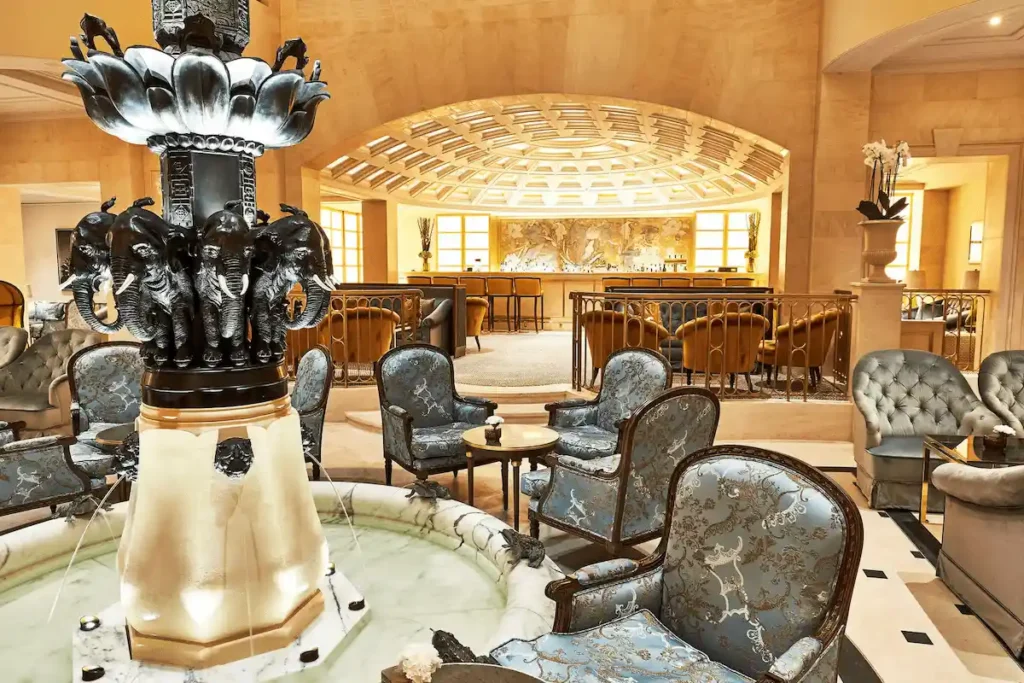
The Lorenz Adlon Esszimmer maintains Michelin-star status by executing French haute cuisine through Prussian culinary doctrine, while the elephant fountain—gifted by the Maharaja of Patiala in 1930—incorporates original 1907 stained glass within its replica structure. The property’s famous luxury currywurst topped with gold leaf translates Berlin’s street food dominance into five-star presentation, maintaining the Adlon tradition of elevating German cultural assets to international luxury standard.
Suite 413’s balcony achieved global recognition during Michael Jackson‘s 2002 incident, demonstrating how the building continues generating cultural authority beyond its imperial foundation.
Guests inhabit rooms where diplomatic negotiations determined Cold War outcomes, where entertainment legends established Berlin as creative capital, and where the Kaiser himself maintained permanent territorial claim through financial contract. The property functions not as historic recreation but as continuation of documented power operations across 117 years of verified political and cultural dominance.
Check Availability & Rates →The 20 million gold mark investment purchased more than architectural grandeur—it secured permanent positioning within the physical corridor where kaisers, presidents, and global celebrities have exercised Berlin’s concentrated authority since 1907, now available as five-star imperial inheritance on Pariser Platz.
FAQ: Hotel Adlon Kempinski Berlin
What makes Hotel Adlon Kempinski Berlin historically significant?
Hotel Adlon Kempinski Berlin was built in 1907 with a 20 million gold mark investment—Europe’s most expensive hotel construction at the time. Kaiser Wilhelm II paid 150,000 gold marks annually to reserve rooms permanently for state visitors, establishing it as imperial extension rather than commercial property. The building served as neutral diplomatic ground through both world wars and Cold War division, with one surviving wing operating as intelligence meeting site until 1984.
Is the current Hotel Adlon Kempinski the original 1907 building?
The original 1907 structure survived Allied bombing but burned on May 2, 1945, during Soviet celebrations in its wine cellars. The current 1997 building occupies the same Pariser Platz footprint, rising one story higher than the original while maintaining New Traditionalist architecture. It incorporates original 1907 stained glass in the elephant fountain and preserves the Brandenburg Gate sightlines Lorenz Adlon designed for imperial observation.
Which notable figures have stayed at Hotel Adlon Kempinski Berlin?
Kaiser Wilhelm II contracted permanent room availability and personally inspected the property before allowing public entry. Albert Einstein maintained a corner window where he waved to passersby, while Charlie Chaplin required police intervention during 1931 fan incidents. Greta Garbo filmed scenes for Grand Hotel within the building, and multiple US Presidents have occupied the Imperial Suite due to its documented security protocols and 24/7 butler service.
What are the signature amenities at Hotel Adlon Kempinski Berlin?
The Adlon Imperial Suite provides personal butler service, integrated sauna and whirlpool, and presidential-level security established through decades hosting heads of state. The Lorenz Adlon Esszimmer maintains Michelin-star status executing French haute cuisine through Prussian culinary tradition. The property serves luxury currywurst topped with gold leaf, translating Berlin street food into five-star presentation, while the elephant fountain incorporates original 1907 stained glass gifted by the Maharaja of Patiala in 1930.
Imperial Authority Continues on Pariser Platz
Hotel Adlon Kempinski Berlin maintains the documented power positioning established through Kaiser Wilhelm II’s 150,000 annual gold mark contract, now available to guests inhabiting the same Brandenburg Gate corridor where diplomatic negotiations and cultural dominance have operated since 1907.
For alternative Berlin properties maintaining comparable historic authority, consider Hotel de Rome Berlin and Das Stue Berlin.
For more curated itineraries and luxury-focused travel insights, visit Your Luxury Guide. For official travel information and destination updates, visit Germany tourism-info.
Your Luxury Guide — Where Exceptional Travel Begins.