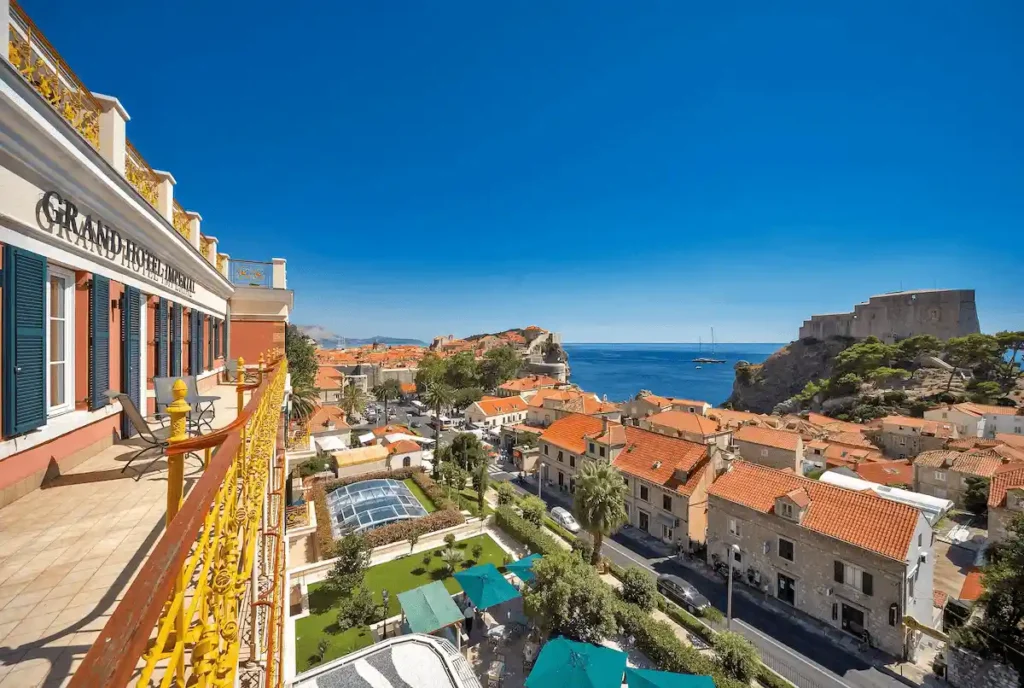
Hilton Imperial Dubrovnik operates from Baron Viktor Kalchberg’s 1897 Grand Hotel Imperial—the first property in the region to introduce electric lighting and mechanical lifts to the Adriatic aristocracy. Positioned on a strategic cliffside plateau 100 meters from Pile Gate, this 149-room fortress hosted British King Edward VIII in 1936 and served as a civilian sanctuary during the 1990s Siege. The ochre-and-white facade still marks the critical threshold between UNESCO’s medieval walls and the city’s first luxury expansion zone.
Explore more commanding estates in our guide to the best historic hotels in Dubrovnik.
Hilton Imperial Dubrovnik ★★★★★
The Hilton Imperial Dubrovnik occupies the site where Baron Viktor Kalchberg engineered Dubrovnik’s transition from medieval fortress to modern resort power in 1897. As “The Grand Hotel Imperial,” this property introduced the first electric lighting system, steam central heating, and mechanical lift infrastructure to the eastern Adriatic—establishing immediate dominance over regional hospitality hierarchy.
The ochre-and-white facade rises from a cliffside plateau that was specifically surveyed for unobstructed sightlines to Lovrijenac Fortress and the open Adriatic, creating a visual command post where guests monitor both the city’s historic defensive perimeter and its maritime trade routes.
Hilton Imperial Dubrovnik is a monumental landmark near Pile Gate, offering guests a prestigious stay with direct balcony views over the medieval walls and Lovrijenac Fortress.
The building’s original footprint spans 149 guest rooms and 9 suites distributed across the main 1897 structure and a private villa annex added in 1913. High ceilings preserve the late-Victorian spatial volume, while the 2005 and 2018 restorations integrated a “Riviera palette” of pale blue and brass—bespoke furniture manufactured by Croatian craftsmen at Internova.
The ground floor retains dramatic stone archways internally clad in antiqued mirroring, reflecting the architectural language of Dubrovnik’s narrow defensive streets directly into the hotel’s social circulation spaces. This deliberate spatial mapping translates the city’s medieval geometry into a luxury environment where guests physically inhabit the transition from fortification to global elite leisure.
The property’s historical weight crystallized in 1936 when British King Edward VIII and Wallis Simpson occupied the Imperial’s suites, cementing its status as the Adriatic’s primary social epicenter for European royalty and diplomatic power.
During the 1990s Siege of Dubrovnik, the hotel absorbed significant structural shelling while serving as a civilian refugee sanctuary—a documented wartime function that established the building’s physical resilience before its total 21st-century reconstruction. Upper-tier balconies and the executive terrace maintain the original 1897 viewpoint design, offering guests direct visual command over Lovrijenac Fortress and the sea approaches that defined Dubrovnik’s 600-year maritime authority.
The wellness infrastructure includes a glass-roofed indoor swimming pool, Turkish hammam, and a four-room “Beauty Line” health club—modern amenities anchored within the building’s Victorian-era spatial hierarchy.
The 244-square-meter Grand Ballroom and five specialized meeting rooms function as Dubrovnik’s main hub for international diplomatic summits, continuing the property’s century-long role as a seat of political negotiation. The Porat Restaurant and Imperial Bar specialize in regional Dalmatian wine vintages and traditional Adriatic seafood, mapping culinary heritage onto the same spaces where Kalchberg’s original 1897 guests first experienced electrified luxury dining on the Croatian coast.
Strategic positioning within UNESCO’s “buffer zone” marks the Imperial as the architectural threshold between medieval defensive urbanism and the 1890s luxury expansion—guests occupy the exact perimeter where Dubrovnik’s historic elite class first established modern authority beyond the city walls.
On-site private parking and an electric car charging station provide rare vehicular access directly adjacent to Pile’s main transport terminal, eliminating the logistical friction that defines most Old Town hotel access.
This is not nostalgic preservation; this is verified positional dominance where Baron Kalchberg’s 1897 infrastructure still controls the city’s primary guest arrival sequence, and every suite maintains visual command over the fortress that guarded the Adriatic’s most valuable medieval port.
Check Availability & Rates →The Imperial stands where Kalchberg deliberately positioned Dubrovnik’s first electrified luxury—a cliffside command post where Victorian engineering met Adriatic maritime authority, and guests still occupy the exact viewpoint that established modern hospitality dominance over the city’s UNESCO-protected medieval perimeter.
FAQ: Hilton Imperial Dubrovnik
What is the historical significance of Hilton Imperial Dubrovnik?
Originally opened as The Grand Hotel Imperial in 1897, this property was designed by Baron Viktor Kalchberg as the first hotel in the region to feature electric lighting, mechanical lifts, and steam central heating. It hosted British King Edward VIII and Wallis Simpson in 1936, establishing its position as the Adriatic’s primary social center for European royalty and diplomatic power for over a century.
How close is Hilton Imperial Dubrovnik to Dubrovnik Old Town?
The hotel sits on a cliffside plateau exactly 100 meters from Pile Gate, the main western entrance to Dubrovnik’s UNESCO World Heritage Old Town. This strategic position within the UNESCO buffer zone places guests at the architectural threshold between the medieval city walls and the 1890s luxury expansion, with direct walking access to the historic center.
What views does Hilton Imperial Dubrovnik offer?
The property was specifically surveyed in 1897 for unobstructed sightlines to Lovrijenac Fortress and the Adriatic Sea. Upper-tier balconies and the executive terrace maintain this original viewpoint design, offering guests direct visual command over the fortress that guarded Dubrovnik’s maritime trade routes and the sea approaches that defined the city’s 600-year naval authority.
What happened to the hotel during the Siege of Dubrovnik?
During the 1990s conflict, the Hilton Imperial served as a sanctuary for local civilian refugees while withstanding significant structural shelling. This documented wartime function established the building’s physical resilience before its complete reconstruction and restoration in 2005 and 2018, which preserved the original 1897 facade while modernizing all interior infrastructure.
The Imperial’s Enduring Cliffside Authority
The Hilton Imperial Dubrovnik maintains Baron Kalchberg’s 1897 strategic positioning—where Victorian electrified luxury first established modern hospitality command over Dubrovnik’s medieval defensive perimeter. Guests continue to occupy the exact cliffside threshold that marked the city’s transition from fortress economy to Adriatic resort power, with every suite and terrace preserving the original sightlines to Lovrijenac Fortress and the maritime approaches that built a 600-year trading empire.
Explore coastal estates with comparable royal pedigrees, Hotel Excelsior Dubrovnik or the Renaissance-era diplomatic authority of The Pucic Palace.
For more curated itineraries and luxury-focused travel insights, visit Your Luxury Guide. For official travel information and destination updates, visit Croatia tourism-info.
Your Luxury Guide — Where Exceptional Travel Begins.