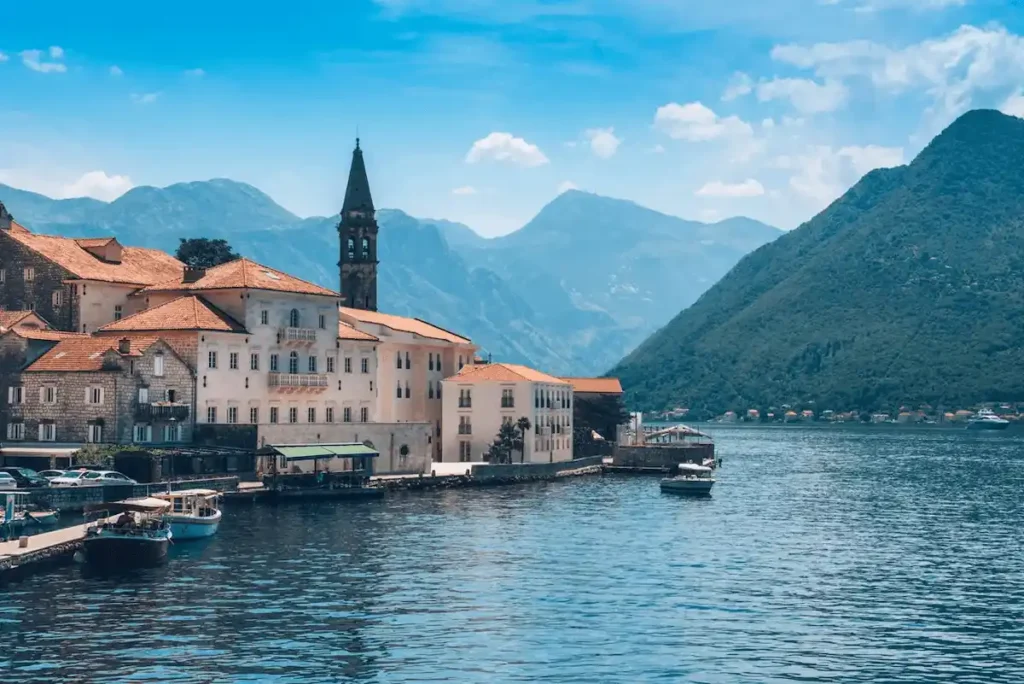
Heritage Grand Perast commands the waterfront of Perast from within the Smekja Palace, the largest and most architecturally significant of the town’s 16 baroque structures. Built in 1764 entirely from white Korčula stone, this former residence of the maritime Smekja family represents the apex of Venetian aristocratic influence during Perast’s “Golden Age”—when the town trained naval officers for both Russian and Venetian empires.
The 130-room hotel preserves the palace’s stone arches, original structural walls, and waterfront positioning while delivering modern luxury through minimalist Mediterranean interiors. Guests occupy suites where 18th-century naval commanders once exercised regional maritime authority, now with direct views of the two iconic island monasteries that define the Bay of Kotor’s UNESCO-protected seascape.
Heritage Grand Perast ★★★★★
The authority of Heritage Grand Perast derives from its physical occupation of the Smekja Palace, the definitive architectural statement of Perast’s naval dominance. The Smekja family built this palazzo during the height of their maritime trade success, establishing it as the town’s social and economic command center. The structure’s white Korčula stone construction—imported at considerable expense—signaled permanent wealth and regional influence.
Today’s guest inhabits that same spatial hierarchy: stone-paved courtyards that replicate Venetian piazzas, arched windows that frame unobstructed views of Our Lady of the Rocks and St. George islands, and rooms where high-quality “Boka” stonework provides natural climate control through centuries-old craftsmanship.
Heritage Grand Perast is a stunningly restored 18th-century landmark and the largest palace in the UNESCO-listed town, offering a rare blend of Venetian baroque architecture and modern Adriatic luxury.
The hotel’s 130 rooms distribute across multiple wings of the palace complex, each maintaining the original stone walls and structural integrity while introducing contemporary minimalist design. The rooms are not replicas of baroque excess; they are strategic renovations that preserve the palazzo’s volumetric grandeur—high ceilings, thick stone walls, original wooden beams—while stripping away decorative clutter.
The result is spatial authority: guests experience the physical scale of Venetian aristocratic living without the visual noise of period furniture. Suites with private balconies offer direct waterfront positioning, the same vantage points from which the Smekja family monitored maritime traffic and commercial movements throughout the bay.
The amenities map directly onto the palace’s historic footprint. The luxury spa operates within stone-vaulted chambers, featuring an indoor pool beneath a glass roof that floods the space with Adriatic light while maintaining the cool temperature gradients inherent to thick-walled baroque construction. The hammam utilizes the palazzo’s natural thermal properties—stone that retains and radiates heat efficiently—enhanced by Mediterranean sea salt treatments sourced from the surrounding coastal regions.
Riva Restaurant occupies the palace’s primary waterfront arcade, where stone columns and arched openings create a dining environment that physically extends into the UNESCO-protected townscape. The menu focuses on Adriatic seafood caught within kilometers of the property, paired with Montenegrin wines from the Crmnica and Skadar Lake regions.
The Private Beach Club operates from a stone-plateau formation directly below the palazzo, offering sun loungers positioned on the same geological shelf that supported the original palace construction. Guests access crystal-clear bay waters from this elevated stone platform, effectively swimming from the foundation of Venetian maritime power.
The hotel’s boat excursion service utilizes private docks that connect directly to the palace, enabling arrivals by water—the historic method of approach for high-status visitors during Perast’s 18th-century naval peak. These excursions navigate to the two island monasteries visible from every waterfront suite, Our Lady of the Rocks (artificially constructed in 1452) and St. George (a 12th-century Benedictine abbey), both representing concentrated nodes of regional religious and political authority.
Perast itself operates as a car-free UNESCO Heritage town, meaning Heritage Grand Perast exists within a protected spatial environment where modern vehicular intrusion is eliminated. Guests move through the same pedestrian stone streets that connected the 16 baroque palaces during Venetian control, experiencing a preserved urban fabric that has not been compromised by 20th-century development.
The hotel’s private courtyard—paved in original stone—functions as an authentic Mediterranean piazza, a semi-public space where the social rituals of baroque aristocracy (evening promenades, staged arrivals, visual displays of wealth) remain physically possible in the 21st century.
Check Availability & Rates →The Smekja Palace was not merely a residence—it was the architectural declaration of Perast’s naval authority, constructed from imported stone at the height of Venetian maritime dominance. Today’s guest occupies that same command structure: waterfront positioning, unobstructed two-island views, and stone-vaulted chambers where regional power once operated as both social ritual and economic reality.
FAQ: Heritage Grand Perast
What makes Heritage Grand Perast historically significant?
Heritage Grand Perast occupies the Smekja Palace, built in 1764 as the largest baroque structure in Perast during the town’s “Golden Age” when it served as a naval training center for Venetian and Russian empires. The palazzo represents the architectural apex of the maritime Smekja family’s regional influence and remains the most prominent building in the UNESCO-protected Bay of Kotor townscape.
What is the architectural heritage of the building?
The hotel is housed entirely within the original 1764 Smekja Palace, constructed from white Korčula stone imported during the Venetian period. The structure preserves its baroque stone arches, original thick walls with natural cooling properties, exposed wooden beams, and waterfront arcade positioning, now integrated with contemporary minimalist Mediterranean interiors across 130 rooms.
What views do rooms at Heritage Grand Perast offer?
Waterfront suites feature original stone-arched windows and private balconies with direct, unobstructed views of the two iconic island monasteries: Our Lady of the Rocks (1452 artificial island construction) and St. George (12th-century Benedictine abbey). These are the same vantage points the Smekja family used to monitor maritime traffic during Perast’s 18th-century naval dominance.
How does the hotel connect to Perast’s UNESCO status?
Heritage Grand Perast operates within the car-free, UNESCO World Heritage-protected town of Perast, where the preserved baroque urban fabric has remained intact since the Venetian period. The hotel’s palazzo is the central architectural feature of this protected landscape, and guests access the same pedestrian stone streets and waterfront positioning that defined aristocratic movement during the town’s 18th-century maritime peak.
Experience Venetian Naval Prestige on Montenegro’s Protected Bay
Heritage Grand Perast delivers the physical occupation of Perast’s most significant baroque structure, where the spatial authority of 18th-century Venetian maritime power translates directly into contemporary luxury positioning. The palazzo‘s white stone construction, waterfront command, and two-island monastery views establish an exclusivity anchored not in manufactured rarity but in documented historical dominance.
For additional Montenegrin properties where architectural lineage defines modern prestige, consider Palazzo Radomiri and Hotel Astoria Budva, both offering verified historical positioning within the UNESCO-protected maritime landscape.
For more curated itineraries and luxury-focused travel insights, visit Your Luxury Guide. For official travel information and destination updates, visit Montenegro tourism-info.
Your Luxury Guide — Where Exceptional Travel Begins.