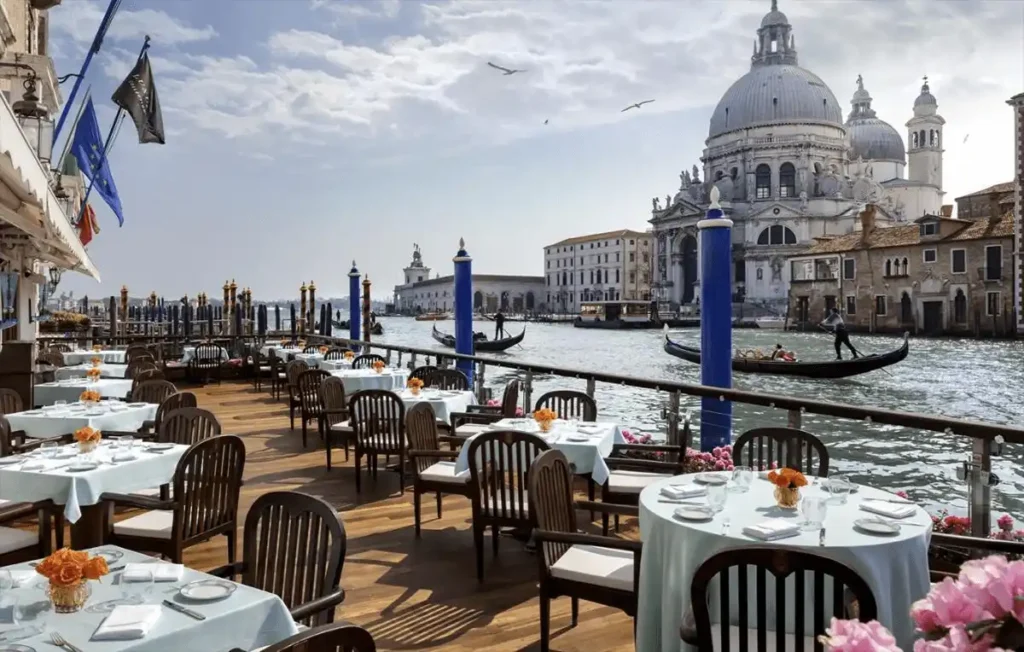
Gritti Palace Venice stands as the definitive Grand Canal residence, occupying a 1475 Gothic palazzo that once served as the private seat of Doge Andrea Gritti—Venice’s 77th head of state. This is the aristocrat’s home, preserved with its original Istrian stone facades, Titian portraits in the lobby, and 61 rooms that maintain the intimate scale of a Renaissance residence.
Behind the Gothic arches lies a contemporary luxury infrastructure: a 250-square-meter rooftop terrace with spa pool, exclusive Riva yacht access, and a Sisley Paris spa occupying chambers where Vatican ambassadors once resided. You’re not visiting Venetian history—you’re inhabiting the command center that shaped it.
Gritti Palace Venice ★★★★★
The physical authority of Gritti Palace Venice begins at its water gate: a Gothic entrance carved from Istrian stone in 1475 by the Pisani family, the same maritime dynasty that controlled Venice’s spice routes. In 1525, Andrea Gritti—the warrior-doge who expanded Venetian territory across the Adriatic—converted this palazzo into his private command residence, transforming its piano nobile into diplomatic chambers where he received ambassadors from the Vatican and Ottoman Empire. That same floor now houses the Redentore Terrazza Suite, where the 250-square-meter private rooftop—one of Venice’s largest—features a heated spa pool overlooking the Salute basilica and a horizon line that traces the doge’s former empire.
Gritti Palace Venice is a legendary sanctuary of Venetian high society, offering guests the rare privilege of residing in a 15th-century noble palazzo that serves as a living museum of the city’s golden age.
The building’s 61 guestrooms preserve the residential layout of a 15th-century noble home. Unlike Venice’s oversized “Grand Hotels,” the Gritti maintains intimate proportions—no sprawling wings, no anonymous corridors.
Rooms occupy the original chambers where Gritti held court, each restored during a 2013 structural intervention (€35 million) that installed a 2,000-square-meter containment tank beneath the foundations to counteract the Acqua Alta tides threatening the palazzo’s Gothic pillars. Designer Chuck Chewning sourced archival silk damasks from Rubelli—the Venetian textile house that has dressed these walls since the 1800s—to re-drape canopy beds and salon armchairs in patterns originally woven for 16th-century doges.
The Hemingway Presidential Suite occupies the exact chambers where Ernest Hemingway wrote Across the River and Into the Trees during his 1948-49 residency, a period when he used the Gritti as his Venetian headquarters. The suite’s private study overlooks the Grand Canal from the same vantage point Hemingway described in his novel—”the best view in Venice, bar none“—now outfitted with a marble bathroom, walk-in wardrobe, and butler service that brings breakfast to a balcony where the writer once watched cargo barges navigate the canal at dawn.
Downstairs, the Club del Doge dining terrace claims what many consider the Grand Canal’s most commanding position: a water-level platform directly opposite the Santa Maria della Salute, where Venetian nobility docked their gondolas for 400 years.
The kitchen bridges Veneto’s “sea and mountains” with crudo di mare platters featuring Chioggia scampi and Carnia prosciutto aged in the Dolomites. Breakfast on this terrace is a daily theater: vaporetti shuttling commuters, delivery boats stacking produce crates, and the occasional billionaire’s yacht gliding past your cappuccino—all framed by the same Gothic arches that once welcomed ambassadors to Doge Gritti’s residence.
The Gritti’s private Riva yacht, Il Doge, is moored at the palazzo’s original water gate. This custom Aquariva—Venice’s ultimate status symbol—provides exclusive lagoon access for champagne runs to Torcello or sunset circuits around San Giorgio Maggiore, piloted by captains who navigate the shallow sandbanks where 15th-century merchant fleets once anchored. It’s the modern equivalent of the doge’s ceremonial bissona, updated for guests who expect both historic provenance and the horsepower to reach Murano in under 15 minutes.
The Gritti Epicurean School occupies the palazzo’s former service kitchens, where since 1975 the hotel has run market-to-table workshops starting at the Rialto Market—the same 11th-century fish bazaar that supplied Gritti’s banquets. You select lagoon catch with the hotel’s chef, return to 15th-century brick ovens, and prepare Venetian classics in rooms where Renaissance cooks once roasted peacocks for state dinners. It’s culinary education anchored by 550 years of uninterrupted palazzo kitchen tradition.
The Gritti SPA—Sisley Paris partnership operates within chambers that served as the Vatican ambassador’s private quarters during the Renaissance. The Venetian hammam uses aromatic protocols developed specifically for the palazzo’s microclimate: humid lagoon air and brackish water that the spa’s phyto-aromatic treatments counteract with alpine herb therapies from the Dolomites. The treatment menu is designed for guests who’ve spent the day navigating marble staircases and need recovery protocols calibrated to Venice’s unique environmental stressors.
Bar Longhi—named after the 18th-century vedutista Pietro Longhi—functions as the palazzo’s social command center, where hand-sculpted Murano mirrors reflect the Grand Canal’s rippling light across walnut paneling. The signature “Basilica” cocktail (Prosecco, elderflower, basil from the palazzo’s rooftop garden) is served on the Riva Lounge, a water-level platform where Venetians have conducted power meetings for five centuries. It’s the modern equivalent of the doge’s private receiving room, now calibrated for guests closing deals over Aperol spritzes while watching the sunset illuminate the Salute’s dome.
The lobby displays a 15th-century portrait of Doge Andrea Gritti from Titian’s atelier—repurchased by the hotel at a 2016 Sotheby’s auction to “bring the master of the house home.” It hangs above the concierge desk as a daily reminder: you’re not staying in a hotel that references history; you’re occupying the seat of the man who commanded Venice at the height of its Mediterranean dominance.
Check Availability & Rates →The Gritti Palace doesn’t invoke Venetian power through decor—it is the architectural seat where that power was exercised, preserved with such fidelity that sleeping in Hemingway’s suite or dining on the doge’s terrace feels less like luxury theater and more like assuming temporary command of a 550-year-old republic that still, somehow, remembers how to run itself.
FAQ: Gritti Palace Venice
What makes Gritti Palace Venice worth the stay?
The 1475 Gothic palazzo served as Doge Andrea Gritti’s private residence—you’re occupying the actual seat of Venetian state power, not a hotel that mimics it. The 250-square-meter Redentore rooftop with spa pool, exclusive Riva yacht access, and 61-room intimate scale preserve the residential atmosphere of a Renaissance command center, while the €35 million structural intervention ensures modern infrastructure protects 15th-century foundations from Venice’s Acqua Alta tides.
Is the Hemingway’s Presidential Suite worth it?
You’re staying in the exact chambers where Ernest Hemingway wrote Across the River and Into the Trees in 1948-49, with the same Grand Canal view he described as “the best in Venice.” The suite includes butler service, a private study overlooking the Salute basilica, and archival Rubelli silk interiors sourced from the textile house that’s dressed these walls since the 1800s—it’s literary heritage with functional luxury calibrated for extended stays.
Is the Gritti’s Grand Canal location genuinely superior to competitors?
The Club del Doge terrace occupies what many consider the canal’s most commanding position: water-level dining directly opposite Santa Maria della Salute, at the exact docking point where Venetian nobility moored gondolas for 400 years. Combined with private Riva yacht access from the palazzo’s original 15th-century water gate, you control Venice’s primary maritime artery the way the doge’s household once did.
What unique experiences does Gritti Palace offer beyond standard luxury hotels?
The Gritti Epicurean School runs market-to-table workshops starting at the 11th-century Rialto Market, teaching Venetian cooking in the palazzo’s original Renaissance kitchens—550 years of uninterrupted culinary tradition. The private Aquariva yacht provides lagoon access to Torcello and Murano with captains who navigate shallow sandbanks where 15th-century merchant fleets anchored, and the rooftop terrace spa pool offers Venice’s rarest amenity: private outdoor space with 360-degree lagoon views in a city where every square meter is contested.
The Gritti Palace Venice Defines Venetian Command
The Gritti Palace Venice translates 550 years of architectural authority into a contemporary luxury stay where every amenity—from the rooftop spa pool to the private Riva yacht—occupies spaces that once served Doge Andrea Gritti’s state functions. This isn’t a hotel that references Venetian history; it’s the preserved seat where that history was made, maintained with the intimate scale and structural integrity that allows you to inhabit a 15th-century palazzo without sacrificing modern expectations.
For travelers seeking similar pedigree in Venice’s historic landscape, explore the St Regis Venice and Ca Sagredo Hotel Venice, both offering Grand Canal positions anchored by verified aristocratic provenance.
For more curated itineraries and luxury-focused travel insights, visit Your Luxury Guide. For official travel information and destination updates, visit Italy tourism.
Your Luxury Guide — Where Exceptional Travel Begins.