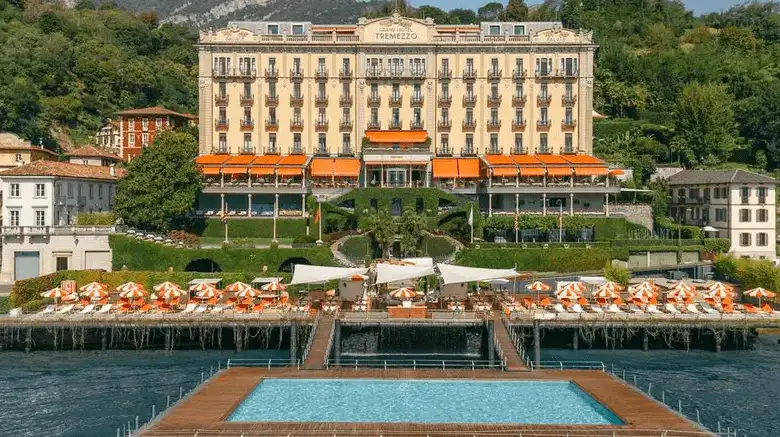
Grand Hotel Tremezzo represents Lake Como’s first purpose-built luxury hotel, constructed in 1910 with reinforced concrete frame technology that allowed for unprecedented window scale and structural ambition. Unlike the region’s converted aristocratic villas, this property was engineered from foundation to roofline as a hospitality palace, its three distinct facades—Italian Liberty, Swiss-Chalet, and Neoclassical—designed to command views from water, mountain, and garden approaches.
The hotel operates under fourth-generation De Santis family stewardship, maintaining the original brass elevator, gold-leaf Music Room, and 20,000-square-meter botanical park while housing the only restaurant legally authorized to use Gualtiero Marchesi’s culinary archive.
Grand Hotel Tremezzo ★★★★★
The 1910 construction established Lake Como’s first hotel designed with reinforced concrete frame engineering, a technical advancement that eliminated load-bearing wall requirements and created the massive unobstructed windows defining the Sala Musica. The Music Room‘s ceiling features original gold-leaf stuccowork restored using vegetable-based pigments to preserve the 116-year-old plaster’s breathability—a conservation approach that maintains the room’s acoustic properties for private concerts still hosted in the space.
Grand Hotel Tremezzo is a legendary 1910 Belle Époque palace that offers guests the rare privilege of residing in a meticulously preserved Art Nouveau estate, blending its world-famous ‘Water-on-the-Water’ floating pool and Gualtiero Marchesi’s culinary legacy with 20,000 square meters of botanical heritage overlooking Bellagio.
The property’s three-facade design reflects its commanding position. The lakefront presents Italian Liberty—the hotel’s signature Art Nouveau vocabulary with curved ironwork and floral motifs. The mountain-facing rear adopts Swiss-Chalet rusticism with exposed timber and stone to harmonize with alpine backdrop. The side wings transition through Neoclassical symmetry toward Villa Carlotta‘s gardens next door. This architectural diplomacy established the hotel as a visual bridge between Como’s varied architectural traditions.
The original 1910 brass-and-mahogany elevator still operates between floors, one of Italy’s oldest functioning hotel lifts, its hand-operated cage mechanism preserved as both functional transport and historical artifact.
The De Santis family, now in fourth-generation ownership, maintains every textile in proprietary Tremezzo Orange—a registered shade created to reflect the “sunny spirit” noted in Greta Garbo’s 1930s correspondence about the property. Staff uniforms, poolside towels, and guest amenities carry this color signature, creating visual continuity across 114 years of operation.
La Terrazza Gualtiero Marchesi holds exclusive legal rights to the late chef’s archive, the only restaurant worldwide authorized to prepare dishes from Marchesi’s documented techniques. The 24k gold-leaf risotto requires hand-application seconds before service to prevent melting into rice, preserving the visual shimmer central to Milanese culinary tradition. The Dripping di Pesce represents 48-hour sauce emulsification, its Jackson Pollock-inspired presentation requiring technical precision in fat-to-acid ratios that maintains separation on the plate.
L’Escale Trattoria occupies the 19th-century wine cellars, its exposed Moltrasio stone walls housing 1,300 Italian wine labels with emphasis on gourmet fondues—Alpine tradition adapted to Mediterranean setting. The basement location maintains constant 14°C temperature ideal for cheese service and wine storage without mechanical intervention.
The 1,000-square-meter T Spa operates within 18th-century Villa Emilia, its Venetian terrazzo floors and silent lounge preserving the structure’s Grand Tour-era proportions while housing contemporary spa equipment. The hammam utilizes White Lasa marble—denser and cooler than Carrara—creating more intense steam retention and heat distribution across surfaces.
The botanical park extends across 20,000 square meters as a satellite garden of Villa Carlotta, featuring 100-year-old azaleas and giant sequoia trees planted in 1910 to mark the hotel’s territorial boundaries.
The floating pool suspends on 40 high-density pontoons engineered to sway with lake currents, providing nautical swimming sensation while maintaining structural stability against Como’s seasonal water level changes. The Rooftop Front Suites, added in 2011 by architect Venelli Kramer, feature motorized glass walls that descend into floor channels, converting enclosed suites into open-air terraces with private heated pools overlooking Bellagio peninsula.
Suite 113, known as the Greta Suite, features bathroom carved from single blocks of Breccia Marrone marble with 1930s-style vanity mirrors matching the period when Garbo occupied the space during multiple Lake Como retreats. The hotel’s “Sense of Lake” boutique collaborates with Bric’s luggage and Mantero silk manufacturers to produce property-exclusive products, extending the De Santis family’s curation into tangible items guests transport beyond the stay.
The handmade T-Bear greeting amenity wears miniature replica of the 1910 concierge uniform, each bear hand-stitched to fourth-generation family hospitality standards that prioritize continuity over contemporary hotel industry trends favoring seasonal refresh cycles.
Check Availability & Rates →Grand Hotel Tremezzo stands where 1910 concrete-frame ambition met Art Nouveau craftsmanship, creating Lake Como’s first purpose-built palace whose three architectural faces—Liberty, Chalet, and Neoclassical—command water, mountain, and garden with equal authority under four generations of family stewardship.
FAQ: Grand Hotel Tremezzo
What makes Grand Hotel Tremezzo architecturally significant on Lake Como?
Grand Hotel Tremezzo was Lake Como’s first hotel built from foundation up in 1910 using reinforced concrete frame technology, allowing for massive unobstructed windows and three distinct architectural facades—Italian Liberty facing the lake, Swiss-Chalet toward mountains, and Neoclassical transitioning to Villa Carlotta gardens. The property operates the original 1910 brass elevator and maintains gold-leaf Music Room restored with vegetable-based pigments.
What dining experience is unique to Grand Hotel Tremezzo?
La Terrazza Gualtiero Marchesi holds exclusive worldwide legal rights to the late chef’s culinary archive, making it the only restaurant authorized to prepare dishes from Marchesi’s documented techniques. The signature 24k gold-leaf risotto requires hand-application seconds before service, and the Dripping di Pesce represents 48-hour sauce emulsification inspired by Jackson Pollock’s artistic approach.
How does the floating pool at Grand Hotel Tremezzo work?
The floating pool suspends on 40 high-density pontoons engineered to sway with Lake Como’s natural currents, providing nautical swimming sensation while maintaining structural stability against seasonal water level changes. The design creates swimming experience that moves with the lake rather than remaining static like traditional pool construction.
What historical continuity does the De Santis family maintain?
The fourth-generation De Santis family ownership maintains proprietary Tremezzo Orange across all textiles—a registered shade reflecting the “sunny spirit” Greta Garbo noted in 1930s correspondence. They preserve the 1910 brass elevator, original Music Room acoustics, and hand-stitch T-Bear greeting amenities wearing miniature 1910 concierge uniforms, prioritizing continuity over contemporary hotel refresh cycles.
The Living Legacy of Lake Como’s First Purpose-Built Palace
Grand Hotel Tremezzo demonstrates how 1910 engineering ambition created architectural possibilities that converted villas couldn’t achieve, its concrete frame and three-facade design establishing visual command across Lake Como’s varied topography.
The De Santis family’s four-generation stewardship maintains original infrastructure—from brass elevator to botanical boundaries—while integrating Marchesi’s culinary archive and floating-pool innovation that respects both historical structure and contemporary luxury expectations.
For those drawn to Lake Como’s palazzo tradition, consider Passalacqua and Grand Hotel Villa Serbelloni, properties whose aristocratic origins complement Tremezzo’s purpose-built hospitality legacy.
More curated itineraries and luxury-focused travel insights at Your Luxury Guide. For official travel information and destination updates, visit Italy tourism.
Your Luxury Guide — Where Exceptional Travel Begins.