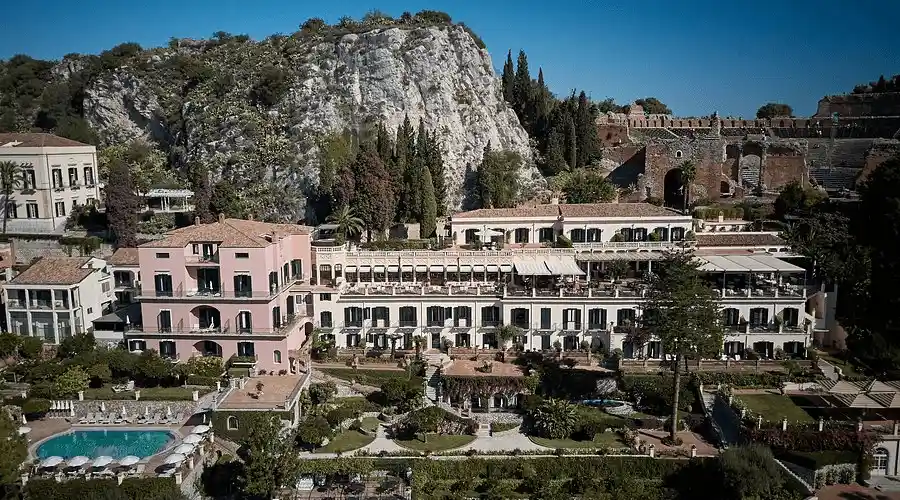
Grand Hotel Timeo, A Belmond Hotel, Taormina opened in 1873 as the first purpose-built luxury hotel on Sicily’s east coast. Perched 200 meters above the Ionian Sea, the property was constructed directly adjacent to Taormina’s 3rd-century BC Greek theater, embedding the ruins into the hotel’s physical experience.
Designed by Florentine architect Giovan Battista Filippo Basile, the hotel attracted European aristocracy during the Belle Époque, establishing Taormina as a winter destination for British and German nobility. Today, the terraced gardens and theater-view suites preserve the original architectural intent while offering contemporary five-star service.
Grand Hotel Timeo, A Belmond Hotel, Taormina ★★★★★
The Grand Hotel Timeo occupies the strategic high ground that defines Taormina—a position valued by Greeks, Romans, and 19th-century European travelers seeking Mediterranean command. When Florentine architect designed the original structure in 1874, he anchored it to the eastern slope overlooking the Greek theater, creating Sicily’s first hotel where archaeological authority became part of the guest experience.
The foundation shares the same volcanic rock base as the 3rd-century BC theater, making this the only property where ancient performance space and modern accommodation occupy the same historical footprint.
Grand Hotel Timeo, A Belmond Hotel, Taormina, is a prestigious historic landmark that offers guests the rare privilege of residing in the city’s original 1873 estate, blending its legendary Belle Époque elegance with a location directly adjacent to the ruins of the Ancient Greek Theater.
The hotel’s Belle Époque expansion in the 1890s doubled its capacity, adding the grand staircase and colonnade terraces that transformed the property into the preferred winter residence for European aristocracy. Kaiser Wilhelm II of Germany stayed multiple seasons between 1896 and 1914, conducting diplomatic correspondence from the ocean-view suites. British nobility followed, drawn by the combination of archaeological proximity and private Mediterranean access. The terraced gardens were engineered to cascade down the cliff face in three levels, creating outdoor rooms that frame both the ancient theater and Mount Etna’s volcanic profile.
The property’s spatial advantage becomes clear in the 71 rooms and suites, where floor-to-ceiling windows capture the Greek theater’s complete semicircle without obstruction. Junior suites on the third and fourth floors position guests at the same elevation as the theater’s upper tiers, the sightlines Hellenistic architects calculated for optimal acoustics and spectacle. The corner suites add the southern exposure toward Giardini Naxos, the bay where Greek colonists landed in 734 BC before climbing to establish Taormina. This dual perspective—ancient landing point and architectural achievement—establishes the geographic importance guests inhabit.
The heated outdoor pool occupies the original Belle Époque terrace, where German and British aristocrats took winter sun beneath Mount Etna. The position, 200 meters above sea level, creates the Mediterranean microclimate that made Taormina a refuge from northern European winters.
Contemporary spa facilities in the lower garden level maintain the original intent—thermal relaxation with archaeological views—while adding modern treatment protocols. The hotel’s restaurant terrace operates as the natural extension of the Greek theater experience, where guests dine with the same Ionian Sea horizon ancient audiences watched during performances.
The property’s value compounds the verified 19th-century pedigree with the Greek and Roman foundations beneath, creating layers of documented authority few Mediterranean properties can match. This is occupation of a site where geographic command has driven human settlement for 2,700 continuous years.
Check Availability & Rates →To stay at the Timeo is to occupy the precise elevation where ancient Greeks engineered spectacle and 19th-century aristocracy claimed winter dominion over the Mediterranean—a cliffside position that has compounded value across 27 centuries of documented human ambition.
FAQ: Grand Hotel Timeo, A Belmond Hotel, Taormina
What makes Grand Hotel Timeo historically significant?
Grand Hotel Timeo opened in 1873 as Sicily’s first purpose-built luxury hotel, constructed directly adjacent to Taormina’s 3rd-century BC Greek theater. Designed by Florentine architect Giovan Battista Filippo Basile, the property established Taormina as a Belle Époque winter destination for European aristocracy, including Kaiser Wilhelm II of Germany who stayed multiple seasons between 1896 and 1914.
What is the relationship between the hotel and the Greek theater?
The hotel shares the same volcanic rock foundation as Taormina’s ancient Greek theater, built in the 3rd century BC. Many rooms and the hotel’s terraced gardens offer direct, unobstructed views of the theater’s semicircular structure and the Ionian Sea beyond, positioning guests at the same elevation ancient audiences occupied for performances.
Which notable historical figures stayed at Grand Hotel Timeo?
Kaiser Wilhelm II of Germany was a regular guest between 1896 and 1914, conducting diplomatic affairs from the hotel’s ocean-view suites. The property attracted significant numbers of British and German nobility during the Belle Époque period when Taormina functioned as a preferred Mediterranean winter retreat for European aristocracy.
What original architectural features remain from 1873?
The hotel preserves Basile’s original colonnade terraces, the grand staircase from the 1890s expansion, and the three-level cascading gardens engineered to frame both the Greek theater and Mount Etna. The Belle Époque terrace, now housing the heated outdoor pool, maintains its original position 200 meters above the Ionian Sea where 19th-century aristocrats took winter sun.
Grand Hotel Timeo Secures Sicily’s Oldest Position of Mediterranean Command
The Grand Hotel Timeo delivers a geographic advantage that has attracted power for nearly three millennia—from Greek colonists to Germanic royalty to today’s guests who understand that certain elevations simply matter more than others in Mediterranean geography.
For those considering Sicily’s other heritage properties where history meets contemporary service, Grand Hotel Et Des Palmes in Palermo and San Domenico Palace Taormina offer equally documented pedigrees where verifiable architectural authority defines the modern luxury experience.
For more curated itineraries and luxury-focused travel insights, visit Your Luxury Guide. For official travel information and destination updates, visit Italy tourism.
Your Luxury Guide — Where Exceptional Travel Begins.