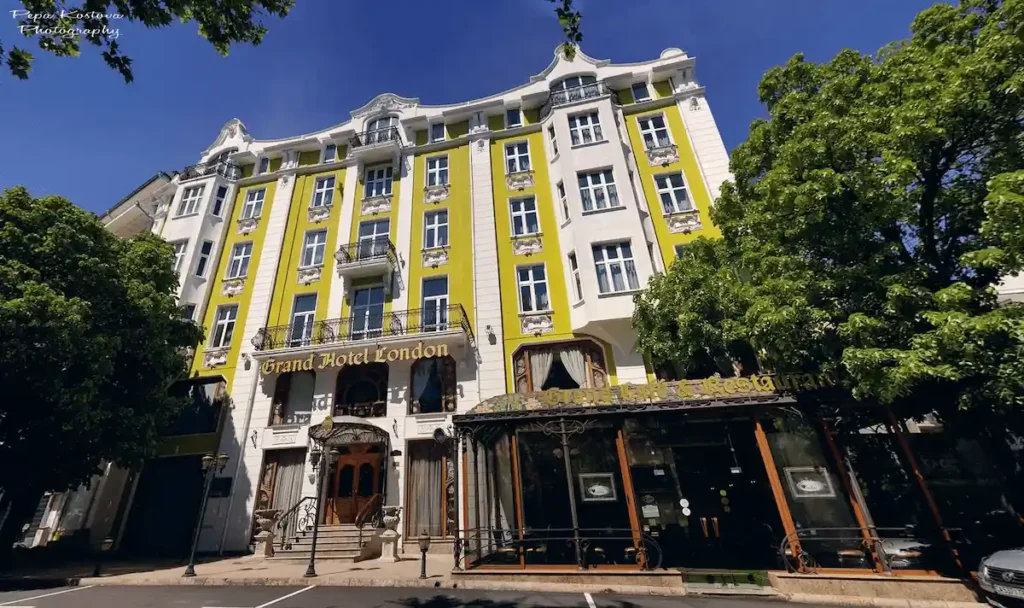
Grand Hotel London Varna stands as the city’s original luxury property, a 1912 Art Nouveau monument designed by architect Dabko Dabkov. As Varna’s first building to install both central heating and an electric Otis-style elevator, this 24-room boutique hotel established the template for Black Sea hospitality. The 4-meter ceilings and ornate plasterwork remain intact, while modern fiber-optic connectivity and climate control serve today’s international executives. Located steps from Musala Square and the Opera House, this is where maritime and diplomatic authority has resided for over a century.
Grand Hotel London Varna
The Grand Hotel London Varna occupies the exact site where Varna’s elite established their first modern luxury foothold in 1912. Architect Dabko Dabkov delivered a Secessionist facade that still dominates the pedestrian district—an ornate stone structure with floor-to-ceiling windows designed to announce wealth and technological advancement. This was the building that introduced central heating and electric vertical transportation to Bulgaria’s Black Sea capital, making it the infrastructure benchmark for the region’s emerging mercantile class.
Grand Hotel London stands as a rare 1912 architectural monument, offering guests a boutique immersion into the Belle Époque elegance of Bulgaria’s maritime capital.
The original Otis-style elevator remains operational, transporting guests through over a century of uninterrupted service. Each of the 24 rooms retains its 4-meter ceiling height—a vertical luxury that modern construction economics have rendered extinct. The thick 1912 masonry provides natural acoustic isolation, turning each suite into a soundproofed chamber despite the building’s position at the heart of Varna’s busiest pedestrian zone. Biedermeier furniture and heavy velvet drapery create a residential atmosphere; these are not hotel rooms but reconstructed 19th-century private quarters.
Restaurant Musala operates within the hotel’s Baroque dining hall, where Black Sea seafood meets French haute cuisine techniques. The menu reflects the cosmopolitan trade routes that once made Varna a crucial Mediterranean port.
Adjacent to it, Grand Café London functions as the city’s premier Viennese coffeehouse—a street-level social observatory where Varna’s political and business classes have negotiated deals over artisan pastries since before World War I. The Grand Café’s outdoor terrace provides direct sight lines to Musala Square, maintaining the property’s century-old role as the city’s primary intelligence-gathering venue.
The basement wellness area exploits the building’s historic stone foundations. Guests access a boutique spa carved into the original 1912 cellar structure, where chocolate wraps and thalassotherapy treatments utilize Bulgaria’s Black Sea mineral traditions. The sauna and fitness facilities occupy what were once coal storage vaults, now climate-controlled and retrofitted with modern equipment while maintaining the building’s original load-bearing walls.
For corporate travelers, the property delivers high-speed fiber-optic internet and 24-hour secretarial services, alongside guarded parking—a rare commodity in Varna’s compact historic center. The business infrastructure runs invisibly behind the Art Nouveau ornamentation, allowing executives to operate from suites where diplomatic cables were once drafted during the Balkan Wars.
The Grand Hotel London Varna doesn’t replicate historic luxury—it is the continuous operation of Varna’s original command infrastructure. Since 1912, this building has functioned as the city’s social and political headquarters. When you book a room here, you’re not visiting history. You’re occupying the exact position where Bulgaria’s Black Sea authority has always resided.
Check Availability & Rates →At Grand Hotel London Varna, every ceiling soars to 4 meters, every corridor preserves its 1912 width, and every elevator ride retraces a century of vertical ascent. This is Dabko Dabkov’s Art Nouveau fortress where Varna’s elite established permanent residence.
FAQ: Grand Hotel London Varna
What makes Grand Hotel London Varna historically significant?
Grand Hotel London Varna (originally Hotel Musala) opened in 1912 as Varna’s first luxury property to feature central heating and an electric Otis-style elevator, establishing the infrastructure standard for Black Sea hospitality. Designed by architect Dabko Dabkov in the Art Nouveau style, the building has operated continuously since 1912 as the city’s primary social and diplomatic hub, surviving two World Wars with its original floor plan intact.
What architectural features are preserved from 1912?
The hotel maintains its original 4-meter high ceilings, ornate plaster moldings, thick load-bearing masonry walls, and the restored 1912 Otis-style elevator. The Secessionist stone facade remains unaltered, and the building’s residential scale—with only 24 guest rooms across multiple floors—preserves the vertical spaciousness impossible to replicate in modern construction.
Where is Grand Hotel London Varna located in the city?
The property sits in the absolute center of Varna’s pedestrian district, directly adjacent to Musala Square. The Opera House is a 5-minute walk, and the hotel’s ground-floor Grand Café London provides direct street-level access to the city’s main commercial corridor. This central position has made it Varna’s primary meeting point for over a century.
What amenities combine historic character with modern functionality?
Each room pairs Biedermeier furniture and 19th-century residential layouts with high-speed fiber-optic internet and modern climate control. The basement wellness area operates within the original 1912 stone foundations, offering sauna and thalassotherapy treatments. Restaurant Musala serves Black Sea seafood in Baroque interiors, while Grand Café London maintains its Viennese coffeehouse tradition with artisan pastries and outdoor terrace seating overlooking Musala Square.
Final Reflection: Where Varna’s Authority Still Resides
The Grand Hotel London Varna represents a rare operational continuity—a building that has functioned as the city’s luxury headquarters without interruption since 1912. While most historic properties were repurposed or demolished, this Art Nouveau structure maintained its original mission through every regime change, war, and economic shift. The result is a working command center where Varna’s current elite conduct business in the same rooms their predecessors used 110 years ago.
Those seeking accommodations that reflect unbroken institutional power, comparable properties include the Sofia Balkan Palace and Grand Hotel Sofia, both maintaining similar operational legacies in Bulgaria’s capital.
For more curated itineraries and luxury-focused travel insights, visit Your Luxury Guide. For official travel information and destination updates, visit Bulgaria tourism-info.
Your Luxury Guide — Where Exceptional Travel Begins.