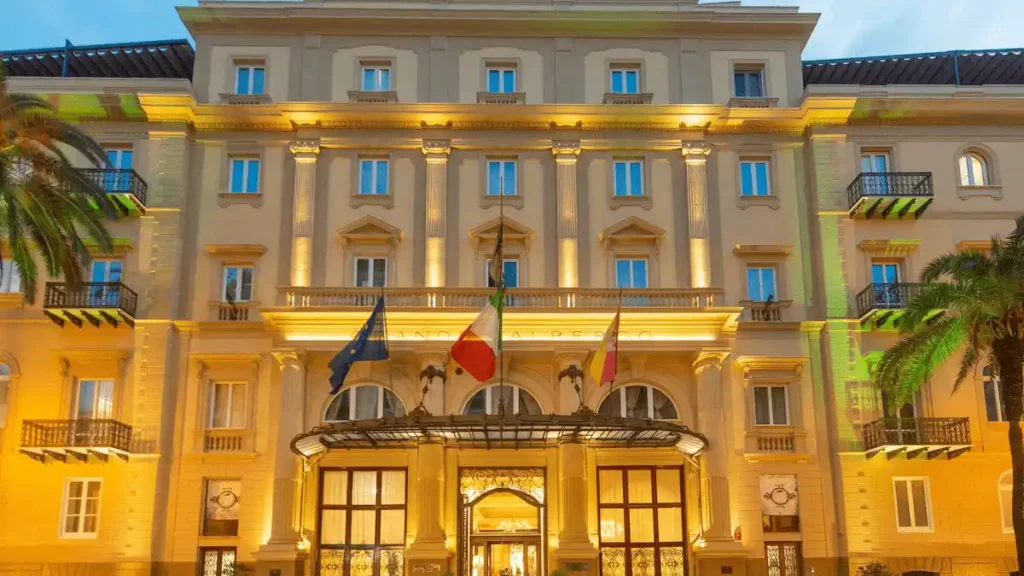
Grand Hotel Et Des Palmes commands an 1874 palazzo built for the Ingham-Whitaker banking dynasty at the apex of Palermo’s Belle Époque prosperity. Wagner composed Parsifal’s final act within these walls in 1882. The palazzo’s monumental marble staircase and frescoed salons represent the architectural authority of Sicily’s most powerful 19th-century merchant families.
Today’s guests inhabit the same ceremonial spaces where European nobility negotiated trade and cultural influence across the Mediterranean. Five-star services now operate within the palazzo‘s original footprint—gilded reception halls, vaulted dining rooms, and guest suites positioned along the piano nobile that once hosted the island’s political elite.
Grand Hotel Et Des Palmes ★★★★★
The palazzo was commissioned in 1874 by Benjamin Ingham Jr. and Joseph Whitaker, whose Marsala wine fortune established them as Sicily’s most influential Anglo-Sicilian banking family. The architects designed a five-story structure in classical Belle Époque style—symmetrical facades, Corinthian pilasters, and ceremonial balconies overlooking Via Roma, Palermo’s primary commercial thoroughfare.
The entrance hall features a double-height marble staircase with wrought-iron balustrades, leading to the piano nobile where the family conducted private audiences and business negotiations.
Grand Hotel et des Palmes is a legendary Belle Époque sanctuary that offers guests the rare privilege of residing in the original 1874 palazzo of the Ingham-Whitaker banking dynasty, blending its opulent Wagnerian history with the architectural grandeur of Ernesto Basile’s Sicilian Liberty style.
Richard Wagner resided here from November 1881 to January 1882, completing the orchestration of Parsifal in a suite 301, overlooking the central courtyard. The hotel preserves this period with documented correspondence and original furnishings from the composer’s stay.
The property’s transformation into a grand hotel occurred in 1907, when the palazzo became the preferred residence for European aristocracy visiting Palermo. The 1920s brought Art Deco renovations to the public spaces—geometric marble flooring in the lobby, bronze elevator doors, and the addition of the Sala Wagner, a frescoed ballroom used for diplomatic receptions during Sicily’s interwar period.
Guest rooms occupy the palazzo’s original residential floors. Superior rooms feature 4.5-meter ceilings with period moldings, parquet flooring, and tall windows framed by silk drapery. Deluxe suites retain the original spatial hierarchy of noble apartments—separate sitting rooms with frescoed ceilings, marble bathrooms installed within former dressing chambers, and views extending across Palermo’s rooftops to Monte Pellegrino. Modern climate control, soundproofing, and connectivity infrastructure operate invisibly within the historic shell.
The ground-floor dining room occupies what was the palazzo’s original reception hall. Breakfast is served beneath a coffered ceiling with original 1874 plasterwork. The bar operates within the former library, maintaining its walnut paneling and built-in shelving. The Sala delle Capriate—a timber-beamed hall used for the family’s private gatherings—now functions as an event space retaining its 19th-century fireplace and terrazzo flooring. A rooftop terrace was added in 2015, providing an elevated vantage point above Via Roma’s continuous arcades.
The palazzo stands 200 meters from Teatro Massimo and 350 meters from Quattro Canti, Palermo’s baroque intersection. The location positions guests at the intersection of the city’s historic commercial axis and its cultural institutions—the same strategic position that made this site valuable to the Ingham-Whitaker family 150 years ago.
The hotel’s concierge operates from the original porter’s lodge, a walnut-paneled booth adjacent to the main entrance where household staff once controlled access to the palazzo’s interior.
Check Availability & Rates →Within these marble halls, the weight of Sicilian commerce and European culture converges—a palazzo built by banking magnates now grants access to the same ceremonial spaces where Mediterranean power was brokered across generations.
FAQ: Grand Hotel Et Des Palmes
What is the historical significance of Grand Hotel Et Des Palmes?
Built in 1874 as the private palazzo for the Ingham-Whitaker banking dynasty, Grand Hotel Et Des Palmes served as the residence where Richard Wagner completed Parsifal in 1882. The property became a grand hotel in 1907 and hosted European aristocracy during Palermo’s Belle Époque period. The palazzo’s marble staircase, frescoed salons, and ceremonial reception halls remain intact from the original construction.
What room types are available at Grand Hotel Et Des Palmes?
Superior rooms feature 4.5-meter ceilings with period moldings and parquet floors. Deluxe suites retain the original layout of noble apartments with separate sitting rooms, frescoed ceilings, and marble bathrooms. All accommodations maintain the palazzo’s 19th-century spatial proportions while integrating modern climate control and connectivity.
Where is Grand Hotel Et Des Palmes located in Palermo?
The hotel occupies Via Roma 398, Palermo’s main commercial thoroughfare. Teatro Massimo stands 200 meters away, while Quattro Canti is 350 meters distant. The position replicates the strategic location chosen by the Ingham-Whitaker family in 1874—at the center of Palermo’s financial and cultural district.
What original architectural features survive in the hotel?
The 1874 double-height marble staircase, Corinthian pilasters on the facade, coffered ceilings in the reception hall, and the Sala delle Capriate’s timber beams remain from the original construction. Art Deco elements added in the 1920s include geometric lobby flooring and bronze elevator doors. The piano nobile retains its ceremonial balconies and tall windows.
Palermo’s Commanding Historic Estates
Grand Hotel Et Des Palmes anchors Palermo’s tradition of aristocratic hospitality within a palazzo that defined the city’s Belle Époque authority. For travelers seeking Sicily’s most distinguished historic accommodations, Grand Hotel Timeo, A Belmond Hotel, Taormina commands clifftop positions above the Ionian coast, while San Domenico Palace Taormina occupies a 15th-century Dominican monastery with terraced gardens overlooking Mount Etna.
For more curated itineraries and luxury-focused travel insights, visit Your Luxury Guide. For official travel information and destination updates, visit Italy tourism.
Your Luxury Guide — Where Exceptional Travel Begins.