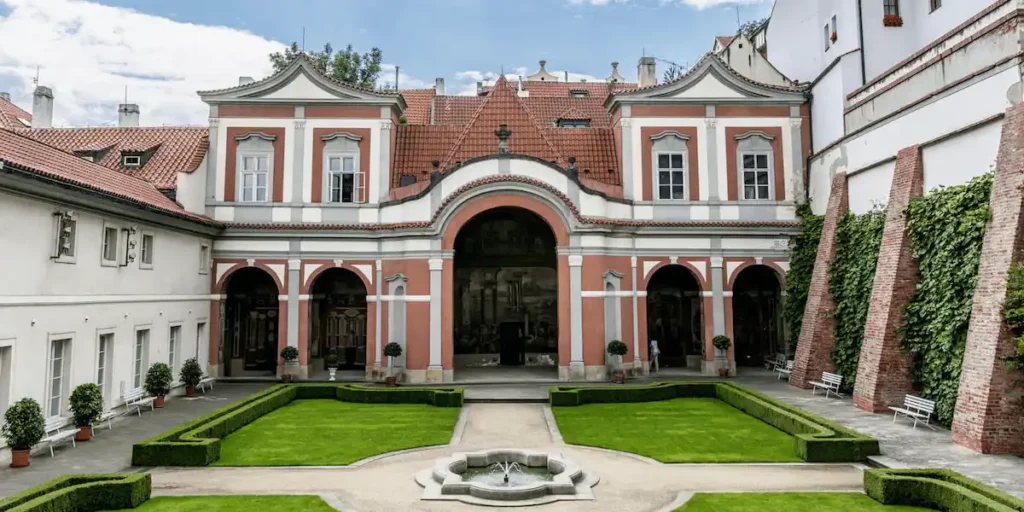
Golden Well Prague occupies the only Renaissance residence physically attached to Prague Castle walls—a 16th-century vertical sanctuary where Emperor Rudolf II housed his legendary court of astronomers, including Tycho Brahe and Johannes Kepler. With just 17 rooms carved into the Castle Hill cliffs, guests inherit a private gate opening directly into the Royal Gardens, bypassing all public queues to inhabit the exact stone corridors where the Holy Roman Empire’s intellectual elite once mapped the heavens.
Behind hand-painted wooden ceilings and original sandstone masonry lies Terasa U Zlaté studně, the #1-rated rooftop restaurant in Prague, delivering French haute cuisine against unobstructed panoramas of the Vltava River and the city’s hundred spires.
Golden Well Prague ★★★★★
This is not proximity to power—this is residence within it. Golden Well Prague stands as the closest hotel to the Czech seat of authority, tucked into a silent cul-de-sac where vehicle noise cannot penetrate and the only audible interruption comes from St. Nicholas Church bells echoing across Malá Strana’s terracotta rooftops.
The building’s 16th-century footprint climbs vertically through the sandstone cliffs, its narrow stone staircases and hand-hewn timber framing unchanged since Emperor Rudolf II designated it as lodging for his inner circle of astronomers and alchemists—men who studied celestial mechanics while the Habsburg Empire expanded beneath them.
Golden Well Prague is a hidden Renaissance gem situated in the former private residence of Emperor Rudolf II, offering the city’s most exclusive vantage point directly inside the rose gardens of Prague Castle.
The spatial advantage is immediate: a guest-only gate opens directly into Prague Castle’s Royal Gardens during public hours, eliminating the tourist queues that strangle access for everyone else. This isn’t metaphorical exclusivity—it’s a physical shortcut through imperial grounds, the same route once reserved for court officials reporting to the Emperor.
Inside, 17 rooms and 2 suites maintain the building’s original Renaissance proportions, where authentic Richelieu antique reproductions and rich silk fabrics occupy spaces defined by centuries-old masonry and original wooden ceilings adorned with hand-painted Renaissance motifs.
The legend of the golden treasure hidden within the building’s well isn’t tourist mythology—it’s documented Czech folklore that has granted this address landmark status for 500 years. Whether the gold existed or not, the story cemented the building’s social permanence long before the modern hospitality industry existed.
The structure’s attachment to Prague Castle walls means guests inhabit the same thermal mass and stone foundations that have supported Czech sovereignty through the Thirty Years’ War, the Austrian Empire, Nazi occupation, and Communist rule. History hasn’t been added here as decoration—it’s the load-bearing structure.
Terasa U Zlaté studně operates from the heated rooftop terrace, consistently awarded the #1 view in Prague not through marketing but through verifiable geography: no other restaurant sits this high on Castle Hill with unobstructed southwestern exposure over the Vltava River, Charles Bridge, and the Baroque sprawl of Old Town. The French-influenced gourmet menu functions as the culinary counterpart to the building’s Habsburg lineage, where dishes are executed with the precision expected by guests who have chosen to stay in the Emperor’s former residence. Year-round operation is guaranteed by industrial heating systems that maintain comfort even when winter temperatures drop below freezing.
The “home-style luxury” approach eliminates the grand ballrooms and convention spaces typical of Prague’s larger palace conversions, focusing instead on in-room massage treatments, specialized pillow menus, and a level of staff attention mathematically impossible in properties exceeding 50 rooms.
The building’s transformation preserved the narrow vertical circulation patterns of its Renaissance origins—no elevators retrofit into medieval wells, no lobbies carved from chapel naves. Access to this elevation requires either navigating the steep cobblestone lanes of Malá Strana or utilizing the complimentary private shuttle that bridges the hotel’s secluded heights with the neighborhood’s transit connections in the square below.
This is the operational reality of staying in a structure designed for an Emperor’s personal astronomers: the same isolation that once allowed Tycho Brahe to observe celestial movements without urban light pollution now provides guests with a silent sanctuary where Prague’s 1.3 million annual tourists cannot penetrate.
The guest isn’t visiting history—they’re residing inside the exact stone envelope where the Scientific Revolution’s mathematical foundations were calculated by candlelight, under ceilings that have witnessed five centuries of European power transitions without requiring demolition or structural compromise.
Check Availability & Rates →Seventeen Renaissance chambers ascending the Castle Hill cliffs—where the same sandstone walls that sheltered imperial astronomers now frame the only private gate opening directly into Prague’s Royal Gardens, and the silence is broken only by church bells that have marked Malá Strana’s hours since the Habsburgs ruled from the palace above.
FAQ: Golden Well Prague
What is the historical significance of Golden Well Prague?
Golden Well Prague served as the private residence of Emperor Rudolf II in the 16th century, housing his legendary court of astronomers including Tycho Brahe and Johannes Kepler. The building is named after a Czech folklore legend involving a golden treasure hidden in its well, cementing its status as a landmark for 500 years.
Does Golden Well Prague provide direct access to Prague Castle?
Yes. The hotel features a private, guest-only gate that opens directly into Prague Castle’s Royal Gardens during public hours, allowing guests to bypass all tourist queues—a route historically reserved for imperial court officials.
What makes Terasa U Zlaté studně restaurant unique?
Located on the hotel’s heated rooftop terrace, Terasa U Zlaté studně holds the #1-rated view in Prague due to its unmatched elevation on Castle Hill with unobstructed southwestern exposure over the Vltava River, Charles Bridge, and Old Town, serving French-influenced gourmet cuisine year-round.
How many rooms does Golden Well Prague have?
The hotel contains only 17 rooms and 2 suites, maintaining the intimate proportions of its original 16th-century Renaissance structure and ensuring exceptional personalized service within the building’s preserved vertical layout carved into the Castle Hill cliffs.
Where Imperial Sight Lines Become Guest Views
Golden Well Prague delivers what larger palace hotels cannot: the operational intimacy of a 16th-century residence where imperial astronomers once calculated celestial mechanics, paired with the only private gate access into Prague Castle’s Royal Gardens. The building’s physical attachment to the seat of Czech power isn’t metaphor—it’s stone-and-mortar proximity that has survived five centuries of European sovereignty changes.
Travelers seeking accommodations where Habsburg lineage translates into measurable spatial advantages, explore the art nouveau grandeur of Hotel Paris Prague or the monastery-turned-sanctuary experience at Augustine Hotel Prague.
For more curated itineraries and luxury-focused travel insights, visit Your Luxury Guide. For official travel information and destination updates, visit Czechia tourism.
Your Luxury Guide — Where Exceptional Travel Begins.