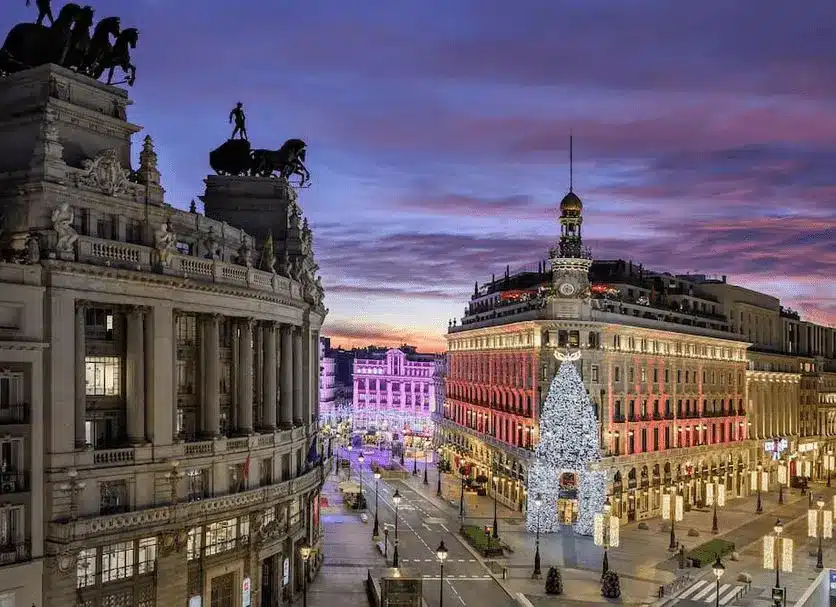
The Four Seasons Hotel Madrid commands a triangular city block where seven 19th-century banking headquarters converge into a single €530 million estate. At its center stands the Palacio de la Equitativa—an 1887 Neo-Baroque fortress built for an American insurance empire, later claimed by Spanish Credit Bank (Banesto) for 84 years of financial dominance.
You occupy not a hotel, but a preserved seat of economic command where 4,000 banking artifacts anchor every corridor. This is the infrastructure where Madrid’s capital class wielded authority—now your private residence.
Four Seasons Hotel Madrid ★★★★★
The Palacio de la Equitativa was never designed for leisure. Built in 1887 as the Spanish headquarters for The Equitable Life Assurance Society of the United States, it operated as a transatlantic financial command post—a Neo-Renaissance declaration of American capital anchoring itself in European markets. By 1920, Banesto absorbed the structure, installing boardrooms where Spain’s credit infrastructure was legislated, commissioning marble banking halls that still frame your approach to the lobby. The 14-tonne steel vault remains in place, now glassed behind reception—a 20th-century instrument of wealth protection repurposed as heritage architecture.
Four Seasons Hotel Madrid is a landmark destination in the heart of the city, unifying seven meticulously restored historic buildings into a single luxury retreat featuring rooftop dining and Spain’s largest urban spa.
The renovation preserved not nostalgia but documentary infrastructure. Original teller counters bisect public spaces as sculptural testimony to the building’s operational past. The Neo-Baroque facades—untouched since 1887—frame seven interconnected buildings gutted and reconstructed by Estudio Lamela into a unified atrium flooded with natural light. The ceiling installation: a 1942 Art Deco stained-glass panel salvaged from Banco Zaragozano, restored to full chromatic intensity. The corridors: 1,500 works—plaster casts from the Royal Academy of Fine Arts juxtaposed with contemporary Spanish commissions—creating an elevated exhibition environment where historic preservation meets curated modernity.
The Royal Suite occupies the former reading salon of the Casino de Madrid, its early 1900s moldings and hand-carved fireplaces left intact. This is not thematic decoration—it is the original material environment where Madrid’s merchant elite conducted private negotiations. The suite’s proportions remain unchanged: double-height ceilings, oak parquet floors, and frescoed wall panels that document the era’s aesthetic dominance.
Dani Brasserie crowns the rooftop—a sky-garden pavilion. The dining floor offers unobstructed panoramas of Madrid’s copper-domed skyline, positioning guests at eye level with the city’s historic architectural peaks. Isa Restaurant & Cocktail Bar operates below in a deliberately darkened space, its Asian-Mediterranean menu and avant-garde mixology program designed as a counterpoint to the Neo-Baroque grandeur surrounding it.
The Spa at Four Seasons spans four subterranean levels—the largest urban wellness complex in Spain. The 14-meter indoor pool sits beneath a glass ceiling engineered to channel daylight into the lowest floor, creating a subterranean environment that defies its depth. Steam chambers, massage suites, and hydrotherapy circuits occupy what were once banking vaults—climate-controlled chambers now retrofitted for thermal relaxation.
Galería Canalejas provides direct internal access to Madrid’s most concentrated luxury retail corridor—Hermès, Louis Vuitton, and Dior boutiques installed within the same seven-building framework. The shopping arcade is not adjacent; it is architecturally integrated, allowing you to move between your suite and Europe’s elite brands without leaving the historic perimeter.
Check Availability & Rates →The Four Seasons Madrid does not replicate power—it preserves its original coordinates. Every teller counter, every vault door, every marble staircase was installed by institutions that controlled Spain’s financial architecture. You now inhabit the infrastructure where that authority was exercised.
FAQ: Four Seasons Hotel Madrid
What historic buildings make up the Four Seasons Hotel Madrid?
The hotel occupies seven interconnected 19th-century structures within the Centro Canalejas complex. The anchor building is the Palacio de la Equitativa (1887), originally constructed as the Spanish headquarters for The Equitable Life Assurance Society and later serving as Banesto’s headquarters from 1920 to 2004. The restoration preserved 4,000 original banking artifacts, including the 14-tonne central vault.
What original features were preserved during the Four Seasons Madrid renovation?
The hotel retained the Neo-Renaissance and Neo-Baroque facades, original marble teller counters, hand-carved fireplaces from the Casino de Madrid reading rooms, and a 1942 Art Deco stained-glass ceiling from Banco Zaragozano. The 14-tonne Banesto vault remains visible behind glass in the lobby. The Royal Suite preserves early 1900s moldings and oak parquet floors from its original configuration.
Who designed the Four Seasons Hotel Madrid?
Estudio Lamela led the architectural restoration, maintaining the historic exterior facades while engineering a unified interior atrium. The €530 million project integrated seven separate buildings into a single operational estate while preserving nearly 1,500 works of art throughout the corridors, balancing classical plaster casts with contemporary Spanish commissions.
What dining options are available at the Four Seasons Madrid?
Dani Brasserie, a rooftop sky-garden restaurant offers panoramic city views and Mediterranean cuisine. Isa Restaurant & Cocktail Bar provides Asian-Mediterranean fusion dining in a sultry lounge environment. Both venues operate as signature culinary destinations independent of the hotel’s in-room dining services.
The Urban Estate Where Spain’s Banking Empire Anchored Itself
The Palacio de la Equitativa was built to project permanence—an American insurance company declaring its European foothold in Spanish stone. Banesto recognized the statement and claimed it for nearly a century of credit authority. The Four Seasons recognized the power coordinates and preserved them as your residential framework. This is not adaptive reuse; it is elite continuity—the same marble stairwells, the same vaulted chambers, now operating under a different mandate. The infrastructure of dominance remains.
Discover more architectural authority at Mandarin Oriental Ritz Madrid and Palacio de los Duques Gran Meliá.
For more curated itineraries and luxury-focused travel insights, visit Your Luxury Guide. For official travel information and destination updates, visit Spain tourism-info.
Your Luxury Guide — Where Exceptional Travel Begins.