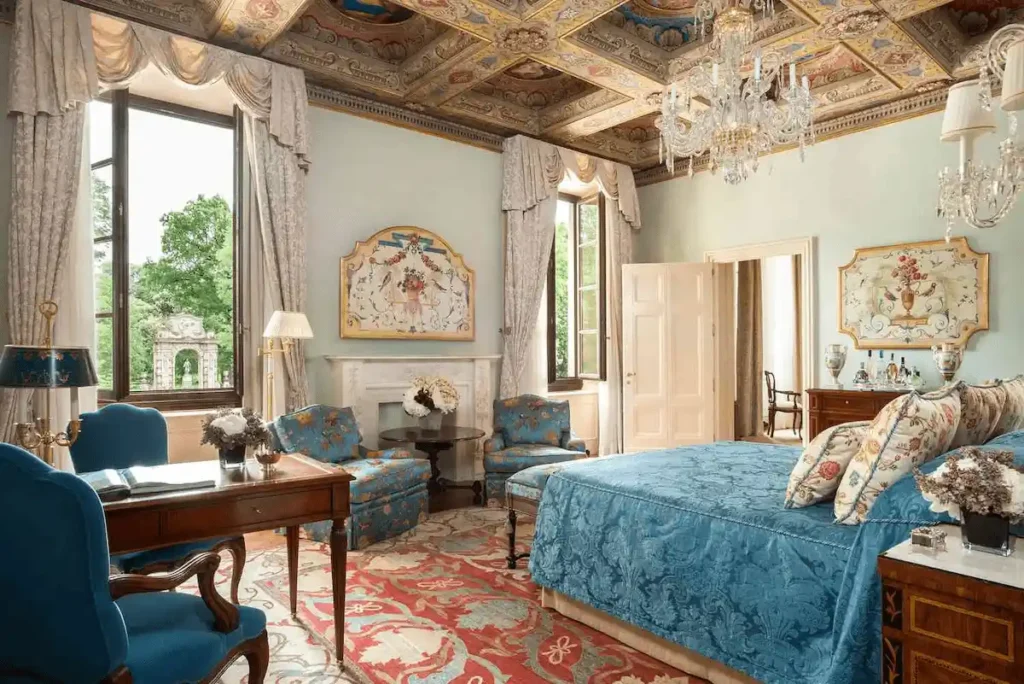
Four Seasons Hotel Firenze occupies two landmark structures: the 15th-century Palazzo della Gherardesca, commissioned by Bartolomeo Scala—chancellor to Lorenzo the Magnificent—and the 16th-century Conventino, a former convent. Connected by 11 acres of botanical gardens, it represents the only luxury estate in Florence where guests inhabit spaces once reserved for Medici-era nobility and high clergy.
Original frescoes by Giovanni Stradano and Volterrano remain intact under Ministry of Cultural Heritage supervision. The property delivers 116 uniquely configured rooms, Michelin-starred Tuscan cuisine, and exclusive experiences including private Uffizi tours and terrace dining on Ponte Vecchio.
Four Seasons Hotel Firenze ★★★★★
The Four Seasons Hotel Firenze functions as a residential command center where Renaissance authority remains architecturally encoded. The Palazzo della Gherardesca was constructed in 1472 as the private residence of Bartolomeo Scala, the most influential political figure in Lorenzo de’ Medici’s inner circle. Scala’s position as chancellor meant the palazzo hosted diplomatic negotiations, literary salons, and strategic alliances that shaped Florentine dominance across Europe.
The building later passed to the Della Gherardesca family—one of Tuscany’s oldest noble houses—who expanded the estate and cemented its status as a seat of hereditary power for over four centuries.
Four Seasons Hotel Firenze is an unrivaled urban sanctuary that offers guests the rare privilege of staying within a meticulously restored Renaissance palace, home to the city’s largest private botanical garden and a Michelin-starred culinary program.
The integration of the Conventino, a 16th-century convent, adds a sacred dimension. Originally constructed to house aristocratic women who had taken vows, the structure maintained direct ties to the Vatican and served as a spiritual retreat for cardinals and bishops. Today, the Conventino’s cloistered corridors and prayer chapels house suites where silk wallpapers and stucco ceilings have been restored to their original Baroque splendor under state preservation mandates.
The 4.5-hectare Gherardesca Garden operates as Florence’s largest privately held botanical park. Its design incorporates a 15th-century Ionic temple, original marble statuary, and rare botanical species collected during the Medici family‘s patronage of global exploration. The garden provides absolute acoustic separation from the city—a level of silence that was historically the privilege of nobility who controlled vast rural estates while residing in urban palaces.
Il Palagio occupies the palazzo’s former stables, a space where Medici horses and carriages were housed during state ceremonies. The Michelin-starred restaurant translates this utilitarian grandeur into a dining environment where Tuscan culinary traditions—refined under centuries of aristocratic patronage—are executed with contemporary precision. The menu prioritizes ingredients sourced from estates that supplied the Medici court, creating a documented continuity between Renaissance feasts and modern haute cuisine.
The spa spans 790 square meters within the garden complex. It utilizes products from Officina Profumo-Farmaceutica di Santa Maria Novella, the world’s oldest pharmacy, established in 1221 and historically patronized by Florentine noble families. Treatments incorporate herbal formulas originally developed for Medici women, linking wellness rituals directly to the estate’s social pedigree.
Suites retain the palazzo’s original spatial logic. No two rooms share identical dimensions because each was designed to reflect the specific rank and function of its Renaissance occupant. High ceilings, frescoed walls, and custom furnishings replicate the domestic environments where Florence’s ruling class exercised their intellectual and political authority. Modern infrastructure—climate control, fiber-optic connectivity, marble bathrooms—has been integrated without compromising the architectural integrity that defines the building’s historic value.
The outdoor heated pool and whirlpool occupy a terraced area originally designed as a Renaissance giardino segreto (secret garden), a private zone where families conducted confidential business away from public eyes.
The Atrium Bar operates under a 19th-century glass ceiling that preserved the palazzo’s courtyard while converting it into a year-round social hub. Afternoon tea and evening aperitivos are served in a space where Medici-era guests once gathered before state dinners.
Exclusive access defines the property’s operational advantage. The concierge secures after-hours entry to the Uffizi Gallery and Accademia, replicating the privileged viewing conditions that Renaissance patrons enjoyed when these collections were private holdings.
Private dinners on the Ponte Vecchio terrace occupy the only accessible dining space on Florence’s most iconic bridge—a venue historically reserved for guild leaders and merchant princes.
Hot air balloon departures from the garden offer aerial views of the city that mirror the strategic oversight Medici commanders exercised from their hilltop villas.
On-site parking eliminates the logistical friction that undermines luxury in Florence’s pedestrian-only historic center. The property’s private entrance and dedicated vehicle access replicate the carriage infrastructure that originally connected noble palaces directly to their urban estates, ensuring seamless transitions between public and private domains.
Check Availability & Rates →Inhabiting the palazzo where Bartolomeo Scala negotiated Lorenzo de’ Medici’s alliances places guests within the exact spatial framework where Florentine supremacy was engineered—a residential authority unmatched in the modern luxury landscape.
H2: FAQ: Four Seasons Hotel Firenze
What makes Four Seasons Hotel Firenze historically significant?
The property comprises the 15th-century Palazzo della Gherardesca, built for Bartolomeo Scala, Lorenzo de’ Medici’s chancellor, and a 16th-century convent with Vatican ties. Original frescoes by Giovanni Stradano and Volterrano remain preserved under Italian Ministry of Cultural Heritage supervision, making it a verified architectural landmark of the Florentine Renaissance.
How large is the private garden at Four Seasons Hotel Firenze?
The Gherardesca Garden spans 4.5 hectares (11 acres), making it the largest private botanical park in Florence’s historic center. It includes a 15th-century Ionic temple, original Renaissance statues, and rare plant species collected during Medici-era global expeditions, providing complete acoustic separation from urban noise.
Does Four Seasons Hotel Firenze have Michelin-starred dining?
Yes. Il Palagio, located in the palazzo’s former stables, holds one Michelin star and specializes in Tuscan cuisine using ingredients sourced from estates that historically supplied the Medici court. The restaurant maintains documented culinary continuity with Renaissance noble dining traditions.
What exclusive experiences does Four Seasons Hotel Firenze offer?
Guests access private after-hours tours of the Uffizi Gallery and Accademia, private dining on the only accessible terrace on Ponte Vecchio, and hot air balloon departures directly from the estate’s gardens. These privileges replicate the access levels historically reserved for Florentine nobility and clergy.
The Medici Legacy Continues in Florence’s Most Commanding Estate
Four Seasons Hotel Firenze operates as the only luxury property in Florence where guests physically occupy a Renaissance seat of political and ecclesiastical power. The architectural preservation, botanical exclusivity, and institutional access combine to deliver an experience that extends beyond accommodation into documented historical participation. Travelers prioritizing verifiable heritage over generic luxury, this estate represents Florence’s highest expression of residential authority.
Explore similar commanding properties at Villa San Michele Florence and The St. Regis Florence, where Tuscan nobility continues to define modern prestige.
For more curated itineraries and luxury-focused travel insights, visit Your Luxury Guide. For official travel information and destination updates, visit Italy tourism.
Your Luxury Guide — Where Exceptional Travel Begins.