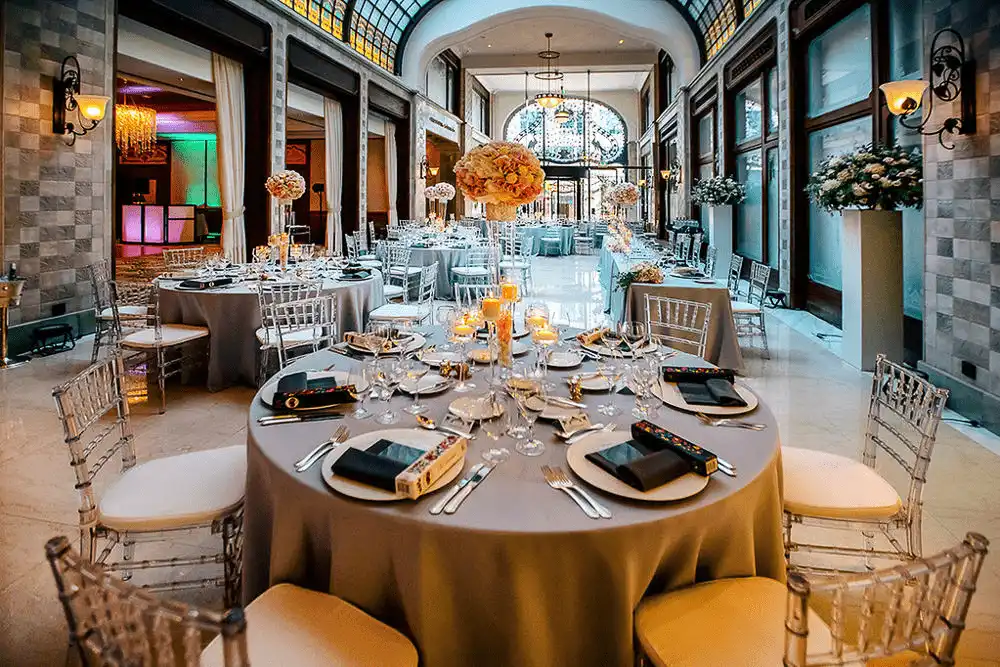
Four Seasons Gresham Palace Budapest occupies the 1906 Secessionist landmark that once housed the London Gresham Life Assurance Company’s Central European headquarters. Architect Zsigmond Quittner designed this T-shaped palace as a fortified seat of British financial power, commanding Roosevelt Square directly opposite the Chain Bridge.
The $110 million restoration transformed Miksa Róth’s stained glass windows, Zsolnay ceramic facades, and over one million mosaic tiles into 179 rooms where contemporary travelers inhabit the same structural authority that secured British capital across the Austro-Hungarian Empire. This is how the elite secure Danube proximity at Budapest’s most commanding address among the best historic hotels in Budapest.
Four Seasons Gresham Palace Budapest ★★★★★
The Four Seasons Gresham Palace stands where British insurance power anchored itself in 1906 Budapest. Zsigmond Quittner engineered this Secessionist fortress for the Gresham Life Assurance Company of London—not as a hotel, but as a high-security residential and commercial complex designed to project permanence. The T-shaped floor plan maximized Danube river frontage while the wrought-iron Peacock Gates announced entrance into a realm where British capital controlled Central European finance through architectural intimidation.
Four Seasons Gresham Palace Budapest is a world-renowned Art Nouveau masterpiece, originally built as an ultra-luxury apartment house for a British insurance company and now widely considered the most prestigious hotel in Hungary.
The 179-room transformation preserved the original power infrastructure. The covered glass-roofed arcade lobby—paved with over one million mosaic tiles—was originally a shopping passage reserved for company executives and their families. Today’s guests walk the same marble staircase where insurance directors ascended beneath Miksa Róth’s stained glass windows, the decorative iron railings still bearing Zsolnay ceramic accents that marked this building as untouchable during an era of rapid urban expansion.
The spatial hierarchy remains intact. Tower Suites and Chain Bridge Suites occupy the palace’s strategic corners, offering sightlines that align precisely with the Chain Bridge’s stone lions and Buda Castle’s illuminated ramparts. These weren’t arbitrary placements—Quittner positioned the building’s most prestigious spaces to dominate Roosevelt Square’s visual axis.
Modern guests inherit these calculated advantages: private balconies with vaulted ceilings that frame the same imperial views British executives used to signal their territorial dominance over Hungary’s financial district.
The building survived WWII bombardment and decades as a deteriorating apartment block during Hungary’s socialist period. The $110 million restoration didn’t modernize away the structural power—it amplified it. Original Peacock Gates now guard a property where the rooftop infinity-edge lap pool overlooks the same cityscape that once confirmed British investment superiority.
The state-of-the-art spa utilizes Hungarian moor mud treatments in a wellness facility that occupies the building’s crown, where executives once surveyed their economic territory.
KOLLÁZS Brasserie operates in spaces originally designed for high-stakes commercial transactions, its rotisserie and on-site patisserie now serving guests who book the same rooms that once quartered visiting London directors. Muzsa Bar‘s Art Deco theatrical cocktail presentations unfold beneath the original arcade’s grand chandeliers—the same lighting infrastructure that illuminated insurance contracts worth millions in pre-war currency.
The property’s competitive advantage isn’t nostalgia. It’s verified spatial dominance at Roosevelt Square, the only five-star address that controls direct Chain Bridge access while occupying a landmark that survived regime changes, war damage, and systematic neglect specifically because its architectural authority couldn’t be replicated.
Twenty-four-hour multilingual concierge services and private airport transfers in luxury vehicles are baseline expectations. The real asset is inhabiting the specific rooms where British financial power secured its Central European operations through structural permanence that outlasted empires.
Check Availability & Rates →The Peacock Gates open onto spaces where insurance directors once commanded the Danube’s financial corridor—today’s suites inherit that territorial advantage through original sightlines, preserved mosaic floors, and the structural certainty that this building was engineered to outlast its occupants’ ambitions.
FAQ: Four Seasons Gresham Palace Budapest
What makes Four Seasons Gresham Palace historically significant?
The palace was commissioned in 1906 by the Gresham Life Assurance Company of London as their Central European headquarters, designed by architect Zsigmond Quittner as a Secessionist fortress to project British financial power. The building’s T-shaped floor plan, Miksa Róth stained glass, and Zsolnay ceramic facades represented the peak of Art Nouveau craftsmanship, serving as both secure residence for company executives and a territorial marker of insurance industry dominance during the Austro-Hungarian Empire.
Where is Four Seasons Gresham Palace located in Budapest?
The palace commands Roosevelt Square (Széchenyi István tér) directly facing the Chain Bridge and Buda Castle, occupying the most strategically dominant position in Budapest’s historic district. This location was deliberately chosen by the Gresham Life Assurance Company to maximize Danube River frontage and establish visual authority over Hungary’s financial corridor.
What original architectural features remain at Gresham Palace?
The $110 million restoration preserved the iconic wrought-iron Peacock Gates, the glass-roofed arcade lobby with over one million original mosaic tiles, the grand marble staircase with Miksa Róth stained glass windows, and Zsolnay ceramic tile facades. The building’s T-shaped floor plan and vaulted ceiling structures remain unchanged, maintaining the spatial hierarchy designed for British insurance executives.
What are the best rooms at Four Seasons Gresham Palace?
Tower Suites and Chain Bridge Suites occupy the palace’s strategic corners with private balconies, vaulted ceilings, and direct sightlines aligned with the Chain Bridge’s stone lions and Buda Castle. These rooms were positioned by architect Zsigmond Quittner to dominate Roosevelt Square’s visual axis, offering the same territorial views British executives used to signal financial superiority.
The Gresham Standard
The Four Seasons Gresham Palace delivers what competing properties cannot replicate: documented architectural authority at Roosevelt Square, where British insurance power engineered permanence through Secessionist design that survived empires, wars, and regime changes. The building’s spatial dominance wasn’t accidental—it was calculated territorial strategy now available as luxury accommodation.
Guests seeking equivalent historic command in Budapest’s other landmark properties should explore Corinthia Budapest or the Habsburg-era grandeur of Matild Palace Budapest.
For more curated itineraries and luxury-focused travel insights, visit Your Luxury Guide. For official travel information and destination updates, visit Hungary tourism-info.
Your Luxury Guide — Where Exceptional Travel Begins.