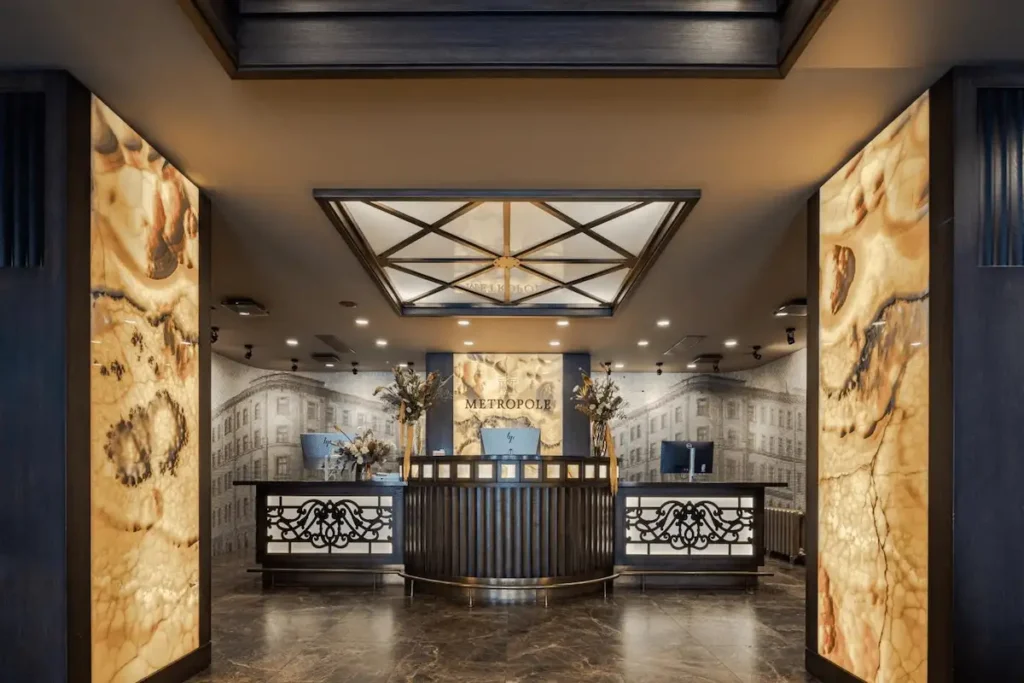
Eurostars Metropole Riga commands the historic Boulevard Ring as the city’s pioneering modern hotel, established in 1871 during Riga’s imperial “Golden Age.” This neoclassical monument introduced international luxury standards to the Baltic elite, hosting foreign delegations during the birth of the Latvian Republic and King Haakon VII of Norway. Behind its preserved ochre facade and 3-meter ceilings, guests access Nordic wellness facilities, Opera House views, and the original De Commerce Gastro Pub—all within the UNESCO buffer zone offering rare vehicle access to the medieval core.
Eurostars Metropole Riga ★★★★
Eurostars Metropole Riga occupies the physical and social epicenter where 19th-century imperial authority met Baltic diplomacy. Designed in 1871 by Riga’s premier architects, this neoclassical edifice established the city’s first professional luxury infrastructure—introducing elite concierge service and high-end dining when Riga functioned as the Russian Empire’s third-largest commercial port.
The symmetrical stone masonry and monumental proportions reflect the architectural vocabulary of power exercised by the merchant class who funded its construction during the city’s economic apex.
Eurostars Metropole Riga is the city’s original grand hotel from 1871, offering travelers the rare opportunity to stay in a prestigious imperial landmark that defined Baltic luxury long before the modern era.
The building’s strategic position on the park-lined Boulevard Ring—tracing the medieval city walls—provided foreign delegations with secure proximity to government ministries during the 1918-1920 independence negotiations. This diplomatic legacy persists in the hotel’s two executive meeting salons, which retain their 19th-century verticality and marble-accented proportions, functioning today as venues for high-level corporate summits.
King Haakon VII of Norway selected this address specifically for its combination of political discretion and operational efficiency—qualities embedded in the building’s original design specifications.
The 84 guest rooms exploit the structure’s historic footprint to deliver spatial advantages rare in compressed Old Town properties. Three-meter ceilings and oversized windows—remnants of 1871 ventilation engineering—create light-saturated environments with unobstructed sightlines to the National Opera’s neoclassical roofline.
Executive rooms offer strategic viewpoints across the “Green Belt” parklands, providing visual command of the city’s dual identity: medieval core and modern cultural district. Deep-set window embrasures function as private observation posts, translating 19th-century defensive architecture into contemporary luxury vantage points.
The ground floor preserves its original grand continental aesthetic—dark woods, leather upholstery, and heated marble floors—while integrating modern climate control and acoustic insulation invisible to the untrained eye. The private wellness sanctuary employs traditional Nordic sauna protocols alongside contemporary fitness infrastructure, designed for post-diplomatic recovery and executive decompression. This functional duality extends to the De Commerce Gastro Pub 1871, which has operated continuously since the hotel’s founding, serving Latvian craft ales and “New Nordic” cuisine to successive generations of Baltic elite.
Operational advantages compound the historic prestige. The hotel occupies the UNESCO buffer zone‘s only luxury position offering direct vehicle access and professional valet parking—an infrastructural rarity translating to seamless airport connectivity via 15-minute direct shuttle. The International Train Station sits immediately adjacent, providing regional exploration capacity without sacrificing the 30-second pedestrian access to Old Town cobblestones.
This convergence of heritage architecture, diplomatic lineage, and transport efficiency positions Eurostars Metropole as the operational headquarters for discerning travelers requiring both historic gravitas and modern utility.
Check Availability & Rates →To occupy Eurostars Metropole is to inhabit Riga’s original seat of international authority—where neoclassical proportions and diplomatic discretion converge within view of the Opera House, surrounded by the legacy infrastructure that introduced Baltic luxury standards in 1871.
FAQ: Eurostars Metropole Riga
What makes Eurostars Metropole historically significant in Riga?
Eurostars Metropole was established in 1871 as Riga’s first modern luxury hotel, introducing international hospitality standards during the city’s imperial “Golden Age.” It served as diplomatic headquarters during Latvia’s 1918-1920 independence negotiations and hosted King Haakon VII of Norway, cementing its role as the Baltic elite’s preferred social and political address.
What are the room features at Eurostars Metropole Riga?
The 84 rooms utilize original 1871 architectural specifications—3-meter ceilings, oversized windows, and deep embrasures—to create light-filled environments with Opera House and parkland views. Modern interventions include heated bathroom floors, high-thread-count linens, and invisible climate control systems integrated during expert restoration.
Where is Eurostars Metropole located in Riga?
The hotel anchors the Boulevard Ring at the intersection of Old Town and the modern Opera District, within the UNESCO buffer zone. It offers rare direct vehicle access with valet parking, 15-minute airport shuttle service, and 30-second pedestrian access to medieval cobblestones, plus immediate proximity to the International Train Station.
Does Eurostars Metropole have wellness facilities?
Yes. The hotel features a private guest-only wellness sanctuary with traditional Nordic sauna and contemporary fitness suite, specifically designed for executive recovery. The ground floor houses De Commerce Gastro Pub 1871, operating continuously since the hotel’s founding with regional Latvian craft ales and New Nordic cuisine.
Experience the Legacy of Riga’s Diplomatic Elite
Eurostars Metropole delivers the rare synthesis of verified historical command and operational modernity—where 1871 neoclassical authority meets Nordic wellness infrastructure opposite the National Opera. Compare this diplomatic heritage with the merchant-class grandeur of Grand Palace Hotel Riga or explore medieval merchant power at Dome Hotel Riga.
For more curated itineraries and luxury-focused travel insights, visit Your Luxury Guide. For official travel information and destination updates, visit Latvia tourism-info.
Your Luxury Guide — Where Exceptional Travel Begins.