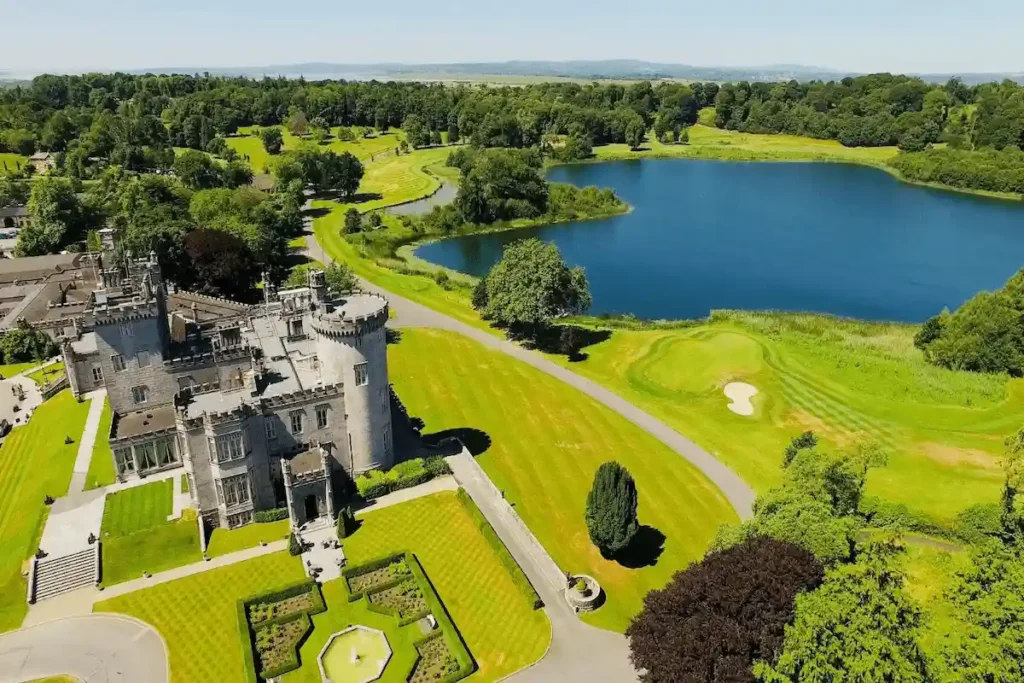
For over four centuries, Dromoland Castle served as the fortified seat of the O’Brien clan—direct descendants of Brian Boru, the High King who unified Ireland in 1002. The castle’s 16th-century origins, expanded into a Gothic Revival masterpiece in the 1820s, represent unbroken territorial authority. Today’s guest occupies the same stone halls where Irish nobility negotiated treaties, hosted state dinners, and controlled one of Ireland’s most strategically significant estates. The 450-acre demesne remains intact—a rare preservation of feudal-scale land ownership. Every window frames grounds that were, for centuries, closed to commoners.
Explore Ireland’s premier luxury castle hotels where aristocratic heritage meets modern five-star hospitality.
Dromoland Castle ★★★★★
The moment you pass through Dromoland’s gates, the 18th-century oak-lined avenue signals a threshold crossing. This is not hotel entry; it is arrival at a sovereign territory. The castle’s limestone façade—120 feet tall at its central tower—was designed to project dominance over the surrounding Clare countryside. The O’Briens commissioned architect James and George Richard Pain to transform the original keep into a Gothic Revival statement in 1826, precisely when European nobility competed through architectural scale. The result: battlements, turrets, and carved stone tracery that declare absolute command.
Inside, the Grand Staircase rises through three stories beneath a vaulted ceiling hand-painted with heraldic crests. They document alliances, territorial claims, and bloodline continuity stretching back nine centuries. The Drawing Room, where the 14th Baron Inchiquin once received dignitaries, now serves as the pre-dinner gathering space. Original oil portraits of O’Brien ancestors line the walls, creating an uninterrupted visual record of dynastic succession.
In Dromoland Castle you are temporarily inhabiting its operational center.
The 97 guest rooms occupy both the castle’s historic wings and the modern Garden Wing, added to preserve the integrity of the original structure while expanding capacity. Castle suites feature 14-foot ceilings, period furnishings sourced from Irish estate auctions, and windows overlooking the estate’s 450 acres. Four-poster beds replicate designs from the O’Brien family inventory. Every detail reinforces the narrative: you sleep where Irish nobility once strategized territorial control.
The estate’s 450 acres function as your private domain during your stay. The championship 18-hole golf course, carved through ancient woodland, was designed by Ron Kirby and J.B. Carr to integrate the landscape’s natural contours. The falconry school operates from the estate’s original mews, where birds of prey have been housed since the 17th century. Private fishing rights on the estate’s lake mirror the exclusive access once reserved for the O’Brien family and their approved guests. The formal gardens, designed by Capability Brown’s Irish contemporaries, remain meticulously maintained according to their 1820s layout.
Dining at Dromoland occurs in the Earl of Thomond Restaurant, a vaulted stone hall where the family’s formal dinners once established social hierarchies. The kitchen sources from the estate’s walled garden—a Victorian-era enclosure that still produces vegetables, herbs, and fruit using heritage seed lines. The wine cellar holds over 400 labels, with particular depth in Burgundy and Bordeaux, reflecting the O’Brien family’s historic trade connections. The Gallery, a wood-paneled bar beneath ancestral portraits, serves single malts and Irish whiskeys in a setting where political alliances were once negotiated over brandy.
The Spa at Dromoland occupies a purpose-built structure connected to the castle via underground passage—a design choice that preserves the historic building’s exterior while providing 20,000 square feet of treatment space.
The pool area‘s floor-to-ceiling windows overlook the private lake, creating the illusion of bathing within the estate’s protected landscape. Treatments incorporate Irish botanicals—seaweed from the Clare coast, bog clay, wild herb infusions—grounding the experience in regional terroir.
Check Availability & Rates →At Dromoland, you don’t simply visit Irish history—you assume temporary custodianship of a bloodline’s territorial legacy, sleeping within walls that have sheltered nine centuries of unbroken dynastic authority, surrounded by 450 acres that remain precisely as the O’Briens commanded them.
FAQ: Dromoland Castle
What is the historical significance of Dromoland Castle?
Dromoland Castle has served as the ancestral seat of the O’Brien dynasty since the 16th century. The O’Briens are direct descendants of Brian Boru, High King of Ireland from 1002-1014. The current Gothic Revival structure, completed in 1826, replaced earlier fortifications on the same site. The estate represents one of Ireland’s few continuously inhabited noble residences, maintaining its original 450-acre demesne intact.
What amenities does Dromoland Castle offer?
The estate provides a championship 18-hole golf course designed by Ron Kirby and J.B. Carr, a School of Falconry with Harris hawks and peregrine falcons, private lake fishing, clay shooting, horseback riding, formal gardens, a 20,000-square-foot spa with indoor pool, two restaurants including the Michelin-recognized Earl of Thomond, and a Gallery bar. All facilities occupy either historic castle spaces or modern additions designed to complement the original architecture.
How many rooms does Dromoland Castle have?
Dromoland Castle offers 97 guest accommodations split between the original castle structure and the Garden Wing. Castle rooms feature period furnishings, 14-foot ceilings, and views over the estate grounds. All rooms include modern amenities—Wi-Fi, climate control, marble bathrooms—integrated to preserve the historic character of the spaces.
Is Dromoland Castle suitable for weddings and events?
Yes. The castle’s Drawing Room, Library, and Great Hall accommodate events from 20 to 200 guests. The Brian Boru Ballroom handles larger receptions up to 300 people. The estate’s private chapel, built in the 19th century, seats 70 for ceremonies. Event coordinators work within the building’s historic framework, using the O’Brien family’s entertaining traditions as operational templates for contemporary functions.
The Sovereignty of Lineage
Dromoland Castle does not offer a “luxury experience.” It provides temporary assumption of a territorial command structure that has operated continuously for four centuries. The O’Brien bloodline—traceable through documented genealogy to the 10th century—built this fortress, expanded it, and maintained it through every phase of Irish political transformation.
When you occupy these rooms, you inhabit the physical infrastructure of dynastic power. The 450-acre estate remains exactly as the family designed it: a self-sufficient domain where every element—from the falconry mews to the walled garden—reinforces autonomy from the outside world.
For those seeking parallel experiences of territorial authority, consider Lough Eske Castle and Clontarf Castle Hotel, where Irish nobility’s architectural legacy continues to define elite hospitality.
For more curated itineraries and luxury-focused travel insights, visit Your Luxury Guide. For official travel information and destination updates, visit Ireland tourism-info.
Your Luxury Guide — Where Exceptional Travel Begins.