Dome Hotel Riga occupies a 17th-century merchant complex steps from the Dome Cathedral, where Hanseatic trade aristocracy once controlled Baltic commerce. This 15-suite property preserves limestone walls, original timber beams, and a centuries-old well beneath its foundation. The restoration won architectural awards for heritage preservation while embedding Nordic minimalism and a rooftop terrace with eye-level Cathedral views.
Guests inhabit the same cobblestone street where merchant dynasties negotiated ship manifests and currency exchange. Modern infrastructure includes a hammam suite, executive boardroom, and the Dome Fish Restaurant, positioning this as Riga’s most discreet power address.
Dome Hotel Riga ★★★★★
The Dome Hotel does not merely occupy medieval space—it commands it. Built during Riga’s Hanseatic zenith when the city controlled grain routes between Russia and Western Europe, this 17th-century residential complex housed the merchant class who dictated terms to kings and guilds. The original limestone walls, three feet thick, were engineered to withstand siege. The heavy timber beams overhead carried the weight of vaulted grain stores. Today, these architectural elements frame 15 suites where guests sleep within the same structural footprint that once secured the Baltic’s most valuable commodity inventories.
Dome Hotel Riga is a meticulously restored 17th-century architectural treasure, offering an intimate boutique experience where guests live within the authentic historical fabric of the UNESCO World Heritage core.
The hotel’s location is not incidental. Positioned on a quiet cobblestone street adjacent to the 13th-century Dome Cathedral—northern Europe’s largest medieval church—the property served as the residential nerve center for Riga’s religious and commercial authority. Merchant families who lived here didn’t walk to power; they woke up inside it. The building’s proximity to the Cathedral meant direct access to the ecclesiastical networks that controlled trade permissions, marriage contracts, and inheritance law across the Hanseatic League.
The restoration, completed after years of meticulous work, earned architectural recognition for its refusal to obscure history. Exposed brick walls reveal construction techniques unchanged since the 1600s. Original staircases, worn smooth by centuries of footfall, connect floors without modern intervention. A preserved well in the foundation—once the building’s sole water source—now serves as a structural artifact visible through protective glass. These are not decorative touches; they are the building’s operational skeleton, maintained in working condition.
The rooftop terrace offers what no other property in Riga’s Old Town provides: eye-level proximity to the Dome Cathedral’s spire. From this vantage, guests observe the red-tiled medieval core exactly as it appeared to merchant families four centuries ago, minus the livestock and open sewers. The terrace functions as both viewing platform and private boardroom, a space where modern deal-making occurs against the backdrop of structures that defined northern European commerce for 300 years.
Interior design operates on a “Nordic Minimalist” principle—maximum spatial clarity, minimum decorative interference. The aesthetic removes nothing that matters while adding nothing that distracts. Suites feature preserved ceiling paintings from the 17th century, their pigments analyzed and stabilized by conservation specialists. Furniture is understated but precisely engineered. Lighting is indirect. The effect is not museum curation but lived-in authority, the visual grammar of old money that never announces itself.
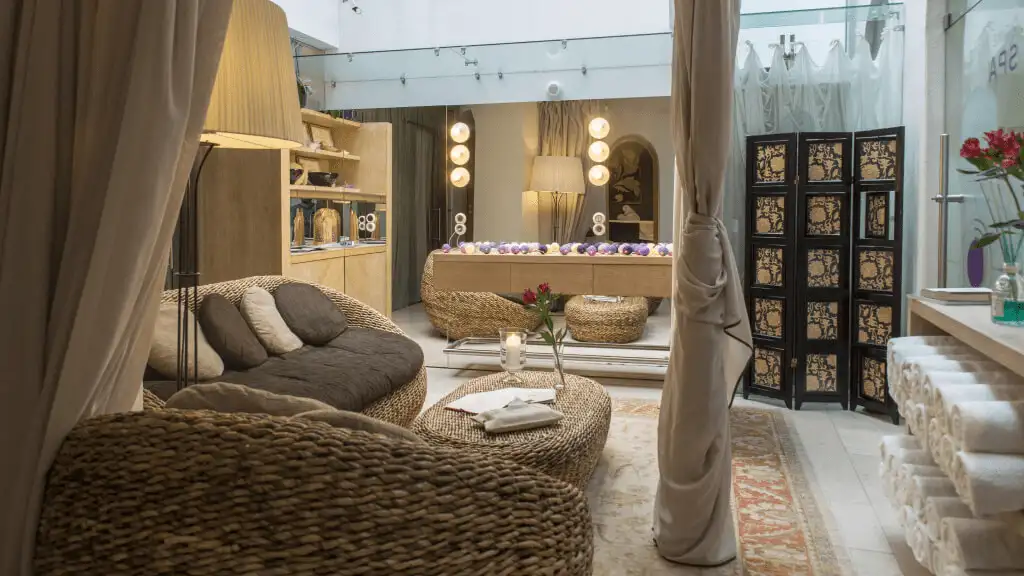
The boutique hammam and sauna suite occupies a vaulted lower level, its stone walls identical to those that once stored merchant cargo. The wellness infrastructure is intimate by design—maximum four guests at a time—mirroring the exclusivity baked into the property’s 15-room capacity. This is not a spa for the masses. It is a private decompression chamber for individuals who control their schedules completely.
The Dome Fish Restaurant operates as the hotel’s culinary anchor, specializing in Baltic catches prepared with techniques that bridge medieval preservation methods and contemporary gastronomy. The menu references historical trade routes—herring from Gotland, eel from the Daugava delta, pike from inland lakes—executed at a Michelin-contender level. Dining here means consuming the same species that sustained Hanseatic wealth, plated for the modern palate.
Despite its pedestrian-zone location within the UNESCO-protected core, the hotel coordinates private transfers and luggage logistics with precision. The Old Town’s car restrictions, which frustrate casual visitors, become an asset here: guests arrive via discreet arrangement, insulated from the foot traffic that floods Dome Square daily. The effect is cinematic—stepping from a private vehicle directly into a 400-year-old merchant sanctuary, the modern world sealed outside thick limestone walls.
This is not a hotel for travelers seeking “authentic medieval charm.” It is a command post for individuals who recognize that power has always occupied specific physical coordinates—and in Riga, those coordinates sit three meters from the Dome Cathedral entrance, inside walls that have watched empires trade ownership of the Baltic for four centuries.
Check Availability & Rates →To stay at the Dome Hotel is to sleep within the architectural marrow of Hanseatic supremacy, where limestone walls that once secured merchant fortunes now frame a hospitality experience calibrated for those who understand that true luxury requires no announcement—only provenance.
FAQ: Dome Hotel Riga
What makes Dome Hotel Riga historically significant?
Dome Hotel Riga occupies a 17th-century merchant residence complex built during the city’s Hanseatic League dominance, when Riga controlled critical Baltic trade routes. The building served as private housing for merchant families who managed grain, timber, and textile commerce between Russia and Western Europe. Its position adjacent to the Dome Cathedral placed residents at the intersection of religious and commercial authority. The property retains original limestone walls, timber beams, and a preserved foundation well, with restoration work earning architectural awards for heritage preservation.
How many rooms does Dome Hotel Riga have?
The hotel contains only 15 guest rooms and suites, a deliberate capacity constraint that ensures maximum privacy and personalized service. This limited inventory mirrors the property’s original function as exclusive merchant residences rather than public lodging. The small scale allows for architectural features impossible in larger properties, including individually preserved ceiling paintings and custom spatial layouts that respect the building’s 400-year-old structural grid.
What is the rooftop terrace view at Dome Hotel Riga?
The private rooftop terrace provides eye-level views of the Dome Cathedral spire and the medieval Old Town’s red-tiled rooftops. This vantage point replicates the visual perspective enjoyed by merchant families in the 17th century, offering unobstructed sight lines across the UNESCO-protected core. The terrace functions as both observation deck and executive meeting space, accommodating private dining and small corporate retreats with the Cathedral as backdrop.
Where is Dome Hotel Riga located in the Old Town?
The hotel sits on a quiet cobblestone street directly adjacent to the Dome Cathedral, within the pedestrian-only UNESCO World Heritage zone. Its location shields guests from the main tourist thoroughfares while maintaining immediate access to the Cathedral entrance and medieval core landmarks. The building occupies the precise coordinates where Riga’s merchant elite historically consolidated power, three meters from the city’s ecclesiastical and commercial nerve center.
A Residence That Requires No Translation
The Dome Hotel operates on a principle foreign to contemporary hospitality: it does not adapt history to fit guest expectations. Guests adapt their expectations to fit history. The building makes no apologies for its thick walls, narrow staircases, or centuries-old spatial logic. Those who recognize the value of inhabiting Hanseatic authority—not simulating it, not touring it, but living inside its preserved architecture—will find no better address in Riga.
Explore similar properties where provenance defines the stay, Konventa Seta Hotel or Eurostars Metropole Riga, each occupying equally commanding historic coordinates within Latvia’s capital.
For more curated itineraries and luxury-focused travel insights, visit Your Luxury Guide. For official travel information and destination updates, visit Latvia tourism-info.
Your Luxury Guide — Where Exceptional Travel Begins.