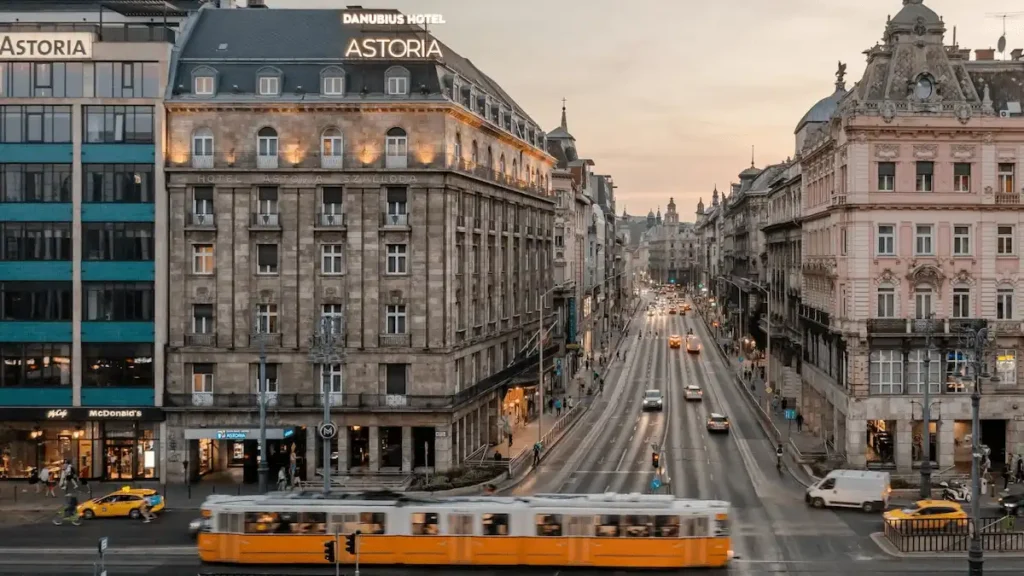
Danubius Hotel Astoria stands at the intersection named in its honor—a 1914 Ármin Hegedűs and Izidor Sterk monument to Empire-style command. Preserved dark wood paneling, polished brass, and leaded glass define spaces where revolutionary governments convened and diplomats negotiated. This is not adaptive reuse; this is original authority maintained across 110 years at Budapest’s administrative and cultural crossroads.
For those seeking historic accommodations where architectural integrity translates to modern prestige, explore best historic hotels in Budapest.
Danubius Hotel Astoria ★★★★
The Danubius Hotel Astoria occupies Budapest’s most strategically significant intersection—the Astoria junction—where the historic Jewish Quarter meets the city’s administrative core. Since 1914, Ármin Hegedűs and Izidor Sterk creation has functioned as a physical command post during Hungary’s most decisive political moments. Revolutionary governments established headquarters here. International missions claimed temporary residence within its walls.
The building remained operational through major 20th-century conflicts, serving as neutral diplomatic ground when other institutions fell.
Danubius Hotel Astoria City Center is one of Budapest’s most atmospheric heritage hotels, opened in 1914 and famously preserved in its original “Empire” style, offering a stay that feels like stepping back into the golden age of Hungarian hospitality.
The Empire-style architecture delivers what Budapest’s elite expected: symmetry, monumental scale, and classicizing restraint. Unlike properties that surrendered original interiors to modernization, the Astoria preserved its early 20th-century spatial hierarchy. Dark wood wainscoting runs the length of public corridors. Polished brass fixtures and leaded glass windows filter light across lobbies designed for political negotiation, not tourist selfies. The thick historic masonry that once muffled wartime sounds now provides acoustic isolation from the junction’s constant traffic flow—a functional advantage born from construction standards that prioritized permanence.
The 138 guest rooms maintain traditional furnishings within the building’s original layout. Historical suites feature furniture and spatial configurations preserved for decades, creating environments where guests inhabit the same physical dimensions occupied by diplomats and revolutionaries. This is living-museum density without the museum’s closure hours. The rooms balance classic aesthetics with 4-star operational standards: climate control, modern bathrooms, reliable connectivity—historic fabric supporting contemporary function.
The Astoria Café operates as it did when poets and political strategists claimed corner tables for extended debate sessions. Traditional Dobos torte and refined Hungarian pastries maintain the culinary lineage that made Budapest’s coffee house culture a European reference point. The café’s authentic “old world” atmosphere explains why international film productions repeatedly select these interiors for period authenticity—the space requires minimal set dressing because the Empire-era elements remain intact.
Direct access to Astoria metro station positions guests at Budapest’s most efficient transport node. This isn’t proximity; this is vertical integration. The hotel sits above the junction where three major boulevards converge and metro lines intersect—the same strategic location that made the building valuable to successive governments.
The Empire Ballroom continues serving its original purpose: hosting events requiring classical grandeur. Crystal chandeliers and stucco work provide the spatial authority expected for diplomatic receptions and high-level corporate gatherings.
The concierge team specializes in heritage tourism, offering guided insights into the hotel’s political and architectural significance. This expertise extends beyond standard city recommendations to explain how the building itself functioned during specific historical periods—where revolutionaries convened, which suites housed foreign missions, how the structure survived conflicts that destroyed neighboring buildings.
The Astoria Restaurant maintains the Hungarian-French fusion tradition that defined turn-of-the-century elite dining, updated with modern gastronomic techniques while preserving classical presentations.
Check Availability & Rates →The Astoria doesn’t recreate history; it preserves the physical authority where Hungary’s 20th-century power struggles unfolded. You inhabit the same Empire-style command spaces that shaped Budapest’s political destiny—authentic architecture supporting modern luxury.
FAQ: Danubius Hotel Astoria
What makes Danubius Hotel Astoria historically significant?
Opened in 1914, the Danubius Hotel Astoria served as headquarters for revolutionary governments and international diplomatic missions throughout Hungary’s turbulent 20th century. Designed by Ármin Hegedűs and Izidor Sterk in Empire style, the building maintained operations through major conflicts, functioning as neutral diplomatic ground. Its preserved interiors—original wood paneling, brass fixtures, leaded glass—provide authentic period environments that have made it a preferred filming location for international productions requiring turn-of-the-century accuracy.
Where is Danubius Hotel Astoria located in Budapest?
The hotel occupies the Astoria intersection (named after the property), where the historic Jewish Quarter meets Budapest’s administrative center. Located directly above Astoria metro station, it sits at the junction of three major boulevards with direct access to metro lines, providing the city’s most efficient transport connectivity to Parliament, Castle District, and other major landmarks.
What are the rooms like at Danubius Hotel Astoria?
The 138 guest rooms maintain traditional furnishings within original early 20th-century layouts. Historical suites feature period furniture and spatial configurations preserved for decades, offering high-density “living museum” experiences with modern 4-star amenities. Thick historic masonry provides exceptional soundproofing despite the central location, while climate control and updated bathrooms balance classic aesthetics with contemporary comfort standards.
Does Danubius Hotel Astoria have dining facilities?
The Astoria Café continues the coffee house tradition that made it a gathering place for poets and revolutionaries, serving traditional Dobos torte and refined Hungarian pastries in authentic Empire-era interiors. The Astoria Restaurant offers Hungarian-French fusion cuisine that honors turn-of-the-century elite dining traditions while incorporating modern gastronomic techniques, maintaining the culinary lineage expected at this historic address.
Legacy Maintained at Budapest’s Power Junction
The Danubius Hotel Astoria delivers what historic properties promise but rarely maintain: original Empire-style authority where architectural preservation creates competitive advantage. This is Budapest’s political and cultural crossroads functioning as it did in 1914—commanding the intersection, housing the elite, maintaining standards through regime changes.
For travelers seeking comparable heritage authenticity in Budapest’s premier palace properties, Anantara New York Palace Budapest and Párisi Udvar Hotel Budapest offer distinct architectural lineages worth examining.
For more curated itineraries and luxury-focused travel insights, visit Your Luxury Guide. For official travel information and destination updates, visit Hungary tourism-info.
Your Luxury Guide — Where Exceptional Travel Begins.